Block 1 - Schedule Trigger
- Type / Role
- n8n-nodes-base.scheduleTrigger - scheduleTrigger
- Config choices
- Version 1.3
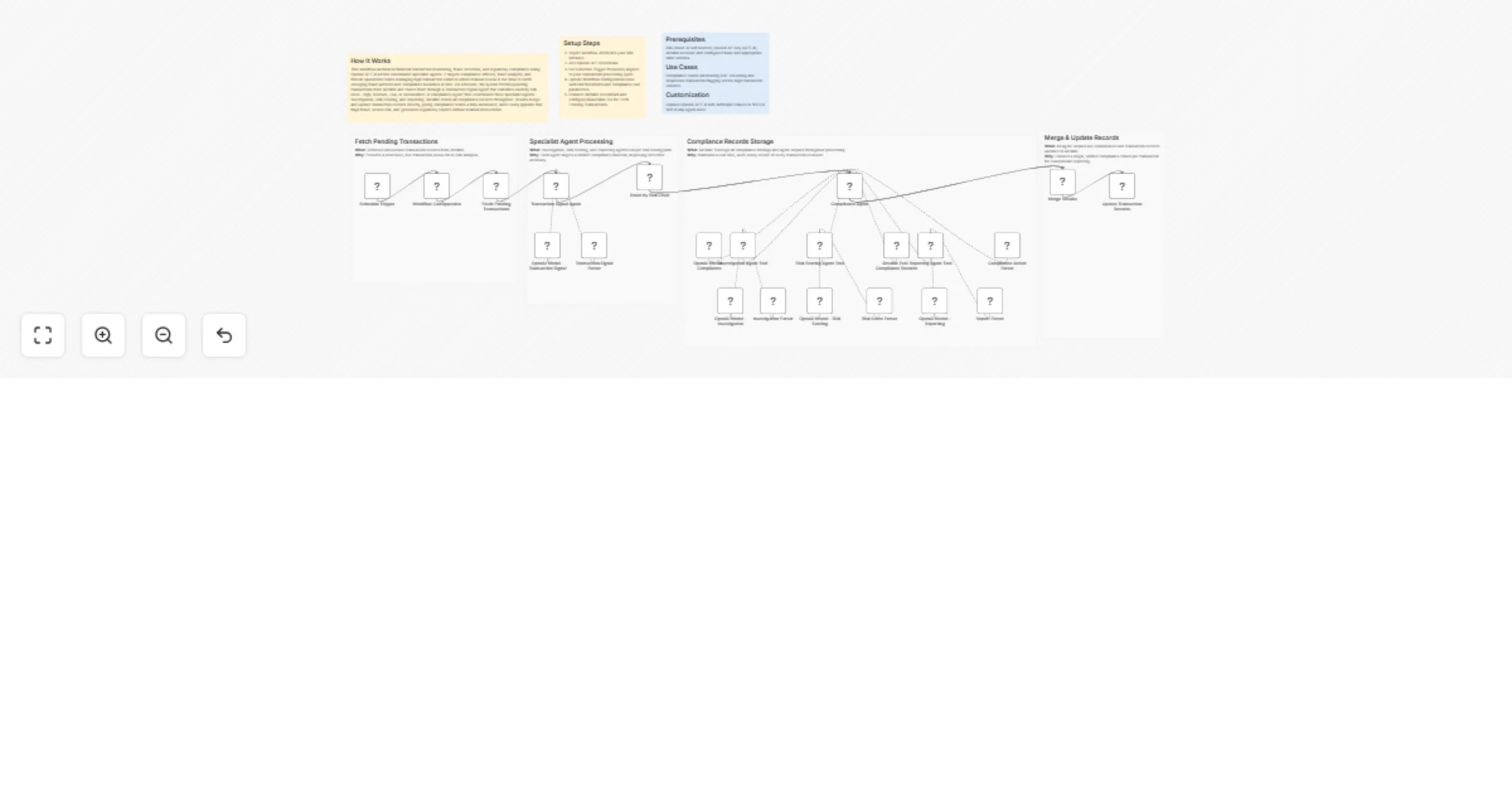
How It Works This workflow automates financial transaction monitoring, fraud detection, and regulatory compliance using OpenAI GPT 4 across coordinated specialist agents. It targets compliance offi...
n8n-nodes-base.scheduletrigger, n8n-nodes-base.set, n8n-nodes-base.airtable, @n8n/n8n-nodes-langchain.agent, @n8n/n8n-nodes-langchain.lmchatopenai, @n8n/n8n-nodes-langchain.outputparserstructured, n8n-nodes-base.switch, @n8n/n8n-nodes-langchain.agenttool
This workflow is cataloged by N8N Workflows and links back to its original n8n.io source page by Cheng Siong Chin.
Original n8n.io sourceThis workflow automates financial transaction monitoring, fraud detection, and regulatory compliance using OpenAI GPT-4 across coordinated specialist agents. It targets compliance officers, fraud analysts, and fintech operations teams managing high transaction volumes where manual review is too slow to catch emerging fraud patterns and compliance breaches in time. On schedule, the system fetches pending transactions from Airtable and routes them through a Transaction Signal Agent that classifies each by risk level—High, Medium, Low, or Unclassified. A Compliance Agent then coordinates three specialist agents: Investigation, Risk Scoring, and Reporting. Airtable stores all compliance records throughout. Results merge and update transaction records directly, giving compliance teams a fully automated, audit-ready pipeline that flags fraud, scores risk, and generates regulatory reports without manual intervention.
n8n (cloud or self-hosted), OpenAI API key (GPT-4), Airtable account with configured base and appropriate table schema
Compliance teams automating AML screening and suspicious transaction flagging across high transaction volumes
Replace OpenAI GPT-4 with Anthropic Claude or NVIDIA NIM in any agent node
Automates end-to-end fraud detection and compliance reporting, eliminating manual transaction reviews
This catalog entry is organized from the workflow JSON. The node-level section below shows the executable blocks available for review before importing the template.
Showing the first 24 of 29 workflow blocks. Download the JSON for the full node graph.
| Workflow | Detect transaction fraud and manage compliance with GPT-4 and Airtable |
|---|---|
| Complexity | advanced |
| Nodes | 29 |
| Categories | SecOps, AI Summarization |
| Author | Cheng Siong Chin |
| Published | 22 Feb 2026 |
Use the JSON export at /data/workflows/13598/13598.json as the source template for this automation.
Open n8n, import the downloaded JSON, and review each node before activating the workflow.
Replace placeholder credentials, API keys, webhook URLs, account IDs, and environment-specific values with your own settings.
Run the workflow manually or in a staging workspace, inspect node output, and confirm downstream systems receive the expected data.
Enable the workflow only after testing, then monitor executions, errors, and rate limits during the first production runs.
Review imported nodes carefully before activation. This catalog entry is intended to help you inspect the workflow structure, understand required services, and find related templates faster.
Node names, credentials, schedules, webhook paths, and external service limits may need adjustment for your workspace.
How It Works This workflow automates financial transaction monitoring, fraud detection, and regulatory compliance using OpenAI GPT 4 across coordinated specialist agents. It targets compliance offi...
Review the workflow JSON, configure any required credentials in n8n, and test the automation in a safe workspace before using it in production.
Yes. Use the block-by-block analysis and the downloadable JSON to inspect each node, then adjust credentials, prompts, schedules, filters, or destinations for your SecOps, AI Summarization use case.