
Detect content decay from Google Search Console and alert via Slack and email

Workflow preview
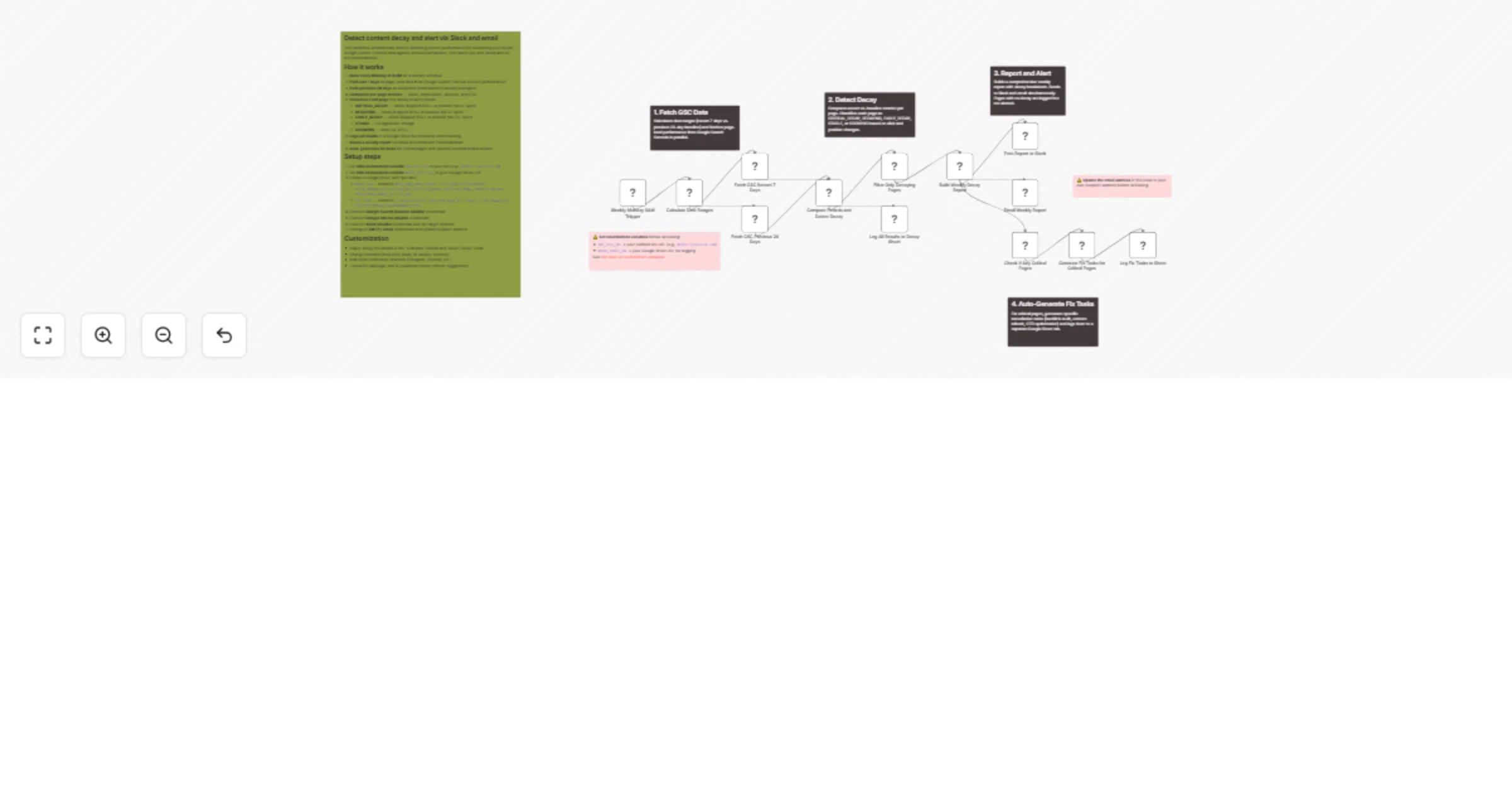
Workflow preview
100%
Detect content decay from Google Search Console and alert via Slack and email preview
Open on n8n.io

1. Workflow Overview

Who is this for? SEO managers, content marketers, bloggers, and growth teams who want to automatically catch declining content performance before it's too late — without manually checking Google Se...

Best for

  • Market Research automation workflows
  • AI Summarization automation workflows
  • advanced n8n builders looking for reusable templates

Tools used

n8n-nodes-base.scheduletrigger, n8n-nodes-base.code, n8n-nodes-base.httprequest, n8n-nodes-base.googlesheets, n8n-nodes-base.filter, n8n-nodes-base.slack, n8n-nodes-base.emailsend, n8n-nodes-base.stickynote

Source and attribution

This workflow is cataloged by N8N Workflows and links back to its original n8n.io source page by Veena Pandian.

Original n8n.io source

1.1 Workflow description

Title
Detect content decay from Google Search Console and alert via Slack and email
Workflow name
Detect content decay from Google Search Console and alert via Slack and email

Who is this for?

SEO managers, content marketers, bloggers, and growth teams who want to automatically catch declining content performance before it's too late — without manually checking Google Search Console every week.

What this workflow does

This workflow runs weekly to compare your recent Google Search Console performance against a historical baseline. It identifies pages experiencing traffic decay at three severity levels, sends detailed reports via Slack and email, logs all data to a tracking sheet, and auto-generates prioritized fix tasks for your most critical pages.

How it works

  1. Weekly trigger fires every Monday at 8 AM.
  2. Fetches two GSC date ranges in parallel — the last 7 days (recent) and the previous 28 days (baseline, normalized to weekly averages).
  3. Compares per-page metrics including clicks, impressions, average position, and CTR.
  4. Classifies each page into one of five signals:
  • CRITICAL_DECAY — clicks dropped 50%+ or position fell 5+ spots with 30%+ click loss
  • DECAYING — clicks dropped 30%+ or position fell 3+ spots
  • EARLY_DECAY — clicks dropped 15%+ or position fell 1.5+ spots
  • STABLE — no significant change
  • GROWING — clicks increased 20%+
  1. Logs all results to a Decay Log Google Sheet tab for historical trending.
  2. Builds a weekly report with summary counts, estimated clicks lost, and per-page breakdowns.
  3. Sends the report to Slack and email simultaneously.
  4. Auto-generates fix tasks for critical pages with specific recommendations (backlink audit, content refresh, CTR optimization, or technical investigation) and logs them to a Fix Tasks sheet tab.

Setup steps

  1. Set environment variables in your n8n instance:
  • GSC_SITE_URL — your verified site URL (e.g., https://yoursite.com)
  • DECAY_SHEET_URL — URL of your Google Sheet for logging
  1. Create a Google Sheet with two tabs:
  • Decay Log with headers: date, page_path, signal, clicks_now, clicks_before, click_change_pct, position_now, position_before, position_change, impressions_now, impression_change_pct, ctr_now
  • Fix Tasks with headers: created, priority, page_path, page_url, signal, click_change_pct, position_change, recommended_action
  1. Connect Google Search Console OAuth2 credentials (your site must be verified in GSC).
  2. Connect Google Sheets OAuth2 credentials.
  3. Connect Slack OAuth2 credentials and configure your alert channel.
  4. Configure email (SMTP) credentials and update the recipient email address in the "Email Weekly Report" node.
  5. Activate the workflow.

Requirements

  • n8n instance (self-hosted or cloud)
  • Google Search Console property with verified ownership
  • Google Cloud project with Search Console API and Sheets API enabled
  • Slack workspace with a bot configured
  • SMTP email credentials (or swap for Gmail node)

How to customize

  • Decay thresholds — Adjust the percentage and position-change cutoffs in the "Compare Periods and Detect Decay" code node to match your sensitivity needs.
  • Schedule — Change from weekly to daily or bi-weekly in the trigger node.
  • Baseline period — Modify the 28-day comparison window to 14 or 90 days.
  • Row limit — Increase the rowLimit in GSC API calls beyond 500 if you have a large site.
  • Fix task logic — Enhance the remediation recommendations with AI-powered content analysis or integrate with project management tools (Notion, Asana, Trello).
  • Notifications — Add Telegram, Discord, or Microsoft Teams alongside or instead of Slack.

1.2 Logical Blocks

This catalog entry is organized from the workflow JSON. The node-level section below shows the executable blocks available for review before importing the template.

2. Block-by-Block Analysis

Block 1 - Weekly Monday 8AM Trigger

Type / Role
n8n-nodes-base.scheduleTrigger - scheduleTrigger
Config choices
Version 1.2

Block 2 - Calculate Date Ranges

Type / Role
n8n-nodes-base.code - code
Config choices
Version 2

Block 3 - Fetch GSC Recent 7 Days

Type / Role
n8n-nodes-base.httpRequest - httpRequest
Config choices
Version 4.2

Block 4 - Fetch GSC Previous 28 Days

Type / Role
n8n-nodes-base.httpRequest - httpRequest
Config choices
Version 4.2

Block 5 - Compare Periods and Detect Decay

Type / Role
n8n-nodes-base.code - code
Config choices
Version 2

Block 6 - Log All Results to Decay Sheet

Type / Role
n8n-nodes-base.googleSheets - googleSheets
Config choices
Version 4.5

Block 7 - Filter Only Decaying Pages

Type / Role
n8n-nodes-base.filter - filter
Config choices
Version 2

Block 8 - Build Weekly Decay Report

Type / Role
n8n-nodes-base.code - code
Config choices
Version 2

Block 9 - Post Report to Slack

Type / Role
n8n-nodes-base.slack - slack
Config choices
Version 2.2

Block 10 - Email Weekly Report

Type / Role
n8n-nodes-base.emailSend - emailSend
Config choices
Version 2.1

Block 11 - Check If Any Critical Pages

Type / Role
n8n-nodes-base.filter - filter
Config choices
Version 2

Block 12 - Generate Fix Tasks for Critical Pages

Type / Role
n8n-nodes-base.code - code
Config choices
Version 2

Block 13 - Log Fix Tasks to Sheet

Type / Role
n8n-nodes-base.googleSheets - googleSheets
Config choices
Version 4.5

Block 14 - Sticky Note

Type / Role
n8n-nodes-base.stickyNote - stickyNote
Config choices
Version 1

Block 15 - Sticky Note1

Type / Role
n8n-nodes-base.stickyNote - stickyNote
Config choices
Version 1

Block 16 - Sticky Note2

Type / Role
n8n-nodes-base.stickyNote - stickyNote
Config choices
Version 1

Block 17 - Sticky Note3

Type / Role
n8n-nodes-base.stickyNote - stickyNote
Config choices
Version 1

Block 18 - Sticky Note4

Type / Role
n8n-nodes-base.stickyNote - stickyNote
Config choices
Version 1

Block 19 - Sticky Note5

Type / Role
n8n-nodes-base.stickyNote - stickyNote
Config choices
Version 1

Block 20 - Sticky Note6

Type / Role
n8n-nodes-base.stickyNote - stickyNote
Config choices
Version 1

3. Summary Table

Workflow Detect content decay from Google Search Console and alert via Slack and email
Complexity advanced
Nodes 20
Categories Market Research, AI Summarization
Author Veena Pandian
Published 03 Mar 2026

4. Reproducing the Workflow from Scratch

  1. 1. Download the workflow JSON

    Use the JSON export at /data/workflows/13838/13838.json as the source template for this automation.

  2. 2. Import the template into n8n

    Open n8n, import the downloaded JSON, and review each node before activating the workflow.

  3. 3. Configure credentials and variables

    Replace placeholder credentials, API keys, webhook URLs, account IDs, and environment-specific values with your own settings.

  4. 4. Test with sample data

    Run the workflow manually or in a staging workspace, inspect node output, and confirm downstream systems receive the expected data.

  5. 5. Activate and monitor

    Enable the workflow only after testing, then monitor executions, errors, and rate limits during the first production runs.

5. General Notes & Resources

Review imported nodes carefully before activation. This catalog entry is intended to help you inspect the workflow structure, understand required services, and find related templates faster.

Node names, credentials, schedules, webhook paths, and external service limits may need adjustment for your workspace.

Frequently asked questions

What does Detect content decay from Google Search Console and alert via Slack and email do?

Who is this for? SEO managers, content marketers, bloggers, and growth teams who want to automatically catch declining content performance before it's too late — without manually checking Google Se...

What do I need before importing this workflow?

Review the workflow JSON, configure any required credentials in n8n, and test the automation in a safe workspace before using it in production.

Can I customize this workflow?

Yes. Use the block-by-block analysis and the downloadable JSON to inspect each node, then adjust credentials, prompts, schedules, filters, or destinations for your Market Research, AI Summarization use case.



