
Detect and enforce abuse cases with OpenAI, Slack, Gmail and Sheets

Workflow preview
Workflow preview
100%
Detect and enforce abuse cases with OpenAI, Slack, Gmail and Sheets preview
Open on n8n.io

1. Workflow Overview

How It Works This workflow automates platform trust and safety operations by deploying a multi agent AI system that detects abuse signals, investigates behaviour, scores risk, checks policy complia...

Best for

  • SecOps automation workflows
  • AI Summarization automation workflows
  • advanced n8n builders looking for reusable templates

Tools used

n8n-nodes-base.webhook, n8n-nodes-base.set, @n8n/n8n-nodes-langchain.agent, @n8n/n8n-nodes-langchain.lmchatopenai, @n8n/n8n-nodes-langchain.outputparserstructured, n8n-nodes-base.switch, @n8n/n8n-nodes-langchain.agenttool, @n8n/n8n-nodes-langchain.toolcode

Source and attribution

This workflow is cataloged by N8N Workflows and links back to its original n8n.io source page by Cheng Siong Chin.

Original n8n.io source

1.1 Workflow description

Title
Detect and enforce abuse cases with OpenAI, Slack, Gmail and Sheets
Workflow name
Detect and enforce abuse cases with OpenAI, Slack, Gmail and Sheets

How It Works

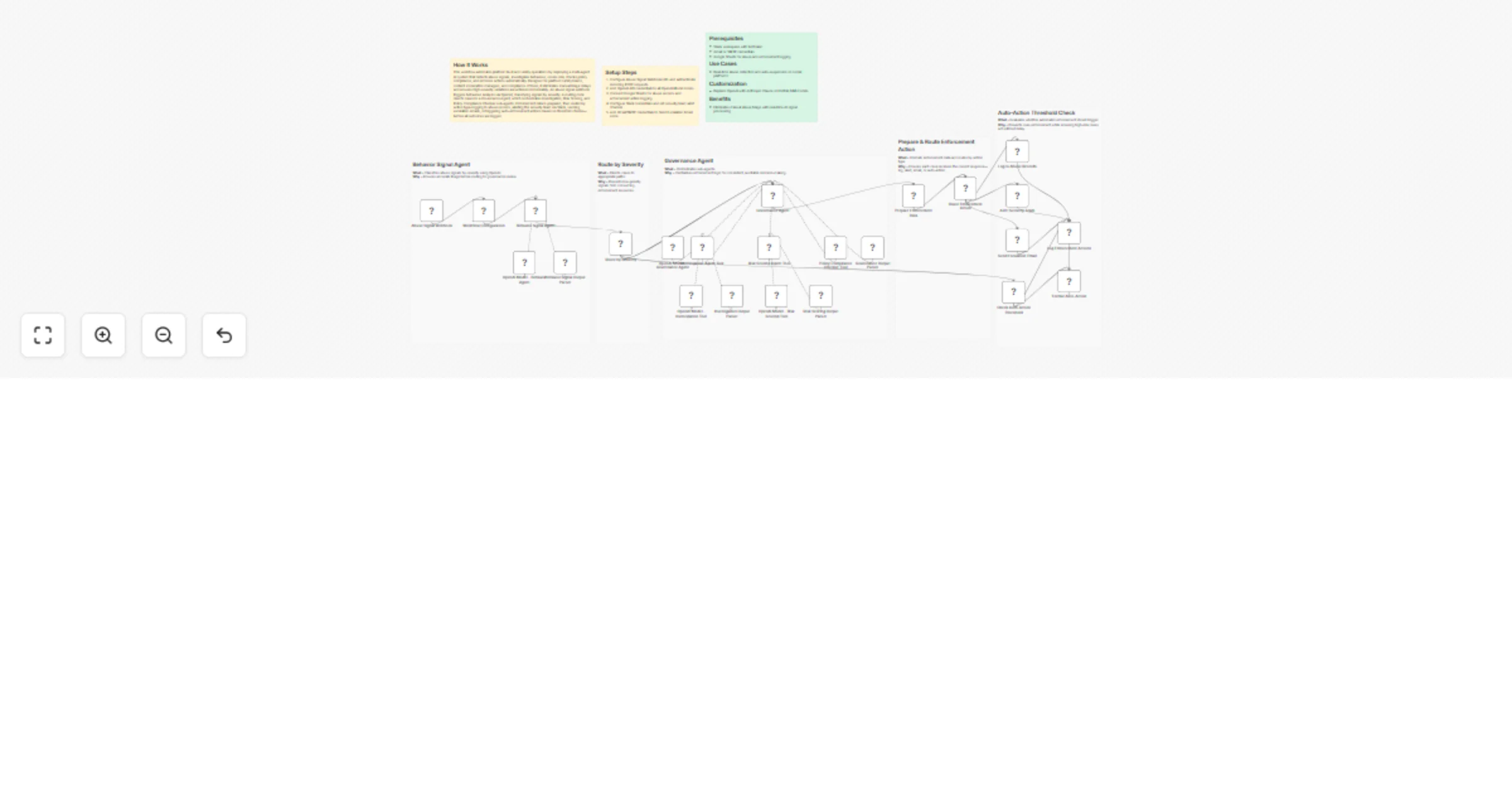
This workflow automates platform trust and safety operations by deploying a multi-agent AI system that detects abuse signals, investigates behaviour, scores risk, checks policy compliance, and enforces actions automatically. Designed for platform safety teams, content moderation managers, and compliance officers, it eliminates manual triage delays and ensures high-severity violations are actioned immediately. An abuse signal webhook triggers behaviour analysis via OpenAI, classifying signals by severity. A routing node directs cases to a Governance Agent, which orchestrates Investigation, Risk Scoring, and Policy Compliance Checker sub-agents. Enforcement data is prepared, then routed by action type-logging to abuse records, alerting the security team via Slack, sending escalation emails, or triggering auto-enforcement actions based on threshold checks—before all outcomes are logged.

Setup Steps

  1. Configure Abuse Signal Webhook URL and authenticate incoming POST requests.
  2. Add OpenAI API credentials to all OpenAI Model nodes.
  3. Connect Google Sheets for abuse records and enforcement action logging.
  4. Configure Slack credentials and set security team alert channel.
  5. Add Gmail/SMTP credentials to Send Escalation Email node.

Prerequisites

  • Slack workspace with bot token
  • Gmail or SMTP credentials
  • Google Sheets for abuse and enforcement logging

Use Cases

  • Real-time abuse detection and auto-suspension on social platforms

Customization

  • Replace OpenAI with Anthropic Claude or NVIDIA NIM models

Benefits

  • Eliminates manual abuse triage with real-time AI signal processing

1.2 Logical Blocks

This catalog entry is organized from the workflow JSON. The node-level section below shows the executable blocks available for review before importing the template.

2. Block-by-Block Analysis

Block 1 - Abuse Signal Webhook

Type / Role
n8n-nodes-base.webhook - webhook
Config choices
Version 2.1

Block 2 - Workflow Configuration

Type / Role
n8n-nodes-base.set - set
Config choices
Version 3.4

Block 3 - Behavior Signal Agent

Type / Role
@n8n/n8n-nodes-langchain.agent - agent
Config choices
Version 3.1

Block 4 - OpenAI Model - Behavior Agent

Type / Role
@n8n/n8n-nodes-langchain.lmChatOpenAi - lmChatOpenAi
Config choices
Version 1.3

Block 5 - Behavior Signal Output Parser

Type / Role
@n8n/n8n-nodes-langchain.outputParserStructured - outputParserStructured
Config choices
Version 1.3

Block 6 - Route by Severity

Type / Role
n8n-nodes-base.switch - switch
Config choices
Version 3.4

Block 7 - Governance Agent

Type / Role
@n8n/n8n-nodes-langchain.agent - agent
Config choices
Version 3.1

Block 8 - OpenAI Model - Governance Agent

Type / Role
@n8n/n8n-nodes-langchain.lmChatOpenAi - lmChatOpenAi
Config choices
Version 1.3

Block 9 - Governance Output Parser

Type / Role
@n8n/n8n-nodes-langchain.outputParserStructured - outputParserStructured
Config choices
Version 1.3

Block 10 - Investigation Agent Tool

Type / Role
@n8n/n8n-nodes-langchain.agentTool - agentTool
Config choices
Version 3

Block 11 - OpenAI Model - Investigation Tool

Type / Role
@n8n/n8n-nodes-langchain.lmChatOpenAi - lmChatOpenAi
Config choices
Version 1.3

Block 12 - Investigation Output Parser

Type / Role
@n8n/n8n-nodes-langchain.outputParserStructured - outputParserStructured
Config choices
Version 1.3

Block 13 - Risk Scoring Agent Tool

Type / Role
@n8n/n8n-nodes-langchain.agentTool - agentTool
Config choices
Version 3

Block 14 - OpenAI Model - Risk Scoring Tool

Type / Role
@n8n/n8n-nodes-langchain.lmChatOpenAi - lmChatOpenAi
Config choices
Version 1.3

Block 15 - Risk Scoring Output Parser

Type / Role
@n8n/n8n-nodes-langchain.outputParserStructured - outputParserStructured
Config choices
Version 1.3

Block 16 - Policy Compliance Checker Tool

Type / Role
@n8n/n8n-nodes-langchain.toolCode - toolCode
Config choices
Version 1.3

Block 17 - Prepare Enforcement Data

Type / Role
n8n-nodes-base.code - code
Config choices
Version 2

Block 18 - Route Enforcement Action

Type / Role
n8n-nodes-base.switch - switch
Config choices
Version 3.4

Block 19 - Log to Abuse Records

Type / Role
n8n-nodes-base.dataTable - dataTable
Config choices
Version 1.1

Block 20 - Alert Security Team

Type / Role
n8n-nodes-base.slack - slack
Config choices
Version 2.4

Block 21 - Send Escalation Email

Type / Role
n8n-nodes-base.emailSend - emailSend
Config choices
Version 2.1

Block 22 - Log Enforcement Actions

Type / Role
n8n-nodes-base.dataTable - dataTable
Config choices
Version 1.1

Block 23 - Check Auto-Action Threshold

Type / Role
n8n-nodes-base.if - if
Config choices
Version 2.3

Block 24 - Format Auto-Action

Type / Role
n8n-nodes-base.set - set
Config choices
Version 3.4

Showing the first 24 of 32 workflow blocks. Download the JSON for the full node graph.

3. Summary Table

Workflow Detect and enforce abuse cases with OpenAI, Slack, Gmail and Sheets
Complexity advanced
Nodes 32
Categories SecOps, AI Summarization
Author Cheng Siong Chin
Published 25 Feb 2026

4. Reproducing the Workflow from Scratch

  1. 1. Download the workflow JSON

    Use the JSON export at /data/workflows/13700/13700.json as the source template for this automation.

  2. 2. Import the template into n8n

    Open n8n, import the downloaded JSON, and review each node before activating the workflow.

  3. 3. Configure credentials and variables

    Replace placeholder credentials, API keys, webhook URLs, account IDs, and environment-specific values with your own settings.

  4. 4. Test with sample data

    Run the workflow manually or in a staging workspace, inspect node output, and confirm downstream systems receive the expected data.

  5. 5. Activate and monitor

    Enable the workflow only after testing, then monitor executions, errors, and rate limits during the first production runs.

5. General Notes & Resources

Review imported nodes carefully before activation. This catalog entry is intended to help you inspect the workflow structure, understand required services, and find related templates faster.

Node names, credentials, schedules, webhook paths, and external service limits may need adjustment for your workspace.

Frequently asked questions

What does Detect and enforce abuse cases with OpenAI, Slack, Gmail and Sheets do?

How It Works This workflow automates platform trust and safety operations by deploying a multi agent AI system that detects abuse signals, investigates behaviour, scores risk, checks policy complia...

What do I need before importing this workflow?

Review the workflow JSON, configure any required credentials in n8n, and test the automation in a safe workspace before using it in production.

Can I customize this workflow?

Yes. Use the block-by-block analysis and the downloadable JSON to inspect each node, then adjust credentials, prompts, schedules, filters, or destinations for your SecOps, AI Summarization use case.



