
Decide multi‐agent vs simple workflows using Azure OpenAI GPT‐4o‐mini

Workflow preview
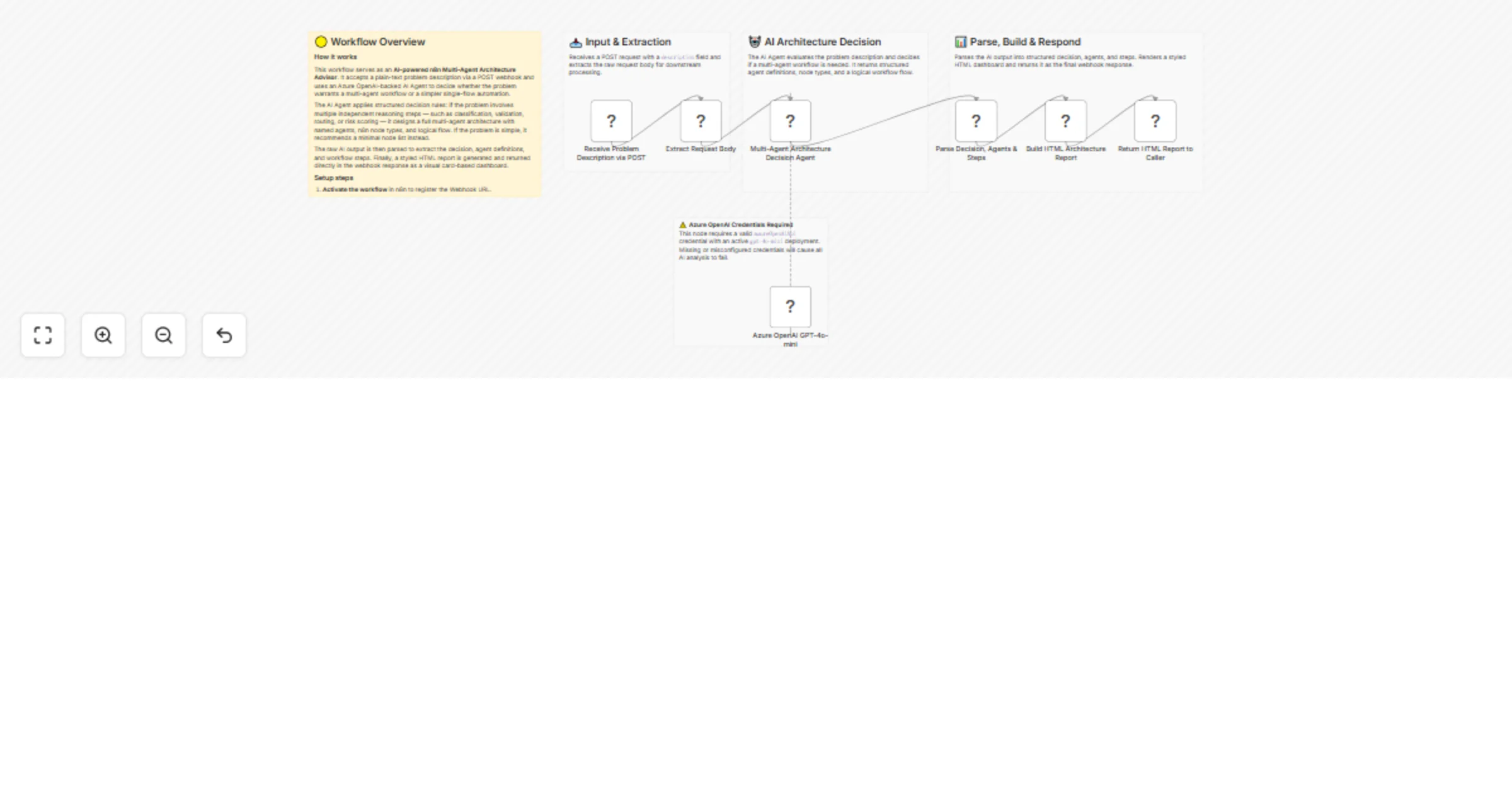
Workflow preview
100%
Decide multi‐agent vs simple workflows using Azure OpenAI GPT‐4o‐mini preview
Open on n8n.io

1. Workflow Overview

Description This workflow acts as an AI Multi Agent Architecture Advisor for n8n. It receives a problem statement via webhook, uses Azure OpenAI (gpt 4o mini) to decide whether the problem needs...

Best for

  • Engineering automation workflows
  • AI Chatbot automation workflows
  • intermediate n8n builders looking for reusable templates

Tools used

n8n-nodes-base.webhook, n8n-nodes-base.code, @n8n/n8n-nodes-langchain.agent, @n8n/n8n-nodes-langchain.lmchatazureopenai, n8n-nodes-base.respondtowebhook, n8n-nodes-base.stickynote

Source and attribution

This workflow is cataloged by N8N Workflows and links back to its original n8n.io source page by Rahul Joshi.

Original n8n.io source

1.1 Workflow description

Title
Decide multi‐agent vs simple workflows using Azure OpenAI GPT‐4o‐mini
Workflow name
Decide multi‐agent vs simple workflows using Azure OpenAI GPT‐4o‐mini

📘 Description

This workflow acts as an AI Multi-Agent Architecture Advisor for n8n. It receives a problem statement via webhook, uses Azure OpenAI (gpt-4o-mini) to decide whether the problem needs a multi-agent design or a simple workflow, then returns a styled HTML report showing the decision, recommended agents (if any), and the suggested step flow.

⚙️ Step-by-Step Flow

  • Receive Problem Description via POST (Webhook)
  • Accepts a POST payload containing a description field.
  • Extract Request Body (Code)
  • Strips the wrapper and outputs only the body JSON to simplify downstream prompts.
  • Multi-Agent Architecture Decision Agent (AI Agent)
  • Analyzes the problem description and outputs one of:
  • Decision: Multi-Agent Required + agent definitions + workflow steps
  • Decision: Not Required + minimal simplified workflow nodes
  • Parse Decision, Agents & Steps (Code)
  • Extracts three structured fields from the

AI output:

decision

  • agents[] (name, purpose, node, reason)
  • workflow_flow[] (ordered steps)
  • Build HTML Architecture Report (Code)
  • Renders a clean card-based HTML dashboard:
  • Decision badge (multi vs simple)
  • Agent cards (if present)
  • Workflow flow chips (steps)
  • Return HTML Report to Caller (Respond to Webhook)
  • Returns the HTML report directly as the webhook response.

🧩 Prerequisites

  • • Azure OpenAI credential with an active gpt-4o-mini deployment
  • • n8n webhook endpoint exposed to the caller (or via tunnel)

💡 Key Benefits

✔ Fast “multi-agent vs simple” decisioning ✔ Outputs an actionable architecture, not generic advice ✔ HTML report is ready to embed in internal tools (Base44/UI) ✔ Structured parsing makes it easy to store or extend later

👥 Perfect For

  • Automation agencies doing solution design calls
  • Teams standardizing how they choose agent-based workflows
  • Internal tooling that needs instant architecture recommendations

1.2 Logical Blocks

This catalog entry is organized from the workflow JSON. The node-level section below shows the executable blocks available for review before importing the template.

2. Block-by-Block Analysis

Block 1 - Receive Problem Description via POST

Type / Role
n8n-nodes-base.webhook - webhook
Config choices
Version 2.1

Block 2 - Extract Request Body

Type / Role
n8n-nodes-base.code - code
Config choices
Version 2

Block 3 - Multi-Agent Architecture Decision Agent

Type / Role
@n8n/n8n-nodes-langchain.agent - agent
Config choices
Version 3

Block 4 - Azure OpenAI GPT-4o-mini

Type / Role
@n8n/n8n-nodes-langchain.lmChatAzureOpenAi - lmChatAzureOpenAi
Config choices
Version 1

Block 5 - Parse Decision, Agents & Steps

Type / Role
n8n-nodes-base.code - code
Config choices
Version 2

Block 6 - Build HTML Architecture Report

Type / Role
n8n-nodes-base.code - code
Config choices
Version 2

Block 7 - Return HTML Report to Caller

Type / Role
n8n-nodes-base.respondToWebhook - respondToWebhook
Config choices
Version 1.5

Block 8 - Sticky Note - Overview

Type / Role
n8n-nodes-base.stickyNote - stickyNote
Config choices
Version 1

Block 9 - Sticky Note - Input Section

Type / Role
n8n-nodes-base.stickyNote - stickyNote
Config choices
Version 1

Block 10 - Sticky Note - AI Section

Type / Role
n8n-nodes-base.stickyNote - stickyNote
Config choices
Version 1

Block 11 - Sticky Note - Output Section

Type / Role
n8n-nodes-base.stickyNote - stickyNote
Config choices
Version 1

Block 12 - Sticky Note - Azure Warning

Type / Role
n8n-nodes-base.stickyNote - stickyNote
Config choices
Version 1

3. Summary Table

Workflow Decide multi‐agent vs simple workflows using Azure OpenAI GPT‐4o‐mini
Complexity intermediate
Nodes 12
Categories Engineering, AI Chatbot
Author Rahul Joshi
Published 02 Mar 2026

4. Reproducing the Workflow from Scratch

  1. 1. Download the workflow JSON

    Use the JSON export at /data/workflows/13792/13792.json as the source template for this automation.

  2. 2. Import the template into n8n

    Open n8n, import the downloaded JSON, and review each node before activating the workflow.

  3. 3. Configure credentials and variables

    Replace placeholder credentials, API keys, webhook URLs, account IDs, and environment-specific values with your own settings.

  4. 4. Test with sample data

    Run the workflow manually or in a staging workspace, inspect node output, and confirm downstream systems receive the expected data.

  5. 5. Activate and monitor

    Enable the workflow only after testing, then monitor executions, errors, and rate limits during the first production runs.

5. General Notes & Resources

Review imported nodes carefully before activation. This catalog entry is intended to help you inspect the workflow structure, understand required services, and find related templates faster.

Node names, credentials, schedules, webhook paths, and external service limits may need adjustment for your workspace.

Frequently asked questions

What does Decide multi‐agent vs simple workflows using Azure OpenAI GPT‐4o‐mini do?

Description This workflow acts as an AI Multi Agent Architecture Advisor for n8n. It receives a problem statement via webhook, uses Azure OpenAI (gpt 4o mini) to decide whether the problem needs...

What do I need before importing this workflow?

Review the workflow JSON, configure any required credentials in n8n, and test the automation in a safe workspace before using it in production.

Can I customize this workflow?

Yes. Use the block-by-block analysis and the downloadable JSON to inspect each node, then adjust credentials, prompts, schedules, filters, or destinations for your Engineering, AI Chatbot use case.



