Block 1 - Anthropic Chat Model1
- Type / Role
- @n8n/n8n-nodes-langchain.lmChatAnthropic - lmChatAnthropic
- Config choices
- Version 1.3
This workflow is provided as-is. Please review and test before using in production.
How it works Every day at 6:00 AM, the workflow pulls all events from your Google Calendar scheduled for that day. It extracts each event’s ID, title, and start time, aggregates them into one list,...
@n8n/n8n-nodes-langchain.lmchatanthropic, n8n-nodes-base.stickynote, n8n-nodes-base.scheduletrigger, n8n-nodes-base.googlecalendar, n8n-nodes-base.set, n8n-nodes-base.aggregate, @n8n/n8n-nodes-langchain.informationextractor, n8n-nodes-base.telegram
This workflow is cataloged by N8N Workflows and links back to its original n8n.io source page by Patrik Schick.
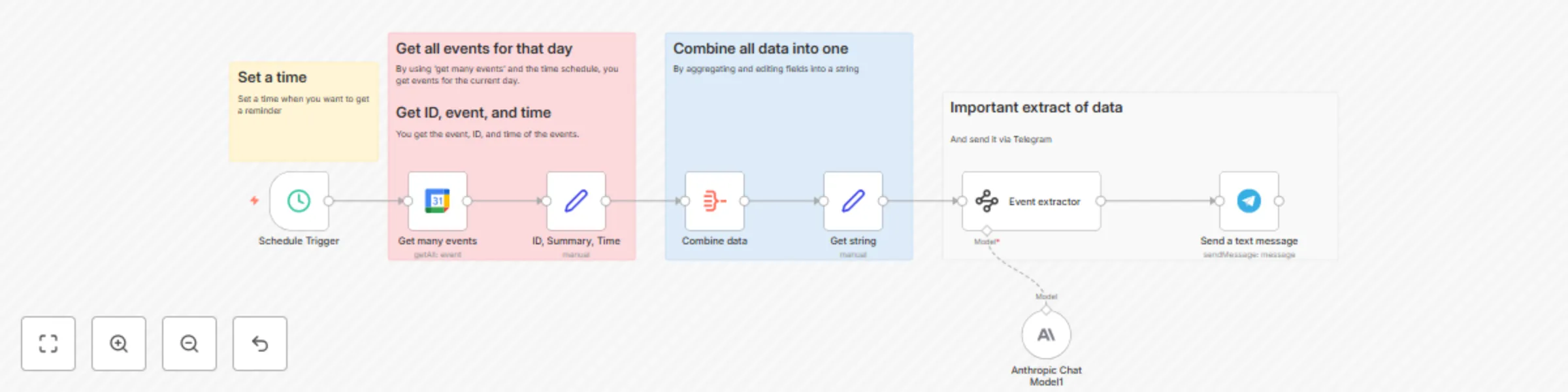
Original n8n.io sourceEvery day at 6:00 AM, the workflow pulls all events from your Google Calendar scheduled for that day. It extracts each event’s ID, title, and start time, aggregates them into one list, and converts them into a text string. This text is passed to an AI-powered Information Extractor (using Claude 3.5 Sonnet) to format the events into a clear daily summary. Finally, the summary is sent as a Telegram message to your chosen chat ID, giving you a ready-to-read daily to-do list.
Connect your Google Calendar account to the Get many events node.
Set the correct calendar in the calendar field.
Link your Telegram account and set your chatId in the Send a text message node.
Adjust the Schedule Trigger node if you want a different reminder time.
Activate the workflow — it will run daily and send your event summary to Telegram automatically.
Reminder time: Change triggerAtHour in the Schedule Trigger node for morning, evening, or multiple reminders per day.
Calendar source: Switch to another Google Calendar or add multiple Get many events nodes for different calendars.
Message style: Edit the Information Extractor system prompt to change language, formatting, or level of detail in your summary.
Delivery channel: Replace or add another messaging node (e.g., Email, Slack, WhatsApp) if you want your to-do list in different apps.
Event filtering: Add a filter before aggregation to include only certain event types or keywords (e.g., “Meeting”, “Deadline”).
This catalog entry is organized from the workflow JSON. The node-level section below shows the executable blocks available for review before importing the template.
| Workflow | Daily calendar digest: Format Google Calendar events with Claude 3.5 Sonnet for Telegram |
|---|---|
| Complexity | intermediate |
| Nodes | 12 |
| Categories | Personal Productivity, Multimodal AI |
| Author | Patrik Schick |
| Published | 11 Aug 2025 |
Use the JSON export at /data/workflows/7266/7266.json as the source template for this automation.
Open n8n, import the downloaded JSON, and review each node before activating the workflow.
Replace placeholder credentials, API keys, webhook URLs, account IDs, and environment-specific values with your own settings.
Run the workflow manually or in a staging workspace, inspect node output, and confirm downstream systems receive the expected data.
Enable the workflow only after testing, then monitor executions, errors, and rate limits during the first production runs.
Review imported nodes carefully before activation. This catalog entry is intended to help you inspect the workflow structure, understand required services, and find related templates faster.
Node names, credentials, schedules, webhook paths, and external service limits may need adjustment for your workspace.
How it works Every day at 6:00 AM, the workflow pulls all events from your Google Calendar scheduled for that day. It extracts each event’s ID, title, and start time, aggregates them into one list,...
Review the workflow JSON, configure any required credentials in n8n, and test the automation in a safe workspace before using it in production.
Yes. Use the block-by-block analysis and the downloadable JSON to inspect each node, then adjust credentials, prompts, schedules, filters, or destinations for your Personal Productivity, Multimodal AI use case.