
CYBERPULSE AI GRC: automated ISO 42001 compliance evaluation

Workflow preview
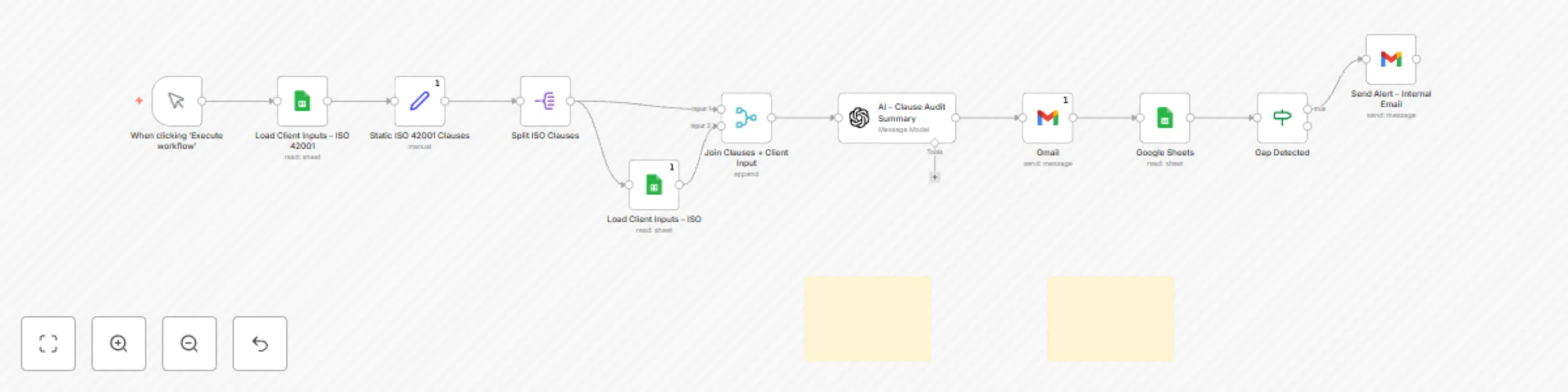
Workflow preview
100%
CYBERPULSE AI GRC: automated ISO 42001 compliance evaluation preview
Open on n8n.io

Important notice

This workflow is provided as-is. Please review and test before using in production.

1. Workflow Overview

Description Automatically evaluates and maps AI governance responses to ISO 42001:2023 clause requirements using AI powered logic. Designed for GRC consultants, audit teams, and AI focused security...

Best for

  • Document Extraction automation workflows
  • AI Summarization automation workflows
  • intermediate n8n builders looking for reusable templates

Tools used

n8n-nodes-base.stickynote, n8n-nodes-base.manualtrigger, n8n-nodes-base.googlesheets, n8n-nodes-base.set, n8n-nodes-base.splitout, n8n-nodes-base.merge, @n8n/n8n-nodes-langchain.openai, n8n-nodes-base.gmail

Source and attribution

This workflow is cataloged by N8N Workflows and links back to its original n8n.io source page by Adnan Tariq.

Original n8n.io source

1.1 Workflow description

Title
CYBERPULSE AI GRC: automated ISO 42001 compliance evaluation
Workflow name
CYBERPULSE AI GRC: automated ISO 42001 compliance evaluation

Description Automatically evaluates and maps AI governance responses to ISO 42001:2023 clause requirements using AI-powered logic. Designed for GRC consultants, audit teams, and AI-focused security programs to reduce time spent on manual clause interpretation and alignment.

Who’s It For: GRC Consultants handling AI governance controls

Internal Auditors preparing for ISO 42001 audits

Security teams implementing AI assurance frameworks

Organizations adopting Responsible AI principles

How It Works: Triggers manually or on schedule (e.g., clause review cycles)

Reads AI control responses from a connected Google Sheet

Uses AI to evaluate each response against ISO 42001 clauses

Flags compliance status (match / partial / gap) with clause mapping

Outputs a clean control map with automated summary

Requirements: Gmail or SMTP node for email

Google Sheets connected (OAuth)

OpenAI or AI node (optional but recommended for advanced clause interpretation)

Google Sheet Requirements: Columns: ClauseID, Clause_Description, Control_Response, Evaluation_Result

Each row must correspond to one ISO 42001 clause

Headers in the first row

Optional: add column for Suggested_Remediation

File Templates: ISO42001_Mapping_Template.xlsx

Includes: clause ID, clause text, response, result, suggested fix

Customization Tips: Modify clause response logic in the evaluation node (e.g., strict vs lenient mapping)

Enable multi-framework mapping (e.g., align to NIST AI RMF as well)

Auto-send mapping result to Drive or S3 as audit evidence

Ethics & Compliance: This module assists with clause interpretation and reporting only. It does not simulate AI models or assess ethical risk directly. For internal reporting, policy alignment, and audit preparation use only.

Setup Instructions: Copy the provided Google Sheet template (ISO42001_Mapping_Template.xlsx)

Fill in your control responses (row = clause)

Connect Google Sheets node using OAuth credentials

In the AI node:

Evaluate clause response using GPT or internal prompt

Flag match/partial/gap

Optional: auto-send report via email or upload to storage

Review results and update your compliance register accordingly

Supports: ISO 42001:2023

AI Governance Principles (OECD, NIST AI RMF)

SOCI Act compliance efforts (AI assurance layer)

ACSC AI oversight recommendations

📬 [email protected] 🌐 https://www.cyberpulsesolutions.com/

1.2 Logical Blocks

This catalog entry is organized from the workflow JSON. The node-level section below shows the executable blocks available for review before importing the template.

2. Block-by-Block Analysis

Block 1 - Sticky Note

Type / Role
n8n-nodes-base.stickyNote - stickyNote
Config choices
Version 1

Block 2 - When clicking ‘Execute workflow’

Type / Role
n8n-nodes-base.manualTrigger - manualTrigger
Config choices
Version 1

Block 3 - Load Client Inputs – ISO 42001

Type / Role
n8n-nodes-base.googleSheets - googleSheets
Config choices
Version 4.6

Block 4 - Static ISO 42001 Clauses

Type / Role
n8n-nodes-base.set - set
Config choices
Version 3.4

Block 5 - Split ISO Clauses

Type / Role
n8n-nodes-base.splitOut - splitOut
Config choices
Version 1

Block 6 - Load Client Inputs – ISO

Type / Role
n8n-nodes-base.googleSheets - googleSheets
Config choices
Version 4.6

Block 7 - Join Clauses + Client Input

Type / Role
n8n-nodes-base.merge - merge
Config choices
Version 3.2

Block 8 - AI – Clause Audit Summary

Type / Role
@n8n/n8n-nodes-langchain.openAi - openAi
Config choices
Version 1.8

Block 9 - Gmail

Type / Role
n8n-nodes-base.gmail - gmail
Config choices
Version 2.1

Block 10 - Google Sheets

Type / Role
n8n-nodes-base.googleSheets - googleSheets
Config choices
Version 4.6

Block 11 - Gap Detected

Type / Role
n8n-nodes-base.if - if
Config choices
Version 2.2

Block 12 - Send Alert – Internal Email

Type / Role
n8n-nodes-base.gmail - gmail
Config choices
Version 2.1

Block 13 - Sticky Note1

Type / Role
n8n-nodes-base.stickyNote - stickyNote
Config choices
Version 1

3. Summary Table

Workflow CYBERPULSE AI GRC: automated ISO 42001 compliance evaluation
Complexity intermediate
Nodes 13
Categories Document Extraction, AI Summarization
Author Adnan Tariq
Published 07 Aug 2025

4. Reproducing the Workflow from Scratch

  1. 1. Download the workflow JSON

    Use the JSON export at /data/workflows/7078/7078.json as the source template for this automation.

  2. 2. Import the template into n8n

    Open n8n, import the downloaded JSON, and review each node before activating the workflow.

  3. 3. Configure credentials and variables

    Replace placeholder credentials, API keys, webhook URLs, account IDs, and environment-specific values with your own settings.

  4. 4. Test with sample data

    Run the workflow manually or in a staging workspace, inspect node output, and confirm downstream systems receive the expected data.

  5. 5. Activate and monitor

    Enable the workflow only after testing, then monitor executions, errors, and rate limits during the first production runs.

5. General Notes & Resources

Review imported nodes carefully before activation. This catalog entry is intended to help you inspect the workflow structure, understand required services, and find related templates faster.

Node names, credentials, schedules, webhook paths, and external service limits may need adjustment for your workspace.

Frequently asked questions

What does CYBERPULSE AI GRC: automated ISO 42001 compliance evaluation do?

Description Automatically evaluates and maps AI governance responses to ISO 42001:2023 clause requirements using AI powered logic. Designed for GRC consultants, audit teams, and AI focused security...

What do I need before importing this workflow?

Review the workflow JSON, configure any required credentials in n8n, and test the automation in a safe workspace before using it in production.

Can I customize this workflow?

Yes. Use the block-by-block analysis and the downloadable JSON to inspect each node, then adjust credentials, prompts, schedules, filters, or destinations for your Document Extraction, AI Summarization use case.



