
Customer authentication for chat support with OpenAI and Redis session management

Workflow preview
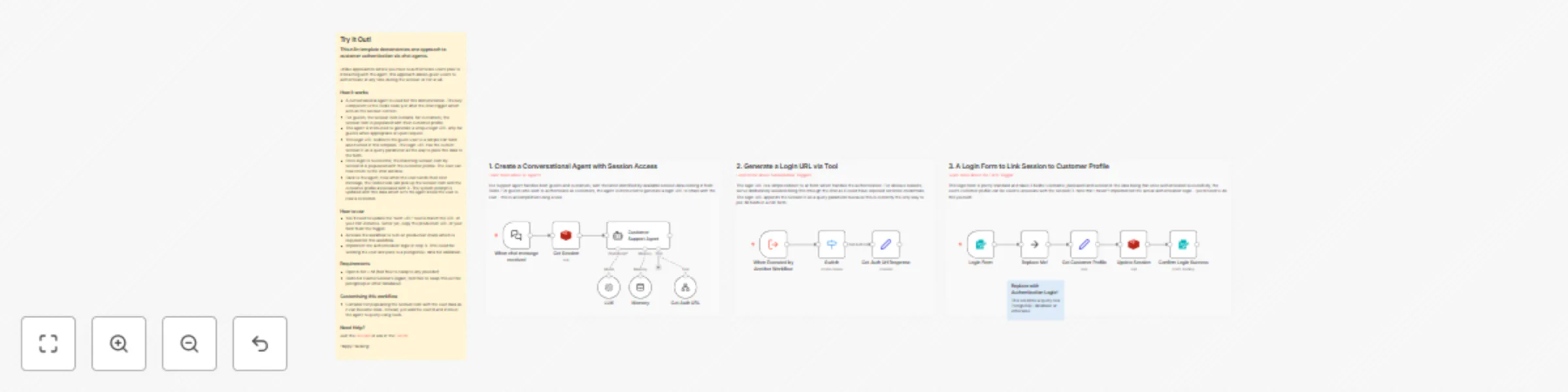
Workflow preview
100%
Customer authentication for chat support with OpenAI and Redis session management preview
Open on n8n.io

Important notice

This workflow is provided as-is. Please review and test before using in production.

1. Workflow Overview

This n8n template demonstrates one approach to customer authentication via chat agents. Unlike approaches where you have to authenticate users prior to interacting with the agent, this approach all...

Best for

  • Support Chatbot automation workflows
  • AI Chatbot automation workflows
  • advanced n8n builders looking for reusable templates

Tools used

@n8n/n8n-nodes-langchain.chattrigger, @n8n/n8n-nodes-langchain.lmchatopenai, @n8n/n8n-nodes-langchain.memorybufferwindow, n8n-nodes-base.redis, n8n-nodes-base.executeworkflowtrigger, n8n-nodes-base.switch, n8n-nodes-base.set, @n8n/n8n-nodes-langchain.toolworkflow

Source and attribution

This workflow is cataloged by N8N Workflows and links back to its original n8n.io source page by Jimleuk.

Original n8n.io source

1.1 Workflow description

Title
Customer authentication for chat support with OpenAI and Redis session management
Workflow name
Customer authentication for chat support with OpenAI and Redis session management

This n8n template demonstrates one approach to customer authentication via chat agents.

Unlike approaches where you have to authenticate users prior to interacting with the agent, this approach allows guest users to authenticate at any time during the session or not at all.

Note about Security: this template is for illustration purposes only and requires much more work to be ready for production!

How it works

  • A conversational agent is used for this demonstration. The key component is the Redis node just after the chat trigger which acts as the session context.
  • For guests, the session item is blank. for customers, the session item is populated with their customer profile.
  • The agent is instructed to generate a unique login URL only for guests when appropriate or upon request.
  • This login URL redirects the guest user to a simple n8n form also hosted in this template. The login URL has the current sessionID as a query parameter as the way to pass this data to the form.
  • Once login is successful, the matching session item by sessionId is populated with the customer profile. The user can now return to the chat window.
  • Back to the agent, now when the user sends their next message, the Redis node will pick up the session item and the customer profile associated with it. The system prompt is updated with this data which let's the agent know the user is now a customer.

How to use

  • You'll need to update the "auth URL" tool to match the URL of your n8n instance. Better yet, copy the production URL of your form from the trigger.
  • Activate the workflow to turn on production mode which is required for this workflow.
  • Implement the authentication logic in step 3. This could be sending the user and pass to a postgreSQL data for validation.

Requirements

  • OpenAI for LLM (feel free to swap to any provider)
  • Redis for Cache/Sessions (again, feel free to swap this out for postgresql or other database)

Customising this workflow

  • Consider not populating the session item with the user data as it can become stale. Instead, just add the userId and instruct the agent to query using tools.
  • Extend the Login URL idea by experimenting with signup URLs or single-use Urls.

1.2 Logical Blocks

This catalog entry is organized from the workflow JSON. The node-level section below shows the executable blocks available for review before importing the template.

2. Block-by-Block Analysis

Block 1 - When chat message received

Type / Role
@n8n/n8n-nodes-langchain.chatTrigger - chatTrigger
Config choices
Version 1.1

Block 2 - LLM

Type / Role
@n8n/n8n-nodes-langchain.lmChatOpenAi - lmChatOpenAi
Config choices
Version 1.2

Block 3 - Memory

Type / Role
@n8n/n8n-nodes-langchain.memoryBufferWindow - memoryBufferWindow
Config choices
Version 1.3

Block 4 - Get Session

Type / Role
n8n-nodes-base.redis - redis
Config choices
Version 1

Block 5 - When Executed by Another Workflow

Type / Role
n8n-nodes-base.executeWorkflowTrigger - executeWorkflowTrigger
Config choices
Version 1.1

Block 6 - Switch

Type / Role
n8n-nodes-base.switch - switch
Config choices
Version 3.2

Block 7 - Get Auth Url Response

Type / Role
n8n-nodes-base.set - set
Config choices
Version 3.4

Block 8 - Get Auth URL

Type / Role
@n8n/n8n-nodes-langchain.toolWorkflow - toolWorkflow
Config choices
Version 2.2

Block 9 - Update Session

Type / Role
n8n-nodes-base.redis - redis
Config choices
Version 1

Block 10 - Confirm Login Success

Type / Role
n8n-nodes-base.form - form
Config choices
Version 1

Block 11 - Customer Support Agent

Type / Role
@n8n/n8n-nodes-langchain.agent - agent
Config choices
Version 1.9

Block 12 - Sticky Note

Type / Role
n8n-nodes-base.stickyNote - stickyNote
Config choices
Version 1

Block 13 - Sticky Note1

Type / Role
n8n-nodes-base.stickyNote - stickyNote
Config choices
Version 1

Block 14 - Sticky Note2

Type / Role
n8n-nodes-base.stickyNote - stickyNote
Config choices
Version 1

Block 15 - Get Customer Profile

Type / Role
n8n-nodes-base.set - set
Config choices
Version 3.4

Block 16 - Replace Me!

Type / Role
n8n-nodes-base.noOp - noOp
Config choices
Version 1

Block 17 - Login Form

Type / Role
n8n-nodes-base.formTrigger - formTrigger
Config choices
Version 2.2

Block 18 - Sticky Note3

Type / Role
n8n-nodes-base.stickyNote - stickyNote
Config choices
Version 1

Block 19 - Sticky Note4

Type / Role
n8n-nodes-base.stickyNote - stickyNote
Config choices
Version 1

3. Summary Table

Workflow Customer authentication for chat support with OpenAI and Redis session management
Complexity advanced
Nodes 19
Categories Support Chatbot, AI Chatbot
Author Jimleuk
Published 19 May 2025

4. Reproducing the Workflow from Scratch

  1. 1. Download the workflow JSON

    Use the JSON export at /data/workflows/4216/4216.json as the source template for this automation.

  2. 2. Import the template into n8n

    Open n8n, import the downloaded JSON, and review each node before activating the workflow.

  3. 3. Configure credentials and variables

    Replace placeholder credentials, API keys, webhook URLs, account IDs, and environment-specific values with your own settings.

  4. 4. Test with sample data

    Run the workflow manually or in a staging workspace, inspect node output, and confirm downstream systems receive the expected data.

  5. 5. Activate and monitor

    Enable the workflow only after testing, then monitor executions, errors, and rate limits during the first production runs.

5. General Notes & Resources

Review imported nodes carefully before activation. This catalog entry is intended to help you inspect the workflow structure, understand required services, and find related templates faster.

Node names, credentials, schedules, webhook paths, and external service limits may need adjustment for your workspace.

Frequently asked questions

What does Customer authentication for chat support with OpenAI and Redis session management do?

This n8n template demonstrates one approach to customer authentication via chat agents. Unlike approaches where you have to authenticate users prior to interacting with the agent, this approach all...

What do I need before importing this workflow?

Review the workflow JSON, configure any required credentials in n8n, and test the automation in a safe workspace before using it in production.

Can I customize this workflow?

Yes. Use the block-by-block analysis and the downloadable JSON to inspect each node, then adjust credentials, prompts, schedules, filters, or destinations for your Support Chatbot, AI Chatbot use case.



