Block 1 - Sticky Note
- Type / Role
- n8n-nodes-base.stickyNote - stickyNote
- Config choices
- Version 1
This workflow is provided as-is. Please review and test before using in production.
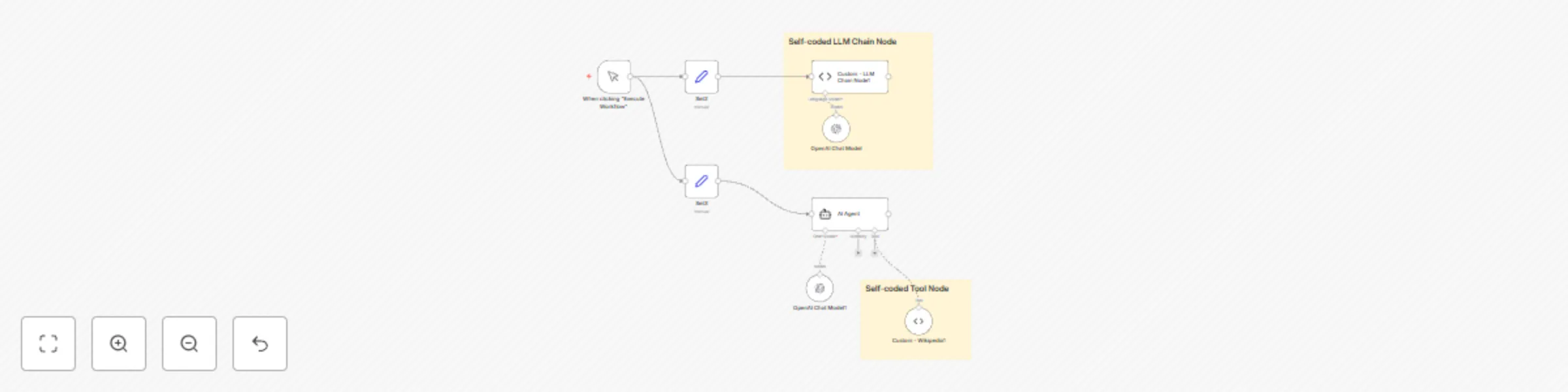
This workflow has multiple functionalities. It starts with a manual trigger, "When clicking 'Execute Workflow'", that activates two separate paths. The first path takes a preset string "Tell me a j...
n8n-nodes-base.stickynote, n8n-nodes-base.manualtrigger, n8n-nodes-base.set, @n8n/n8n-nodes-langchain.code, @n8n/n8n-nodes-langchain.lmchatopenai, @n8n/n8n-nodes-langchain.agent, @n8n/n8n-nodes-langchain.toolcode
This workflow is cataloged by N8N Workflows and links back to its original n8n.io source page by n8n Team.
Original n8n.io sourceThis workflow has multiple functionalities. It starts with a manual trigger, "When clicking 'Execute Workflow'", that activates two separate paths.
The first path takes a preset string "Tell me a joke" and processes it through a custom Language Learning Model (LLM) chain node. This node interacts with an OpenAI node for query processing.
The second path takes another preset string "What year was Einstein born?" and passes it to an "Agent" node. This agent further interacts with a Chat OpenAI node and a custom Wikipedia node to produce the required information.
The workflow uses both built-in and custom nodes, and integrates with OpenAI for both paths. It's built for experimenting with language models, specifically in the context of conversational agents and information retrieval.
Note that to use this template, you need to be on n8n version 1.19.4 or later.
This catalog entry is organized from the workflow JSON. The node-level section below shows the executable blocks available for review before importing the template.
| Workflow | Custom LangChain agent written in JavaScript |
|---|---|
| Complexity | intermediate |
| Nodes | 10 |
| Categories | Engineering, AI RAG |
| Author | n8n Team |
| Published | 03 Oct 2023 |
Use the JSON export at /data/workflows/1955/1955.json as the source template for this automation.
Open n8n, import the downloaded JSON, and review each node before activating the workflow.
Replace placeholder credentials, API keys, webhook URLs, account IDs, and environment-specific values with your own settings.
Run the workflow manually or in a staging workspace, inspect node output, and confirm downstream systems receive the expected data.
Enable the workflow only after testing, then monitor executions, errors, and rate limits during the first production runs.
Review imported nodes carefully before activation. This catalog entry is intended to help you inspect the workflow structure, understand required services, and find related templates faster.
Node names, credentials, schedules, webhook paths, and external service limits may need adjustment for your workspace.
This workflow has multiple functionalities. It starts with a manual trigger, "When clicking 'Execute Workflow'", that activates two separate paths. The first path takes a preset string "Tell me a j...
Review the workflow JSON, configure any required credentials in n8n, and test the automation in a safe workspace before using it in production.
Yes. Use the block-by-block analysis and the downloadable JSON to inspect each node, then adjust credentials, prompts, schedules, filters, or destinations for your Engineering, AI RAG use case.