Create AI newsletters from YouTube with LangChain, Gemini, Apify & Gmail
Workflow preview

$20/month : Unlimited workflows
2500 executions/month

THE #1 IN WEB SCRAPING
Scrape any website without limits
HOSTINGER  Early Deal
DISCOUNT 20% Try free
Early DealDISCOUNT 20%
Self-hosted n8n
Unlimited workflows - from $4.99/mo

#1 hub for scraping, AI & automation
6000+ actors - $5 credits/mo
Overview
Video → Newsletter AI Agent
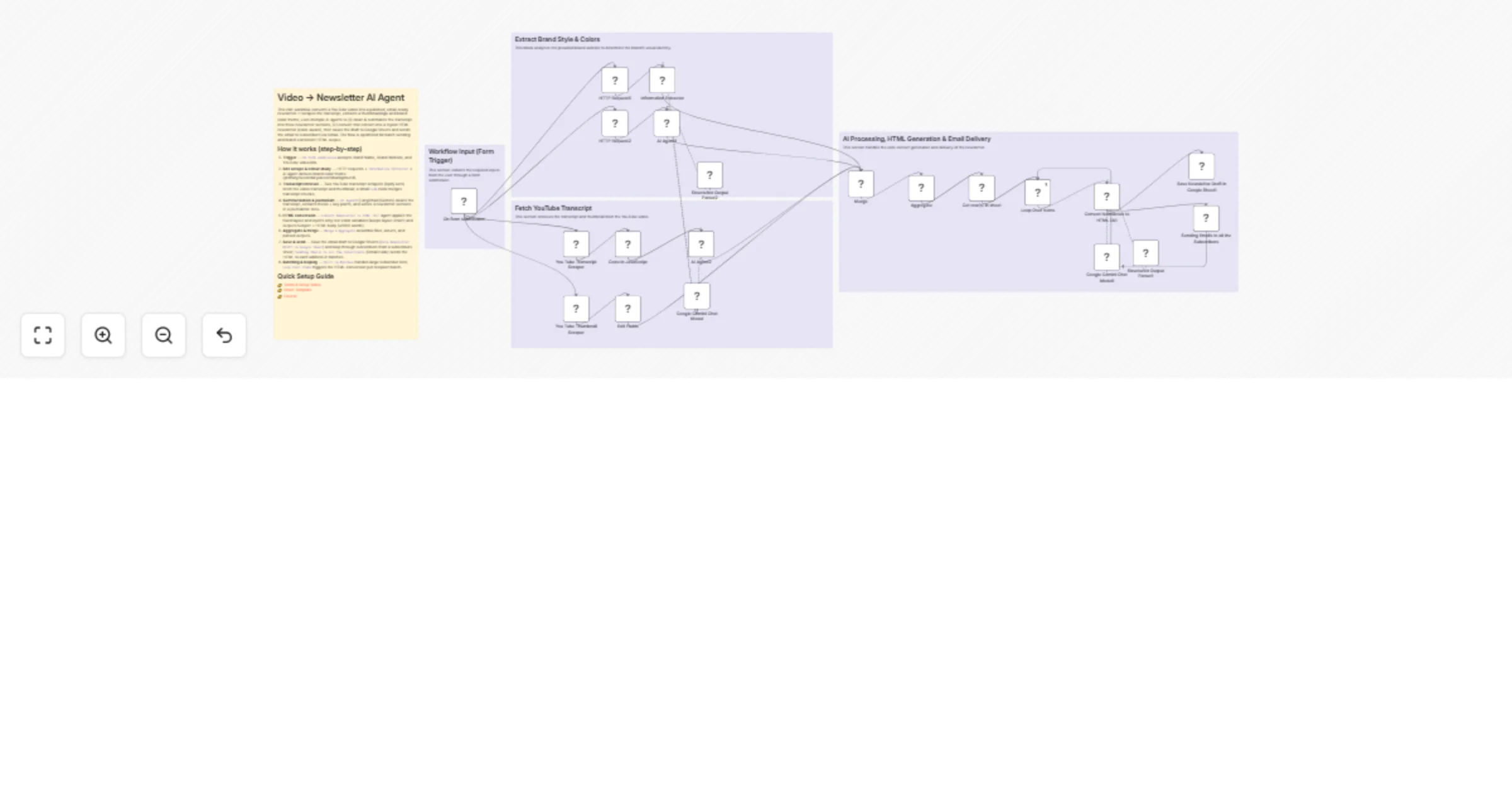
This n8n workflow converts a YouTube video into a polished, email-ready newsletter. It scrapes the transcript, extracts a thumbnail/logo and brand color theme, uses multiple AI agents to (1) clean & summarize the transcript into three newsletter sections, (2) convert that content into a styled HTML newsletter (color-aware), then saves the draft to Google Sheets and sends the email to subscribers via Gmail. The flow is optimized for batch sending and brand-consistent HTML output.
How it works (step-by-step)
- Trigger —
On form submissionaccepts Brand Name, Brand Website, and YouTube video link. - Site scrape & colour study — HTTP requests +
Information Extractor→ AI agent derives brand color theme (primary/secondary/accent/background). - Transcript retrieval — Two YouTube transcript scrapers (Apify acts) fetch the video transcript and thumbnail; a small
Codenode merges transcript chunks. - Summarization & journalism —
AI Agent2(LangChain/Gemini) cleans the transcript, extracts thesis + key points, and writes 3 newsletter sections in a journalistic tone. - HTML conversion —
Convert Newsletter to HTML (AI)agent applies the fixed layout and injects only text color variables (keeps layout intact) and outputs Subject + HTML body (≤1000 words). - Aggregate & merge —
Merge+Aggregateassemble files, assets, and parsed outputs. - Save & send — Save the email draft to Google Sheets (
Save Newsletter Draft in Google Sheet) and loop through subscribers from a subscribers sheet;Sending Emails to all the Subscribers(Gmail node) sends the HTML to each address in batches. - Batching & looping —
Split In Batcheshandles large subscriber lists;Loop Over Itemstriggers the HTML-conversion per recipient batch.
Quick Setup Guide
👉 Demo & Setup Video 👉 Sheet Template 👉 Course
Nodes of interest
On form submission(formTrigger) — entry point for video + brand inputs.You Tube Transcript Scraper,You Tube Transcript Scraper1(HTTP Request → Apify) — transcript + thumbnail fetching.Information Extractor&AI Agent1— website color/theme extraction.Code in JavaScript— merges transcript pieces into a single text payload.AI Agent2(LangChain agent + Gemini Chat Model) — transcript → journalist-style newsletter sections.Convert Newsletter to HTML (AI)(LangChain agent + Structured Output Parser) — builds constrained, brand-aware HTML email and subject.Structured Output Parser1/2— enforce schemas for color theme / structured outputs.Get row(s) in sheet&Save Newsletter Draft in Google Sheet(Google Sheets) — subscriber list + draft storage.Loop Over Items/Split In Batches— batch processing for sends.Sending Emails to all the Subscribers(Gmail) — SMTP/OAuth send.OpenRouter Chat Model— LM compute provider configured in the workflow.
What you’ll need (credentials & resources)
- Google Sheets OAuth2 (for reading subscribers & saving drafts).
- Gmail OAuth2 (for sending HTML emails).
- Gemini / LLM provider credentials (Gemini API key or equivalent) for the LangChain agents.
- Apify API key (for the YouTube transcript scrapers).
- ConvertAPI (or similar) key if you convert logos (SVG→PNG) server-side.
- Host storage / publicly accessible URLs for images (thumbnails, logos) or a file-store (S3).
- Optional: SendGrid / Mailgun credentials if you swap Gmail for a transactional email provider. Security note: do NOT hardcode credentials in node parameters; use n8n credentials manager or environment variables.
Recommended settings & best practices
- Batch size & rate-limits: set
Split In Batchesto a conservative batch size (e.g., 50–200) and add delays between batches to avoid provider rate limits and Gmail throttling. - Retries & timeouts: enable retries for HTTP Request nodes and set sensible timeouts (e.g., 30–60s). Use exponential backoff.
- LM controls: set token/response length limits and
max_output_tokens(or equivalent) to avoid runaway costs; enforce the 1000-word HTML hard limit in the prompt. - Validation: validate the YouTube URL and that transcript content exists before invoking AI summarization (fail fast with a clear error).
- Schema enforcement: use
Structured Output Parsernodes with strict JSON schemas to prevent malformed outputs. - Testing: run with a small subscriber test sheet and use a safety test Gmail account before sending to production lists.
- Logging & monitoring: log each run (video URL, subject, send count, errors) to a monitoring sheet or external logging service.
- Privacy & compliance: ensure recipients have consent to receive emails (store opt-ins); include unsubscribe handling if you move beyond one-off sends. Comply with CAN-SPAM / local laws.
- Credential rotation: rotate API keys periodically and revoke compromised tokens.
- Content safety: instruct the LM agents to avoid hallucinated citations — only include links you can verify.
Customization ideas
- Multi-language support: auto-detect video language and run summarizer in that language.
- A/B subject testing: generate 2–3 subject lines and send variations to subsets.
- Scheduling: add a scheduler node to delay sends or publish at optimal send-times per recipient timezone.
- Integrate with SendGrid/Mailgun for higher throughput and analytics (opens/clicks).
- Add personalization tokens (first name, company) from subscribers sheet to the HTML (merge fields).
- Auto-attach transcript as plain-text footer or include “Read more” link to a hosted full article.
- Add analytics: record opens, clicks, and engagement back into Google Sheets or a database.
- Support other platforms: ingest videos from Vimeo, Loom, or uploaded MP4s.
- Use a templating engine to allow multiple newsletter layouts and style variants.
- Auto-generate social posts (Twitter/X, LinkedIn) from the newsletter summary.
Tags
n8n newsletter youtube transcript langchain gemini apify gmail google-sheets html-email automation batching ai content-ops