
Create AI diary entries from LINE photos with OpenAI Vision and Google Drive

Workflow preview
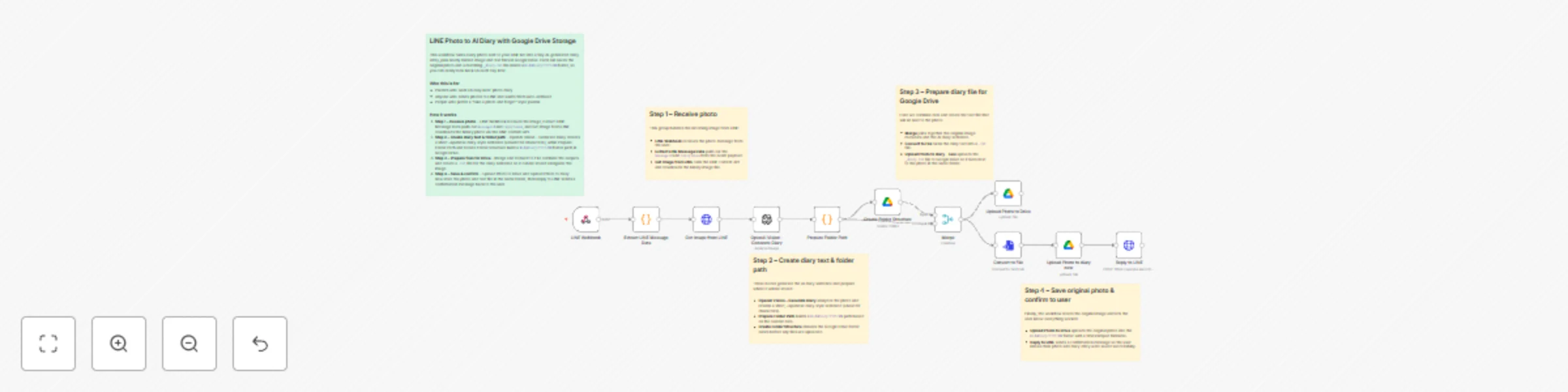
Workflow preview
100%
Create AI diary entries from LINE photos with OpenAI Vision and Google Drive preview
Open on n8n.io

Important notice

This workflow is provided as-is. Please review and test before using in production.

1. Workflow Overview

Overview This workflow turns photos sent to a LINE bot into tiny AI generated diary entries and saves everything neatly in Google Drive. Each time a user sends an image, the workflow creates a time...

Best for

  • Personal Productivity automation workflows
  • Multimodal AI automation workflows
  • advanced n8n builders looking for reusable templates

Tools used

n8n-nodes-base.webhook, n8n-nodes-base.code, n8n-nodes-base.httprequest, @n8n/n8n-nodes-langchain.openai, n8n-nodes-base.googledrive, n8n-nodes-base.merge, n8n-nodes-base.converttofile, n8n-nodes-base.stickynote

Source and attribution

This workflow is cataloged by N8N Workflows and links back to its original n8n.io source page by SOLOVIEVA ANNA.

Original n8n.io source

1.1 Workflow description

Title
Create AI diary entries from LINE photos with OpenAI Vision and Google Drive
Workflow name
Create AI diary entries from LINE photos with OpenAI Vision and Google Drive

Overview

This workflow turns photos sent to a LINE bot into tiny AI-generated diary entries and saves everything neatly in Google Drive. Each time a user sends an image, the workflow creates a timestamped photo file and a matching text file with a short diary sentence, stored inside a year/month folder structure (KidsDiary/YYYY/MM). It’s a simple way to keep a lightweight visual diary for kids or daily life without manual typing.

LINE Photo to AI Diary with Goo…

Who this is for

Parents who want to archive kids’ photos with a short daily comment

People who often send photos to LINE and want them auto-organized in Drive

Anyone who prefers a low-friction, “take a photo and forget” style diary

How it works

Trigger: A LINE Webhook receives an image message from the user.

Extract metadata: The workflow extracts the messageId and replyToken.

Download image: It calls the LINE content API to fetch the image as binary.

AI diary text: OpenAI Vision generates a one-sentence, diary-style caption (about 50 Japanese characters).

Folder structure: A KidsDiary/YYYY/MM folder is created (or reused) in Google Drive.

Save files: The photo is saved as YYYY-MM-DD_HHmmss.jpg and the diary text as YYYY-MM-DD_HHmmss_diary.txt in the same folder.

Confirm on LINE: The bot replies to the user that the photo and diary have been saved.

How to set up

Connect your LINE Messaging API credentials in the HTTP Request nodes.

Connect your Google Drive credential in the Google Drive nodes and choose a root folder.

Make sure the webhook URL is correctly registered in the LINE Developers console.

Customization ideas

Change the AI prompt to adjust tone (e.g., more playful, more sentimental).

Localize the diary language or add an English translation.

Add a second branch to post the saved diary entry to Slack, Notion, or email.

Organize Google Drive folders by child’s name instead of only by date.

1.2 Logical Blocks

This catalog entry is organized from the workflow JSON. The node-level section below shows the executable blocks available for review before importing the template.

2. Block-by-Block Analysis

Block 1 - LINE Webhook

Type / Role
n8n-nodes-base.webhook - webhook
Config choices
Version 2.1

Block 2 - Extract LINE Message Data

Type / Role
n8n-nodes-base.code - code
Config choices
Version 2

Block 3 - Get Image from LINE

Type / Role
n8n-nodes-base.httpRequest - httpRequest
Config choices
Version 4.2

Block 4 - OpenAI Vision - Generate Diary

Type / Role
@n8n/n8n-nodes-langchain.openAi - openAi
Config choices
Version 1.8

Block 5 - Prepare Folder Path

Type / Role
n8n-nodes-base.code - code
Config choices
Version 2

Block 6 - Create Folder Structure

Type / Role
n8n-nodes-base.googleDrive - googleDrive
Config choices
Version 3

Block 7 - Upload Photo to Drive

Type / Role
n8n-nodes-base.googleDrive - googleDrive
Config choices
Version 3

Block 8 - Reply to LINE

Type / Role
n8n-nodes-base.httpRequest - httpRequest
Config choices
Version 4.2

Block 9 - Merge

Type / Role
n8n-nodes-base.merge - merge
Config choices
Version 3.2

Block 10 - Convert to File

Type / Role
n8n-nodes-base.convertToFile - convertToFile
Config choices
Version 1.1

Block 11 - Upload Photo to diary new

Type / Role
n8n-nodes-base.googleDrive - googleDrive
Config choices
Version 3

Block 12 - Sticky Note - Step 1

Type / Role
n8n-nodes-base.stickyNote - stickyNote
Config choices
Version 1

Block 13 - Sticky Note - Step 2

Type / Role
n8n-nodes-base.stickyNote - stickyNote
Config choices
Version 1

Block 14 - Sticky Note - Step 3

Type / Role
n8n-nodes-base.stickyNote - stickyNote
Config choices
Version 1

Block 15 - Sticky Note - Step 4

Type / Role
n8n-nodes-base.stickyNote - stickyNote
Config choices
Version 1

Block 16 - Sticky Note - Overview1

Type / Role
n8n-nodes-base.stickyNote - stickyNote
Config choices
Version 1

3. Summary Table

Workflow Create AI diary entries from LINE photos with OpenAI Vision and Google Drive
Complexity advanced
Nodes 16
Categories Personal Productivity, Multimodal AI
Author SOLOVIEVA ANNA
Published 03 Dec 2025

4. Reproducing the Workflow from Scratch

  1. 1. Download the workflow JSON

    Use the JSON export at /data/workflows/11445/11445.json as the source template for this automation.

  2. 2. Import the template into n8n

    Open n8n, import the downloaded JSON, and review each node before activating the workflow.

  3. 3. Configure credentials and variables

    Replace placeholder credentials, API keys, webhook URLs, account IDs, and environment-specific values with your own settings.

  4. 4. Test with sample data

    Run the workflow manually or in a staging workspace, inspect node output, and confirm downstream systems receive the expected data.

  5. 5. Activate and monitor

    Enable the workflow only after testing, then monitor executions, errors, and rate limits during the first production runs.

5. General Notes & Resources

Review imported nodes carefully before activation. This catalog entry is intended to help you inspect the workflow structure, understand required services, and find related templates faster.

Node names, credentials, schedules, webhook paths, and external service limits may need adjustment for your workspace.

Frequently asked questions

What does Create AI diary entries from LINE photos with OpenAI Vision and Google Drive do?

Overview This workflow turns photos sent to a LINE bot into tiny AI generated diary entries and saves everything neatly in Google Drive. Each time a user sends an image, the workflow creates a time...

What do I need before importing this workflow?

Review the workflow JSON, configure any required credentials in n8n, and test the automation in a safe workspace before using it in production.

Can I customize this workflow?

Yes. Use the block-by-block analysis and the downloadable JSON to inspect each node, then adjust credentials, prompts, schedules, filters, or destinations for your Personal Productivity, Multimodal AI use case.



