Convert markdown content to Google Docs document with automatic formatting
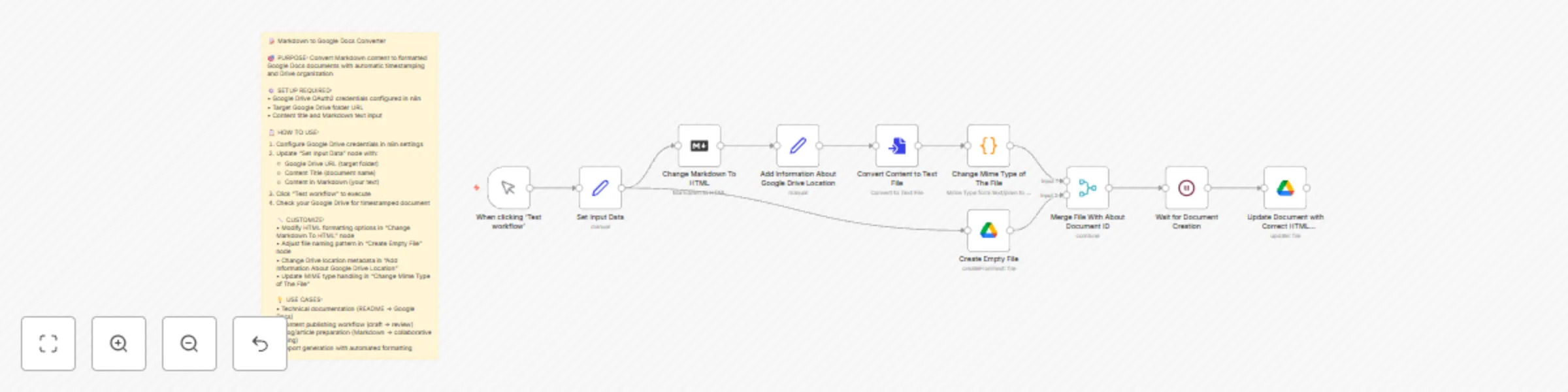
Workflow preview


 Early Deal
DISCOUNT 20%

Important notice
This workflow is provided as-is. Please review and test before using in production.
Overview
This workflow is perfect for technical writers, content creators, marketers, and developers who write in Markdown but need to collaborate or publish using Google Docs format. Ideal for teams that want to streamline their content creation and review process.
What problem does this workflow solve?
Manual conversion from Markdown to Google Docs is time-consuming and often loses formatting. This workflow eliminates the tedious copy-paste process, automatically preserves formatting, and creates organized, timestamped documents in your Google Drive. Perfect for content teams who write in Markdown but need Google Docs for collaboration and review.
What this workflow does
- Converts Markdown to HTML with proper formatting preservation (headers, lists, links, tables)
- Creates timestamped Google Docs documents with automatic naming
- Adds Drive location metadata for better organization and reference
- Maintains document structure including emojis, tables, and text formatting
- Automates file creation in specified Google Drive folders
Setup
- Google Drive OAuth2 credentials configured in n8n
- Target Google Drive folder URL
- Input your content title and Markdown text in the "Set Input Data" node
How to customize this workflow to your needs
- Modify HTML formatting options in the Markdown conversion node
- Change file naming patterns to match your organization system
- Adjust Drive folder structure and metadata inclusion
- Update MIME type handling for different output requirements
- Add additional processing steps like notifications or integrations
Perfect for technical documentation workflows, content publishing pipelines, blog preparation, and automated report generation.
Setup Instructions - Markdown to Google Docs Converter
Prerequisites
- n8n instance (local or cloud)
- Google account with Google Drive access
- Basic understanding of n8n workflow configuration
Step 1: Import the Workflow
- Open n8n and navigate to
Workflows - Click "Add workflow" → "Import from JSON"
- Upload the
Export_Markdown_Content_do_Google_Docs_Document.jsonfile - Save the workflow with a descriptive name
Step 2: Configure Google Drive Credentials
Create Google Drive OAuth2 Credentials
- In n8n, go to
Settings→Credentials - Click "Add credential" → "Google Drive OAuth2 API"
- Follow the OAuth setup to authorize n8n access to Google Drive:
- Visit Google Cloud Console
- Create or select a project
- Enable Google Drive API
- Create OAuth2 credentials
- Add authorized redirect URI for your n8n instance
- Name the credential (e.g., "Google Drive - Markdown Converter")
Configure Google Drive Nodes
Update these nodes with your Google Drive credentials:
Create Empty FileUpdate Document with Correct HTML Formatting
In each node:
- Select your Google Drive credential from the dropdown
- Test the connection to ensure it works properly
Step 3: Prepare Your Google Drive
Create Target Folder
- Go to Google Drive (drive.google.com)
- Create a new folder for your converted documents
- Copy the folder URL (will look like:
https://drive.google.com/drive/folders/FOLDER_ID) - Ensure the folder has proper permissions for your Google account
Step 4: Configure Input Data
Set Your Default Values
Open the "Set Input Data" node
Update the assignments with your preferences:
Google Drive URL:
- Replace the example URL with your target folder URL
- Format:
https://drive.google.com/drive/folders/YOUR_FOLDER_ID
Content Title:
- Set a default title or leave placeholder text
- This will be used in the document filename
Content in Markdown:
- Add your Markdown content or keep example for testing
- Supports standard Markdown syntax (headers, lists, links, tables)
Step 5: Test the Workflow
Initial Test Run
- Ensure all credentials are configured
- Click the "Test workflow" button on the Manual Trigger node
- Monitor the execution - check for any errors in node outputs
- Verify the result:
- Check your Google Drive folder
- Look for a new document with timestamp in the name
- Open the document to verify formatting
Troubleshooting Common Issues
Google Drive Permission Errors:
- Verify OAuth2 credentials are properly configured
- Check that the target folder exists and is accessible
- Ensure Google Drive API is enabled in Google Cloud Console
Markdown Conversion Issues:
- Check that your Markdown syntax is valid
- Test with simple content first (headers, paragraphs, lists)
- Verify the "Change Markdown To HTML" node settings
File Creation Problems:
- Confirm the Google Drive folder URL format is correct
- Check that the folder ID in the URL is valid
- Ensure your Google account has write permissions to the folder
Step 6: Customize for Your Needs
Modify HTML Formatting Options
In the "Change Markdown To HTML" node:
- Enable/disable emoji support (currently enabled)
- Adjust table formatting (currently enabled)
- Modify header ID generation (currently disabled)
- Configure space requirements for headers
Update File Naming Pattern
In the "Create Empty File" node:
- Change the naming convention: Currently uses
_PUB {Content Title} {timestamp} - Modify timestamp format: Currently
yyyy-MM-dd HH:mm:ss - Add prefixes or suffixes as needed for your organization
Step 7: Production Usage
Regular Workflow Execution
- Update the "Set Input Data" node with new content
- Execute the workflow manually or set up triggers
- Monitor execution logs for any issues
- Check Google Drive for generated documents
Integration Options
Webhook Integration:
- Add a Webhook trigger to accept external Markdown content
- Useful for automated content publishing workflows
Email Integration:
- Add email notifications when documents are created
- Include links to generated Google Docs
Advanced Configuration
Error Handling
- Add error handling nodes after critical operations
- Implement retry logic for API failures
- Set up notifications for failed executions
Performance Optimization
- Adjust the "Wait for Document Creation" timing if needed
- Consider file size limits for Google Docs
Support and Troubleshooting
Common Solutions
- Timeout errors: Increase wait time in "Wait for Document Creation"
- Authentication failures: Refresh Google OAuth2 credentials
- Formatting issues: Test with simpler Markdown first
Getting Help
- Check n8n community forums for Google Drive integration issues
- Review Google Drive API documentation for rate limits
- Test with minimal Markdown content to isolate problems
Total setup time: ~15-20 minutes
Difficulty level: Intermediate
Requirements: Google account, n8n instance, basic OAuth2 setup knowledge