Clean and log IoT sensor data to InfluxDB (Webhook | Function | HTTP)
Workflow preview

$20/month : Unlimited workflows
2500 executions/month

THE #1 IN WEB SCRAPING
Scrape any website without limits
HOSTINGER  Early Deal
DISCOUNT 20% Try free
Early DealDISCOUNT 20%
Self-hosted n8n
Unlimited workflows - from $4.99/mo

#1 hub for scraping, AI & automation
6000+ actors - $5 credits/mo
Important notice
This workflow is provided as-is. Please review and test before using in production.
Overview
🌡 IoT Sensor Data Cleaner + InfluxDB Logger (n8n | Webhook | Function | InfluxDB)
This workflow accepts raw sensor data from IoT devices via webhook, applies basic cleaning and transformation logic, and writes the cleaned data to an InfluxDB instance for time-series tracking. Perfect for renewable energy sites, smart farms and environmental monitoring setups using dashboards like Grafana or Chronograf.
⚡ Quick Implementation Steps
- Import the workflow JSON into your n8n instance.
- Edit the Set Config node to include your InfluxDB credentials and measurement name.
- Use the webhook URL (
/webhook/sensor-data) in your IoT device or form to send sensor data. - Start monitoring your data directly in InfluxDB!
🎯 Who’s It For
- IoT developers and integrators.
- Renewable energy and environmental monitoring teams.
- Data engineers working with time-series data.
- Smart agriculture and utility automation platforms.
🛠 Requirements
| Tool | Purpose |
|---|---|
| n8n Instance | For automation |
| InfluxDB (v1 or v2) | To store time-series sensor data |
| IoT Device or Platform | To POST sensor data |
| Function Node | To filter and transform data |
🧠 What It Does
- Accepts JSON-formatted sensor data via HTTP POST.
- Validates the data (removes invalid or noisy readings).
- Applies transformation (rounding, timestamp formatting).
- Pushes the cleaned data to InfluxDB for real-time visualization.
🧩 Workflow Components
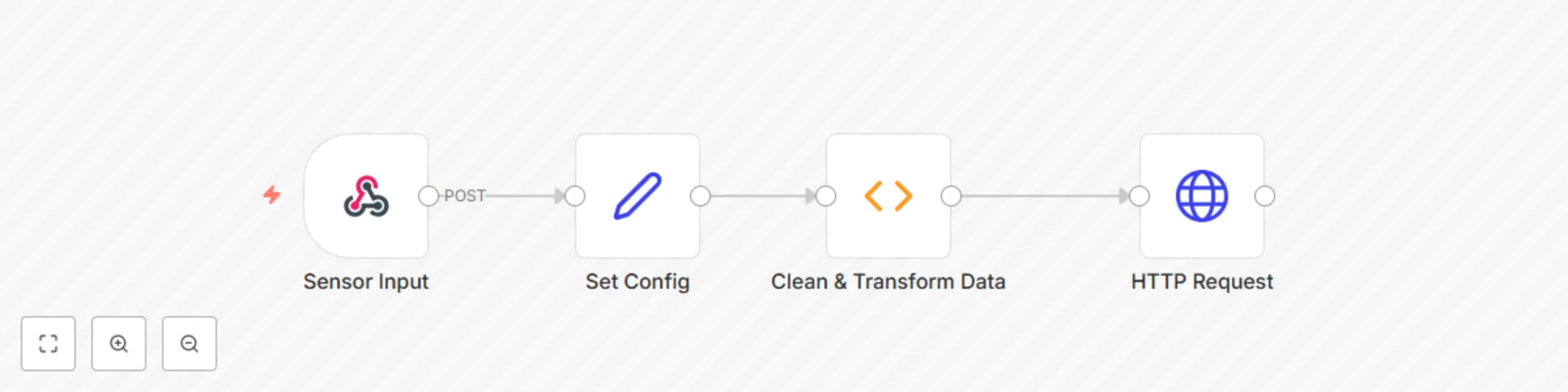
- Webhook Node: Exposes an HTTP endpoint to receive sensor data.
- Function Node: Filters out-of-range values, formats timestamp, rounds data.
- Set Node: Stores configurable values like InfluxDB host, user/pass, and measurement name.
- InfluxDB Node: Writes valid records into the specified database bucket.
🔧 How To Set Up – Step-by-Step
Import Workflow:
- Upload the provided
.jsonfile into your n8n workspace.
- Upload the provided
Edit Configuration Node:
- Update InfluxDB connection info in the
Set Confignode:influxDbHost,influxDbDatabase,influxDbUsername,influxDbPasswordmeasurement: What you want to name the data set (e.g.,sensor_readings)
- Update InfluxDB connection info in the
Send Data to Webhook:
- Webhook URL:
https://your-n8n/webhook/sensor-data - Example payload:
{
  "temperature": 78.3,
  "humidity": 44.2,
  "voltage": 395.7,
  "timestamp": "2024-06-01T12:00:00Z"
}
- Webhook URL:
View in InfluxDB:
- Log in to your InfluxDB/Grafana dashboard and query the new measurement.
✨ How To Customize
| Customization | Method |
|---|---|
| Add more fields (e.g., wind_speed) | Update the Function & InfluxDB nodes |
| Add field/unit conversion | Use math in the Function node |
| Send email alerts on anomalies | Add IF → Email branch after Function node |
| Store in parallel in Google Sheets | Add Google Sheets node for hybrid logging |
➕ Add‑ons (Advanced)
| Add-on | Description |
|---|---|
| 📊 Grafana Integration | Real-time charts using InfluxDB |
| 📧 Email on Faulty Data | Notify if voltage < 0 or temperature too high |
| 🧠 AI Filtering | Add OpenAI or TensorFlow for anomaly detection |
| 🗃 Dual Logging | Save data to both InfluxDB and BigQuery/Sheets |
📈 Use Case Examples
- Remote solar inverter sends temperature and voltage via webhook.
- Environmental sensor hub logs humidity and air quality data every minute.
- Smart greenhouse logs climate control sensor metrics.
- Edge IoT devices periodically report health and diagnostics remotely.
🧯 Troubleshooting Guide
| Issue | Cause | Solution |
|---|---|---|
| No data logged in InfluxDB | Invalid credentials or DB name | Recheck InfluxDB values in config |
| Webhook not triggered | Wrong method or endpoint | Confirm it is a POST to /webhook/sensor-data |
| Data gets filtered | Readings outside valid range | Check logic in Function node |
| Data not appearing in dashboard | Influx write format error | Inspect InfluxDB log and field names |
📞 Need Assistance?
Need help integrating this workflow into your energy monitoring system or need InfluxDB dashboards built for you?
👉 Contact WeblineIndia | Experts in workflow automation and time-series analytics.