
Build a LinkedIn job intelligence pipeline with Apify and Google Sheets

Workflow preview
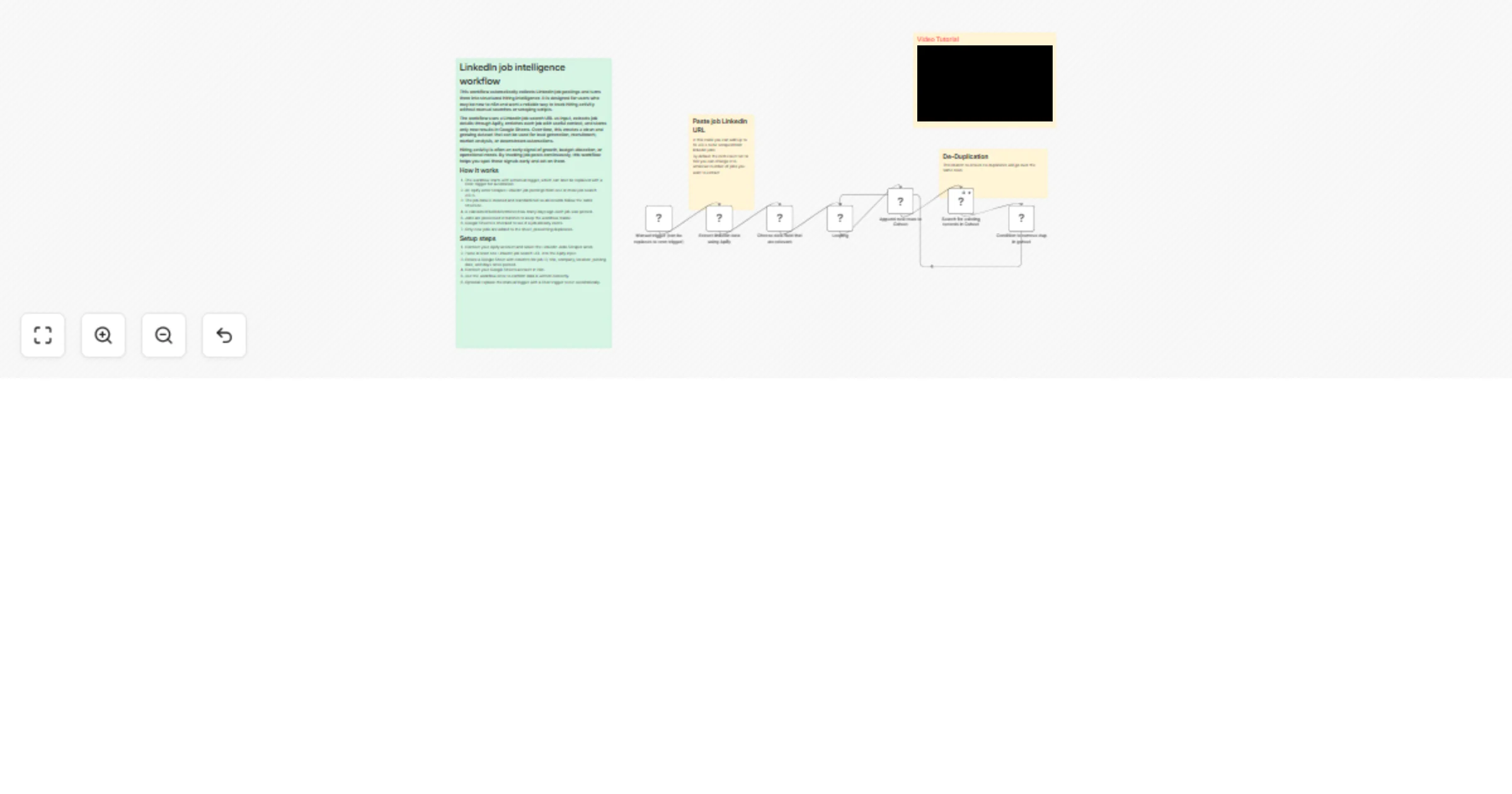
Workflow preview
100%
Build a LinkedIn job intelligence pipeline with Apify and Google Sheets preview
Open on n8n.io

1. Workflow Overview

Categories Lead Generation, Market Intelligence, Recruitment Automation, Business Intelligence LinkedIn Job Intelligence Automation (n8n + Apify) This workflow creates a fully automated LinkedIn jo...

Best for

  • Market Research automation workflows
  • intermediate n8n builders looking for reusable templates

Tools used

n8n-nodes-base.stickynote, n8n-nodes-base.manualtrigger, @apify/n8n-nodes-apify.apify, n8n-nodes-base.splitinbatches, n8n-nodes-base.googlesheets, n8n-nodes-base.if, n8n-nodes-base.set

Source and attribution

This workflow is cataloged by N8N Workflows and links back to its original n8n.io source page by Ahmed Salama.

Original n8n.io source

1.1 Workflow description

Title
Build a LinkedIn job intelligence pipeline with Apify and Google Sheets
Workflow name
Build a LinkedIn job intelligence pipeline with Apify and Google Sheets

Categories

Lead Generation, Market Intelligence, Recruitment Automation, Business Intelligence


LinkedIn Job Intelligence Automation (n8n + Apify)

This workflow creates a fully automated LinkedIn job intelligence system that continuously scrapes job postings, enriches them with time-based insights, removes duplicates, and stores them in a structured Google Sheet for analysis, outreach, or decision-making.

Built for founders, recruiters, sales teams, and consultants who want real-time hiring signals instead of static lead databases, this workflow turns job postings into actionable business intelligence.


Benefits

  • Real-Time Hiring Signals Detect company growth, hiring urgency, and budget intent before announcements.

  • Automated Lead Discovery Identify companies actively hiring relevant roles, indicating readiness to buy services or tools.

  • Zero Manual Work Fully automated scraping, enrichment, and storage.

  • De-duplicated Data Prevents repeated job entries using job ID matching logic.

  • Time-Based Insight Automatically calculates how many days ago a job was posted.

  • Flexible Output Stored in Google Sheets for BI tools, CRMs, AI agents, or manual review.


How It Works

LinkedIn Job Scraping (Apify Actor)

  • Uses Apify LinkedIn Jobs Scraper actor
  • Accepts up to 10 LinkedIn job search URLs
  • Extracts up to 100 jobs per run (configurable)
  • Pulls structured data including:
  • Job ID
  • Job title
  • Company name
  • Location
  • Posting date
  • Job URL

Data Enrichment & Transformation

  • Standardizes all job fields using a Set node
  • Computes “How many days since posted” using runtime date comparison
  • Prepares clean, analysis-ready records

Batch Processing Control

  • Uses Split In Batches to:
  • Avoid API throttling
  • Maintain stable execution
  • Scale safely for larger job volumes

De-Duplication Logic

  • Checks Google Sheets for existing job IDs
  • Only inserts new jobs
  • Ensures clean historical datasets with no duplicates

Persistent Storage (Google Sheets)

  • Appends validated job records to a centralized sheet
  • Acts as:
  • Lead database
  • Market intelligence log
  • BI or AI agent data source

Required Setup Configuration

Apify Integration

  • Connect Apify OAuth credentials
  • Use the LinkedIn Jobs Scraper actor
  • Customize:
  • Keywords
  • Location
  • Job count
  • Company scraping toggle

Google Sheets Integration

  • Create a target Google Sheet
  • Columns required:
  • Job ID
  • Job URL
  • Title
  • Company Name
  • Location
  • Posted Date
  • Days Since Posted
  • Enable OAuth access for n8n

n8n Configuration

  • Manual trigger (can be replaced with Cron for automation)
  • Batch size control for scaling
  • Error-safe execution with continuation enabled

Business Use Cases

Sales & Lead Generation Teams

  • Target companies actively hiring roles related to your offer
  • Prioritize outreach based on hiring urgency

Founders & CEOs

  • Monitor competitor hiring velocity
  • Identify market expansion signals early

Recruiters & Staffing Agencies

  • Build live job pipelines without manual LinkedIn searches
  • Reduce sourcing time dramatically

Consultants & Agencies

  • Detect companies entering problem-aware or scaling phases
  • Align service offers with real hiring pain points

Market & VC Analysts

  • Use hiring data as a leading indicator for growth or decline

Revenue Potential

This workflow enables multiple monetization paths:

  • Lead Intelligence as a Service Sell curated hiring signals to sales teams or agencies

  • Recruitment Automation Reduce recruiter sourcing costs by 70–90%

  • Consulting Insights Bundle hiring data into strategy or growth audits

  • Outbound Acceleration Increase reply rates by targeting active hiring companies


Difficulty Level

Beginner to Intermediate


Estimated Build Time

30–45 minutes


Monthly Operating Cost

  • Apify usage (based on volume)
  • Google Sheets: Free
  • n8n: Self-hosted or cloud plan

Typical range: $10–25/month


Why This Workflow Works

  • Hiring data reflects real budget allocation
  • Job posts act as pre-revenue intent signals
  • Time-based metrics enable prioritization
  • De-duplication ensures long-term data quality
  • Simple storage makes it easy to extend with:
  • CRMs
  • AI agents
  • BI dashboards
  • Email or LinkedIn outreach automations

Advanced Extensions

  • Auto-enrich companies with LinkedIn company data
  • Push qualified jobs into CRM as leads
  • Trigger outbound emails based on posting age
  • Add AI classification for role relevance
  • Connect to Slack or email alerts for new jobs

1.2 Logical Blocks

This catalog entry is organized from the workflow JSON. The node-level section below shows the executable blocks available for review before importing the template.

2. Block-by-Block Analysis

Block 1 - Sticky Note

Type / Role
n8n-nodes-base.stickyNote - stickyNote
Config choices
Version 1

Block 2 - Sticky Note1

Type / Role
n8n-nodes-base.stickyNote - stickyNote
Config choices
Version 1

Block 3 - Sticky Note2

Type / Role
n8n-nodes-base.stickyNote - stickyNote
Config choices
Version 1

Block 4 - Manual trigger (can be replaces to cron trigger)

Type / Role
n8n-nodes-base.manualTrigger - manualTrigger
Config choices
Version 1

Block 5 - Extract linkedin data using Apify

Type / Role
@apify/n8n-nodes-apify.apify - apify
Config choices
Version 1

Block 6 - Looping

Type / Role
n8n-nodes-base.splitInBatches - splitInBatches
Config choices
Version 3

Block 7 - Append new rows to Gsheet

Type / Role
n8n-nodes-base.googleSheets - googleSheets
Config choices
Version 4.7

Block 8 - Search for existing records in Gsheet

Type / Role
n8n-nodes-base.googleSheets - googleSheets
Config choices
Version 4.7

Block 9 - Condition to remove dup in gsheet

Type / Role
n8n-nodes-base.if - if
Config choices
Version 2.3

Block 10 - Choose data field that are relevant

Type / Role
n8n-nodes-base.set - set
Config choices
Version 3.4

Block 11 - Sticky Note3

Type / Role
n8n-nodes-base.stickyNote - stickyNote
Config choices
Version 1

3. Summary Table

Workflow Build a LinkedIn job intelligence pipeline with Apify and Google Sheets
Complexity intermediate
Nodes 11
Categories Market Research
Author Ahmed Salama
Published 20 Jan 2026

4. Reproducing the Workflow from Scratch

  1. 1. Download the workflow JSON

    Use the JSON export at /data/workflows/12838/12838.json as the source template for this automation.

  2. 2. Import the template into n8n

    Open n8n, import the downloaded JSON, and review each node before activating the workflow.

  3. 3. Configure credentials and variables

    Replace placeholder credentials, API keys, webhook URLs, account IDs, and environment-specific values with your own settings.

  4. 4. Test with sample data

    Run the workflow manually or in a staging workspace, inspect node output, and confirm downstream systems receive the expected data.

  5. 5. Activate and monitor

    Enable the workflow only after testing, then monitor executions, errors, and rate limits during the first production runs.

5. General Notes & Resources

Review imported nodes carefully before activation. This catalog entry is intended to help you inspect the workflow structure, understand required services, and find related templates faster.

Node names, credentials, schedules, webhook paths, and external service limits may need adjustment for your workspace.

Frequently asked questions

What does Build a LinkedIn job intelligence pipeline with Apify and Google Sheets do?

Categories Lead Generation, Market Intelligence, Recruitment Automation, Business Intelligence LinkedIn Job Intelligence Automation (n8n + Apify) This workflow creates a fully automated LinkedIn jo...

What do I need before importing this workflow?

Review the workflow JSON, configure any required credentials in n8n, and test the automation in a safe workspace before using it in production.

Can I customize this workflow?

Yes. Use the block-by-block analysis and the downloadable JSON to inspect each node, then adjust credentials, prompts, schedules, filters, or destinations for your Market Research use case.



