Batch scrape website URLs from Google Sheets to Google Docs with Firecrawl
Workflow preview


 Early Deal
DISCOUNT 20%

Important notice
This workflow is provided as-is. Please review and test before using in production.
Overview
This workflow contains community nodes that are only compatible with the self-hosted version of n8n.
Firecrawl batch scraping to Google Docs
Who's it for
AI chatbot developers, content managers, and data analysts who need to extract and organize content from multiple web pages for knowledge base creation, competitive analysis, or content migration projects.
What it does
This workflow automatically scrapes content from a list of URLs and converts each page into a structured Google Doc in markdown format. It's designed for batch processing multiple pages efficiently, making it ideal for building AI knowledge bases, analyzing competitor content, or migrating website content to documentation systems.
How it works
The workflow follows a systematic scraping process:
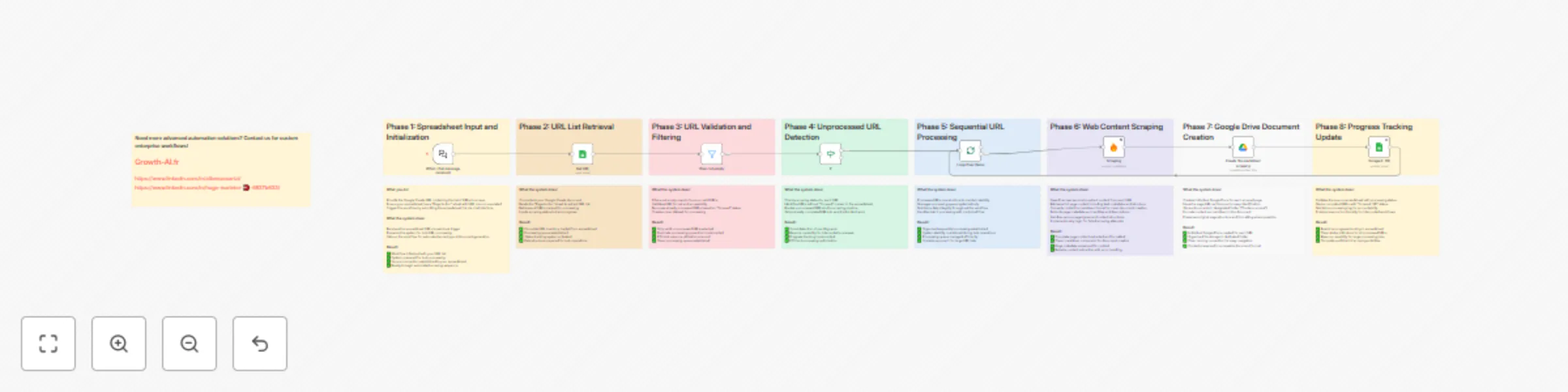
URL Input: Reads a list of URLs from a Google Sheets template Data Validation: Filters out empty rows and already-processed URLs Batch Processing: Loops through each URL sequentially Content Extraction: Uses Firecrawl to scrape and convert content to markdown Document Creation: Creates individual Google Docs for each scraped page Progress Tracking: Updates the spreadsheet to mark completed URLs Final Notification: Provides completion summary with access to scraped content
Requirements
Firecrawl API key (for web scraping) Google Sheets access Google Drive access (for document creation) Google Sheets template (provided)
How to set up
Step 1: Prepare your template
Copy the Google Sheets template Create your own version for personal use Ensure the sheet has a tab named "Page to doc" List all URLs you want to scrape in the "URL" column
Step 2: Configure API credentials
Set up the following credentials in n8n:
Firecrawl API: For web content scraping and markdown conversion Google Sheets OAuth2: For reading URLs and updating progress Google Drive OAuth2: For creating content documents
Step 3: Set up your Google Drive folder
The workflow saves scraped content to a specific Drive folder Default folder: "Contenu scrapé" (Content Scraped) Folder ID: 1ry3xvQ9UqM2Rf9C4-AoJdg1lfB9inh_5 (customize this to your own folder) Create your own folder and update the folder ID in the "Create file markdown scraping" node
Step 4: Choose your trigger method
Option A: Chat interface
Use the default chat trigger Send your Google Sheets URL through the chat interface
Option B: Manual trigger
Replace chat trigger with manual trigger Set the Google Sheets URL as a variable in the "Get URL" node
How to customize the workflow
URL source customization
Sheet name: Change "Page to doc" to your preferred tab name Column structure: Modify field mappings if using different column names URL validation: Adjust filtering criteria for URL format requirements Batch size: The workflow processes all URLs sequentially (no batch size limit)
Scraping configuration
Firecrawl options: Add specific scraping parameters (wait times, JavaScript rendering) Content format: Currently outputs markdown (can be modified for other formats) Error handling: The workflow continues processing even if individual URLs fail Retry logic: Add retry mechanisms for failed scraping attempts
Output customization
Document naming: Currently uses the URL as document name (customizable) Folder organization: Create subfolders for different content types File format: Switch from Google Docs to other formats (PDF, TXT, etc.) Content structure: Add headers, metadata, or formatting to scraped content
Progress tracking enhancements
Status columns: Add more detailed status tracking (failed, retrying, etc.) Metadata capture: Store scraping timestamps, content length, etc. Error logging: Track which URLs failed and why Completion statistics: Generate summary reports of scraping results
Use cases
AI knowledge base creation
E-commerce product pages: Scrape product descriptions and specifications for chatbot training Documentation sites: Convert help articles into structured knowledge base content FAQ pages: Extract customer service information for automated support systems Company information: Gather about pages, services, and team information
Content analysis and migration
Competitor research: Analyze competitor website content and structure Content audits: Extract existing content for analysis and optimization Website migrations: Backup content before site redesigns or platform changes SEO analysis: Gather content for keyword and structure analysis
Research and documentation
Market research: Collect information from multiple industry sources Academic research: Gather content from relevant web sources Legal compliance: Document website terms, policies, and disclaimers Brand monitoring: Track content changes across multiple sites
Workflow features
Smart processing logic
Duplicate prevention: Skips URLs already marked as "Scrapé" (scraped) Empty row filtering: Automatically ignores rows without URLs Sequential processing: Handles one URL at a time to avoid rate limiting Progress updates: Real-time status updates in the source spreadsheet
Error handling and resilience
Graceful failures: Continues processing remaining URLs if individual scrapes fail Status tracking: Clear indication of completed vs. pending URLs Completion notification: Summary message with link to scraped content folder Manual restart capability: Can resume processing from where it left off
Results interpretation
Organized content output
Each scraped page creates:
Individual Google Doc: Named with the source URL Markdown formatting: Clean, structured content extraction Metadata preservation: Original URL and scraping timestamp Organized storage: All documents in designated Google Drive folder
Progress tracking
The source spreadsheet shows:
URL list: Original URLs to be processed Status column: "OK" for completed, empty for pending Real-time updates: Progress visible during workflow execution Completion summary: Final notification with access instructions
Workflow limitations
Sequential processing: Processes URLs one at a time (prevents rate limiting but slower for large lists) Google Drive dependency: Requires Google Drive for document storage Firecrawl rate limits: Subject to Firecrawl API limitations and quotas Single format output: Currently outputs only Google Docs (easily customizable) Manual setup: Requires Google Sheets template preparation before use No content deduplication: Creates separate documents even for similar content