Back up self-hosted workflows to Google Drive daily with change detection
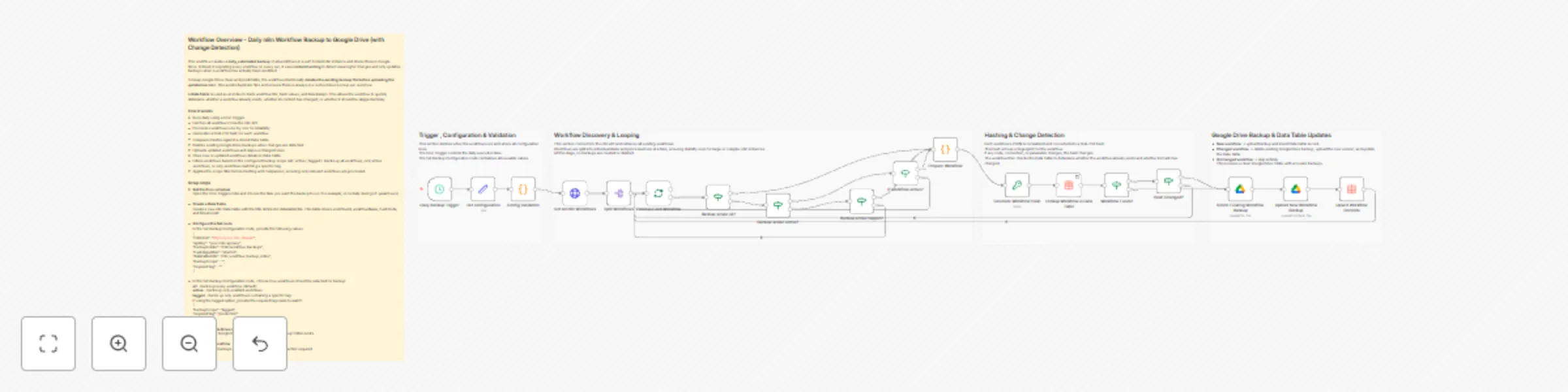
Workflow preview


 Early Deal
DISCOUNT 20%

Important notice
This workflow is provided as-is. Please review and test before using in production.
Overview
This workflow creates a daily, automated backup of all workflows in a self-hosted n8n instance and stores them in Google Drive. Instead of exporting every workflow on every run, it uses content hashing to detect meaningful changes and only updates backups when a workflow has actually been modified.
To keep Google Drive clean and predictable, the workflow intentionally deletes the existing backup file before uploading the updated version. This avoids duplicate files and ensures there is always one authoritative backup per workflow.
A Data Table is used as an index to track workflow IDs, hash values, and timestamps. This allows the workflow to quickly determine whether a workflow already exists, whether its content has changed, or whether it should be skipped entirely.
How it works
- Runs daily using a Cron Trigger.
- Fetches all workflows from the n8n API.
- Processes workflows one-by-one for reliability.
- Generates a SHA-256 hash for each workflow.
- Compares hashes against a stored Data Table.
- Deletes existing Google Drive backups when changes are detected.
- Uploads updated workflows and skips unchanged ones.
- Store new or updated workflows details in Data Table.
- Filters workflows based on the configured backup scope (all | active | tagged ). Backs up all workflows, only active workflows, or only workflows matching a specific tag.
- Applies the scope filter before hashing and comparison, ensuring only relevant workflows are processed.
Setup steps
Set the Cron schedule Open the Cron Trigger node and choose the time you want the backup to run (for example, once daily during off-peak hours).
Create a Data Table Create a new n8n Data Table with the title defined in dataTableTitle. This table stores workflowId, workflowName, hashCode, and DriveFiveId.
Configure the Set node In the Set Backup Configuration node, provide the following values: { "n8nHost": "https://your-n8n-domain", "apiKey": "your-n8n-api-key", "backupFolder": "/n8n/workflow-backups", "hashAlgorithm": "sha256", "dataTableTitle": "n8n_workflow_backup_index", "backupScope" : "",
"requiredTag" : "" }In the Set Backup Configuration node, choose how workflows should be selected for backup: all – backs up every workflow (default) active – backs up only enabled workflows tagged – backs up only workflows containing a specific tag If using the tagged option, provide the required tag name to match. { "backupScope": "tagged", "requiredTag": "production" }
Connect Google Drive credentials Authorize your Google Drive account and ensure the backup folder exists.
Activate the workflow Once enabled, backups run automatically with no further action required.