Automated weekly Google Calendar summary via email with AI ✨🗓️📧
Workflow preview


 Early Deal
DISCOUNT 20%

Important notice
This workflow is provided as-is. Please review and test before using in production.
Overview
Workflow: Automated Weekly Google Calendar Summary via Email with AI ✨🗓️📧
Get a personalized, AI-powered summary of your upcoming week's Google Calendar events delivered straight to your inbox! This workflow automates the entire process, from fetching events to generating an intelligent summary and emailing it to you.
🌟 Overview
This n8n workflow connects to your Google Calendar, retrieves events for the upcoming week (Monday to Sunday, based on the day the workflow runs), uses Google Gemini AI to create a well-structured and insightful summary, and then emails this summary to you. It's designed to help you start your week organized and aware of your commitments.
Key Features:
- Automated Weekly Summary: Runs on a schedule (default: weekly) to keep you updated.
- AI-Powered Insights: Leverages Google Gemini to not just list events, but to identify important ones and offer a brief weekly outlook.
- Personalized Content: Uses your specified timezone, locale, name, and city for accurate and relevant information.
- Clear Formatting: Events are grouped by day and displayed chronologically with start and end times. Important events are highlighted.
- Email Delivery: Receive your schedule directly in your inbox in a clean HTML format.
- Customizable: Easily adapt to your specific calendar, AI preferences, and email settings.
⚙️ How It Works: Step-by-Step
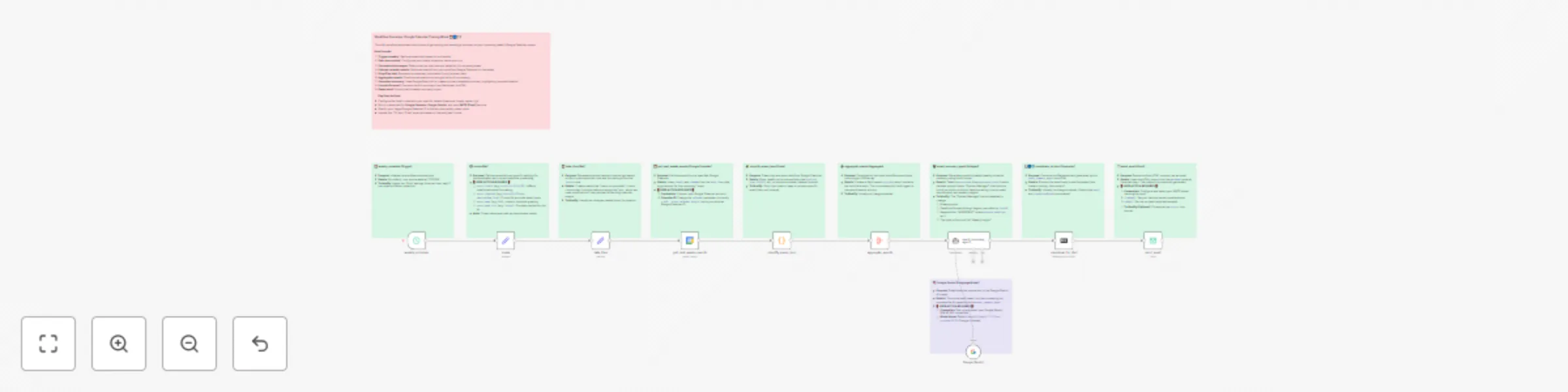
The workflow consists of the following nodes, working in sequence:
weekly_schedule(Schedule Trigger):- What it does: Initiates the workflow.
- Default: Triggers once a week at 12:00 PM. You can adjust this to your preference (e.g., Sunday evening or Monday morning).
locale(Set Node):- What it does: This is a crucial node for you to configure! It sets user-specific parameters like your preferred language/region (
users-locale), timezone (users-timezone), your name (users-name), and your home city (users-home-city). These are used throughout the workflow for correct date/time formatting and personalizing the AI prompt.
- What it does: This is a crucial node for you to configure! It sets user-specific parameters like your preferred language/region (
date-time(Set Node):- What it does: Dynamically generates various date and time strings based on the current execution time and the
localesettings. This is used to define the precise 7-day window (from the current day to 7 days ahead, ending at midnight) for fetching calendar events.
- What it does: Dynamically generates various date and time strings based on the current execution time and the
get_next_weeks_events(Google Calendar Node):- What it does: Connects to your specified Google Calendar and fetches all events within the 7-day window calculated by the
date-timenode. - Requires: Google Calendar API credentials and the ID of the calendar you want to use.
- What it does: Connects to your specified Google Calendar and fetches all events within the 7-day window calculated by the
simplify_evens_json(Code Node):- What it does: Runs a small JavaScript snippet to clean up the raw event data from Google Calendar. It removes several fields that aren't needed for the summary (like
htmlLink,etag,iCalUID), making the data more concise for the AI.
- What it does: Runs a small JavaScript snippet to clean up the raw event data from Google Calendar. It removes several fields that aren't needed for the summary (like
aggregate_events(Aggregate Node):- What it does: Takes all the individual (and now simplified) event items and groups them into a single JSON array called
eventdata. This is the format the AI agent expects for processing.
- What it does: Takes all the individual (and now simplified) event items and groups them into a single JSON array called
Google Gemini(LM Chat Google Gemini Node):- What it does: This node is the connection point to the Google Gemini language model.
- Requires: Google Gemini (or PaLM) API credentials.
event_summary_agent(Agent Node):- What it does: This is where the magic happens! It uses the
Google Geminimodel and a detailed system prompt to generate the weekly schedule summary. - The Prompt Instructs the AI to:
- Start with a friendly greeting.
- Group events by day (Monday to Sunday) for the upcoming week, using the user's timezone and locale.
- Format event times clearly (e.g.,
09:30 AM - 10:30 AM: Event Summary). - Identify and prefix "IMPORTANT:" to events with keywords like "urgent," "deadline," "meeting," etc., in their summary or description.
- Conclude with a 1-2 sentence helpful insight about the week's schedule.
- Process the input
eventdata(the JSON array of calendar events).
- What it does: This is where the magic happens! It uses the
Markdown(Markdown to HTML Node):- What it does: Converts the text output from the
event_summary_agent(which is generated in Markdown format for easy structure) into HTML. This ensures the email body is well-formatted with proper line breaks, lists, and emphasis.
- What it does: Converts the text output from the
send_email(Email Send Node):- What it does: Sends the final HTML summary to your specified email address.
- Requires: SMTP (email sending) credentials and your desired "From" and "To" email addresses.
🚀 Getting Started: Setup Instructions
Follow these steps to get the workflow up and running:
Import the Workflow:
- Download the workflow JSON file.
- In your n8n instance, go to "Workflows" and click the "Import from File" button. Select the downloaded JSON file.
Configure Credentials: You'll need to set up credentials for three services. In n8n, go to "Credentials" on the left sidebar and click "Add credential."
- Google Calendar API:
- Search for "Google Calendar" and create new credentials using OAuth2. Follow the authentication flow.
- Once created, select these credentials in the
get_next_weeks_eventsnode.
- Google Gemini (PaLM) API:
- Search for "Google Gemini" or "Google PaLM" and create new credentials. You'll typically need an API key from Google AI Studio or Google Cloud.
- Once created, select these credentials in the
Google Gemininode.
- SMTP / Email:
- Search for your email provider (e.g., "SMTP," "Gmail," "Outlook") and create credentials. This usually involves providing your email server details, username, and password/app password.
- Once created, select these credentials in the
send_emailnode.
- Google Calendar API:
‼️ IMPORTANT: Customize User Settings in the
localeNode:- Open the
localenode. - Update the following values in the "Assignments" section:
users-locale: Set your locale string (e.g.,"en-AU"for English/Australia,"en-US"for English/United States,"de-DE"for German/Germany). This affects how dates, times, and numbers are formatted.users-timezone: Set your timezone string (e.g.,"Australia/Sydney","America/New_York","Europe/London"). This is critical for ensuring event times are displayed correctly for your location.users-name: Enter your name (e.g.,"Bob"). This is used to personalize the email greeting.users-home-city: Enter your home city (e.g.,"Sydney"). This can be used for additional context by the AI.
- Open the
Configure the
get_next_weeks_events(Google Calendar) Node:- Open the node.
- In the "Calendar" parameter, you need to specify which calendar to fetch events from.
- The default might be a placeholder like
c_4d9c2d4e139327143ee4a5bc4db531ffe074e98d21d1c28662b4a4d4da898866@group.calendar.google.com. - Change this to your primary calendar (often your email address) or the specific Calendar ID you want to use. You can find Calendar IDs in your Google Calendar settings.
- The default might be a placeholder like
Configure the
send_emailNode:- Open the node.
- Set the
fromEmailparameter to the email address you want the summary to be sent from. - Set the
toEmailparameter to the email address(es) where you want to receive the summary. - You can also customize the
subjectline if desired.
(Optional) Customize the AI Prompt in
event_summary_agent:- If you want to change how the AI summarizes events (e.g., different keywords for important events, a different tone, or specific formatting tweaks), you can edit the "System Message" within the
event_summary_agentnode's parameters.
- If you want to change how the AI summarizes events (e.g., different keywords for important events, a different tone, or specific formatting tweaks), you can edit the "System Message" within the
(Optional) Adjust the Schedule in
weekly_schedule:- Open the
weekly_schedulenode. - Modify the "Rule" to change when and how often the workflow runs (e.g., a specific day of the week, a different time).
- Open the
Activate the Workflow:
- Once everything is configured, toggle the "Active" switch in the top right corner of the workflow editor to ON.
📬 What You Get
You'll receive an email (based on your schedule) with a subject like "Next Week Calendar Summary : [Start Date] - [End Date]". The email body will contain:
- A friendly greeting.
- Your schedule for the upcoming week (Monday to Sunday), with events listed chronologically under each day.
- Event times displayed in your local timezone (e.g.,
09:30 AM - 10:30 AM: Team Meeting). - Priority events clearly marked (e.g.,
IMPORTANT: 02:00 PM - 03:00 PM: Project Deadline Review). - A brief, insightful observation about your week's schedule.
🛠️ Troubleshooting & Notes
- Timezone is Key: Ensure your
users-timezonein thelocalenode is correct. This is the most common source of incorrect event times. - Google API Permissions: When setting up Google Calendar and Gemini credentials, make sure you grant the necessary permissions.
- AI Output Varies: The AI-generated summary can vary slightly each time. The prompt is designed to guide it, but LLMs have inherent creativity.
- Calendar Event Details: The quality of the summary (especially for identifying important events) depends on how detailed your calendar event titles and descriptions are. Including keywords like "meeting," "urgent," "prepare for," etc., in your events helps the AI.
💬 Feedback & Contributions
Feel free to modify and enhance this workflow! If you have suggestions, improvements, or run into issues, please share them in the n8n community.
Happy scheduling!