Automated rsync backup with password auth & alert system
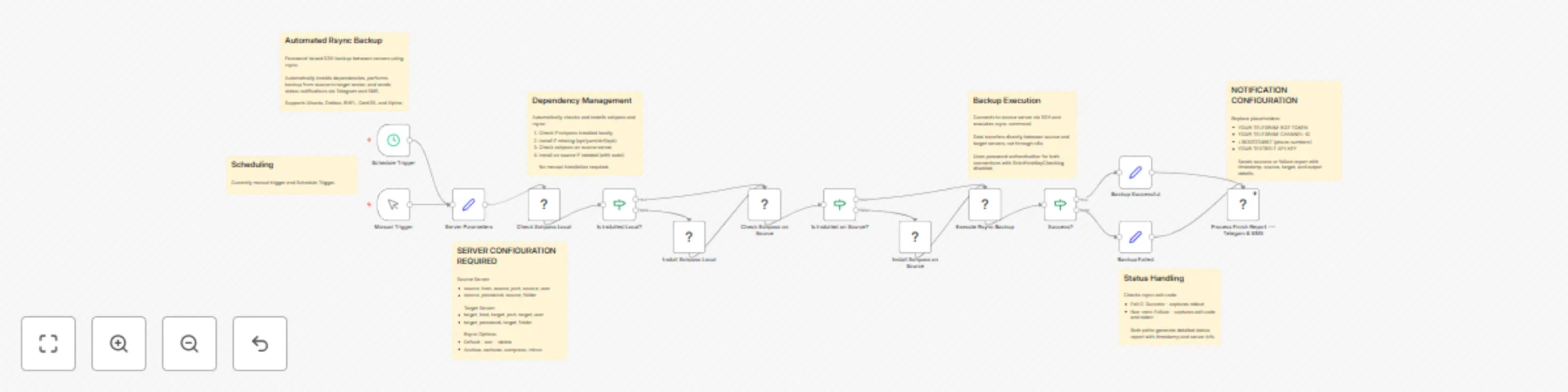
Workflow preview


 Early Deal
DISCOUNT 20%

Important notice
This workflow is provided as-is. Please review and test before using in production.
Overview
Automated Rsync Backup with Password Auth & Alert System
Overview
This n8n workflow provides automated rsync backup capabilities between servers using password authentication. It automatically installs required dependencies, performs the backup operation from a source server to a target server, and sends status notifications via Telegram and SMS.
Features
- Password-based SSH authentication (no key management required)
- Automatic dependency installation (sshpass, rsync)
- Cross-platform support (Ubuntu/Debian, RHEL/CentOS, Alpine)
- Source-to-target backup execution
- Multi-channel notifications (Telegram and SMS)
- Detailed success/failure reporting
- Manual trigger for on-demand backups
Setup Instructions
Prerequisites
- n8n Instance: Running n8n with Linux environment
- Server Access: SSH access to both source and target servers
- Telegram Bot: Created via @BotFather (optional)
- Textbelt API Key: For SMS notifications (optional)
- Network: Connectivity between n8n, source, and target servers
Server Requirements
Source Server:
- SSH access enabled
- User with sudo privileges (for package installation)
- Read access to source folder
Target Server:
- SSH access enabled
- Write access to target folder
- Sufficient storage space
Configuration Steps
1. Server Parameters Configuration
Open the Server Parameters node and configure:
Source Server Settings:
source_host: IP address or hostname of source serversource_port: SSH port (typically 22)source_user: Username for source serversource_password: Password for source usersource_folder: Full path to folder to backup (e.g.,/home/user/data)
Target Server Settings:
target_host: IP address or hostname of target servertarget_port: SSH port (typically 22)target_user: Username for target servertarget_password: Password for target usertarget_folder: Full path to destination folder (e.g.,/backup/data)
Rsync Options:
rsync_options: Default is-avz --delete-a: Archive mode (preserves permissions, timestamps, etc.)-v: Verbose output-z: Compression during transfer--delete: Remove files from target that don't exist in source
2. Notification Setup (Optional)
Telegram Configuration:
- Create bot via @BotFather on Telegram
- Get bot token (format:
1234567890:ABCdefGHIjklMNOpqrsTUVwxyz) - Create notification channel
- Add bot as administrator
- Get channel ID:
- Send test message to channel
- Visit:
https://api.telegram.org/bot<YOUR_BOT_TOKEN>/getUpdates - Find
"chat":{"id":-100XXXXXXXXXX}
SMS Configuration:
- Register at https://textbelt.com
- Purchase credits
- Obtain API key
Update Notification Node: Edit Process Finish Report --- Telegram & SMS node:
- Replace
YOUR-TELEGRAM-BOT-TOKENwith bot token - Replace
YOUR-TELEGRAM-CHANNEL-IDwith channel ID - Replace
+36301234567with target phone number(s) - Replace
YOUR-TEXTBELT-API-KEYwith Textbelt key
3. Security Considerations
Password Storage:
- Consider using n8n credentials for sensitive passwords
- Avoid hardcoding passwords in workflow
- Use environment variables where possible
SSH Security:
- Workflow uses
StrictHostKeyChecking=nofor automation - Consider adding known hosts manually for production
- Review firewall rules between servers
Testing
- Start with small test folder
- Verify network connectivity:
ping source_hostandping target_host - Test SSH access manually first
- Run workflow with test data
- Verify backup completion on target server
How to Use
Automatic Operation
Once activated, the workflow runs automatically:
- Frequency: Every days midnight
Manual Execution
- Open the workflow in n8n
- Click on Manual Trigger node
- Click "Execute Workflow"
- Monitor execution progress
Scheduled Execution
To automate backups:
- Replace Manual Trigger with Schedule Trigger node
- Configure schedule (e.g., daily at 2 AM)
- Save and activate workflow
Workflow Process
Step 1: Dependency Check
The workflow automatically:
- Checks if sshpass is installed locally
- Installs if missing (supports apt, yum, dnf, apk)
- Checks sshpass on source server
- Installs on source if needed (with sudo)
Step 2: Backup Execution
- Connects to source server via SSH
- Executes rsync command from source to target
- Uses password authentication for both connections
- Transfers data directly between servers (not through n8n)
Step 3: Status Reporting
Success Message Format:
[Timestamp] -- SUCCESS :: source_host:/path -> target_host:/path :: [rsync output]
Failure Message Format:
[Timestamp] -- ERROR :: source_host -> target_host :: [exit code] -- [error message]
Rsync Options Guide
Common Options:
-a: Archive mode (recommended)-v: Verbose output for monitoring-z: Compression (useful for slow networks)--delete: Mirror source (removes extra files from target)--exclude: Skip specific files/folders--dry-run: Test without actual transfer--progress: Show transfer progress--bwlimit: Limit bandwidth usage
Example Configurations:
# Basic backup
-avz

# Mirror with deletion
-avz --delete

# Exclude temporary files
-avz --exclude='*.tmp' --exclude='*.cache'

# Bandwidth limited (1MB/s)
-avz --bwlimit=1000

# Dry run test
-avzn --delete
Monitoring
Execution Logs
- Check n8n Executions tab
- Review stdout for rsync details
- Check stderr for error messages
Verification
After backup:
- SSH to target server
- Check folder size:
du -sh /target/folder - Verify file count:
find /target/folder -type f | wc -l - Compare with source:
ls -la /target/folder
Troubleshooting
Connection Issues
"Connection refused" error:
- Verify SSH port is correct
- Check firewall rules
- Ensure SSH service is running
"Permission denied" error:
- Verify username/password
- Check user has required permissions
- Ensure sudo works (for installation)
Installation Failures
"Unsupported package manager":
- Workflow supports: apt, yum, dnf, apk
- Manual installation may be required for others
"sudo: password required":
- User needs passwordless sudo or
- Modify installation commands
Rsync Errors
"rsync error: some files/attrs were not transferred":
- Usually permission issues
- Check file ownership
- Review excluded files
"No space left on device":
- Check target server storage
- Clean up old backups
- Consider compression options
Notification Issues
No Telegram message:
- Verify bot token and channel ID
- Check bot is admin in channel
- Test with curl command manually
SMS not received:
- Check Textbelt credit balance
- Verify phone number format
- Review API key validity
Best Practices
Backup Strategy
- Test First: Always test with small datasets
- Schedule Wisely: Run during low-traffic periods
- Monitor Space: Ensure adequate storage on target
- Verify Backups: Regularly test restore procedures
- Rotate Backups: Implement retention policies
Security
- Use Strong Passwords: Complex passwords for all accounts
- Limit Permissions: Use dedicated backup users
- Network Security: Consider VPN for internet transfers
- Audit Access: Log all backup operations
- Encrypt Sensitive Data: Consider rsync with encryption
Performance
- Compression: Use
-zfor slow networks - Bandwidth Limits: Prevent network saturation
- Incremental Backups: Rsync only transfers changes
- Parallel Transfers: Consider multiple workflows for different folders
- Off-Peak Hours: Schedule during quiet periods
Advanced Configuration
Multiple Backup Jobs
Create separate workflows for:
- Different server pairs
- Various schedules
- Distinct retention policies
Backup Rotation
Implement versioning:
# Add timestamp to target folder
target_folder="/backup/data_$(date +%Y%m%d)"
Pre/Post Scripts
Add nodes for:
- Database dumps before backup
- Service stops/starts
- Cleanup operations
- Verification scripts
Error Handling
Enhance workflow with:
- Retry mechanisms
- Fallback servers
- Detailed error logging
- Escalation procedures
Maintenance
Regular Tasks
- Daily: Check backup completion
- Weekly: Verify backup integrity
- Monthly: Test restore procedure
- Quarterly: Review and optimize rsync options
- Annually: Audit security settings
Monitoring Metrics
Track:
- Backup duration
- Transfer size
- Success/failure rate
- Storage utilization
- Network bandwidth usage
Recovery Procedures
Restore from Backup
To restore files:
# Reverse the rsync direction
rsync -avz target_server:/backup/folder/ source_server:/restore/location/
Disaster Recovery
- Document server configurations
- Maintain backup access credentials
- Test restore procedures regularly
- Keep workflow exports as backup
Support Resources
- Rsync documentation: https://rsync.samba.org/
- n8n community: https://community.n8n.io/
- SSH troubleshooting guides
- Network diagnostics tools