Automated LinkedIn posts with AI-generated content using OpenAI GPT
Workflow preview


 Early Deal
DISCOUNT 20%

Important notice
This workflow is provided as-is. Please review and test before using in production.
Overview
LinkedIn Auto-Post Agent for n8n
🚀 Automate your LinkedIn presence with AI-powered content generation
This n8n workflow automatically generates and publishes engaging LinkedIn posts using OpenAI's GPT models. Perfect for professionals and businesses who want to maintain an active LinkedIn presence without manual effort.
✨ Features
- 🤖 AI-Powered Content: Generate professional LinkedIn posts using OpenAI GPT-3.5-turbo or GPT-4
- ⏰ Automated Scheduling: Post content automatically on weekdays at 9 AM (customizable)
- 🎯 Manual Trigger: Generate and post content on-demand
- 🔒 Secure: All credentials stored securely in n8n's encrypted credential system
- 📊 Error Handling: Built-in retry logic and error notifications
- 🎨 Customizable: Easily modify prompts, scheduling, and content parameters
🏗️ Architecture
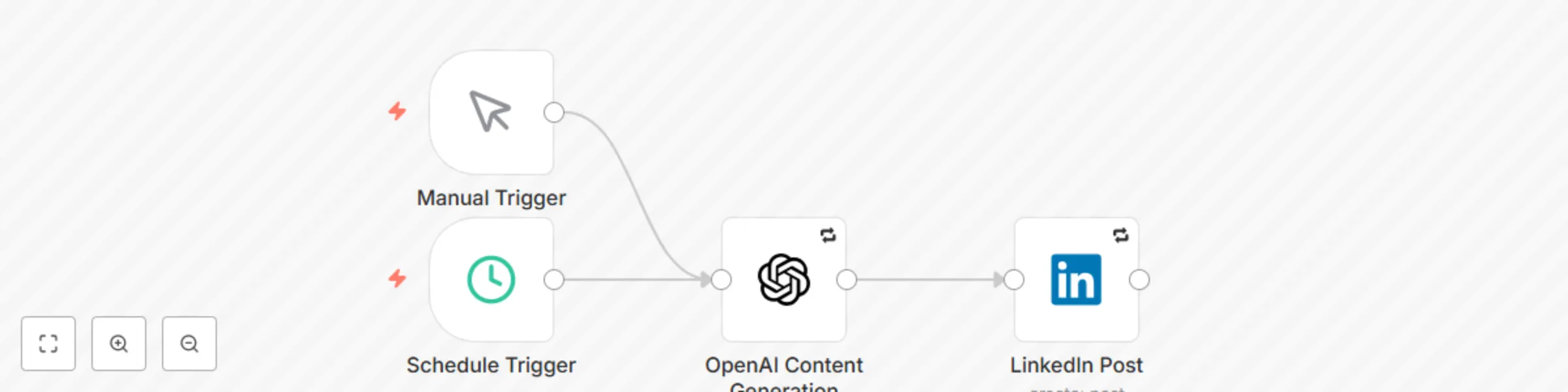
This workflow uses a streamlined 3-node architecture:
Schedule/Manual Trigger → OpenAI Content Generation → LinkedIn Post
Node Details
- Schedule Trigger: Automatically triggers the workflow (default: weekdays at 9 AM)
- Manual Trigger: Allows on-demand content generation
- OpenAI Content Generation: Creates LinkedIn-optimized content using AI
- LinkedIn Post: Publishes the generated content to LinkedIn
📋 Prerequisites
- n8n instance (self-hosted or cloud)
- OpenAI API account and API key
- LinkedIn account with API access
- Basic familiarity with n8n workflows
🚀 Quick Start
1. Import the Workflow
- Download the
linkedin-auto-post-agent.jsonfile - In your n8n instance, go to Workflows → Import from File
- Select the downloaded JSON file
- Click Import
2. Set Up Credentials
OpenAI API Credentials
- Go to Credentials in your n8n instance
- Click Create New Credential
- Select OpenAI
- Enter your OpenAI API key
- Name it "OpenAI API" and save
LinkedIn OAuth2 Credentials
- Create a LinkedIn App at LinkedIn Developer Portal
- Configure OAuth 2.0 settings:
- Redirect URL:
https://your-n8n-instance.com/rest/oauth2-credential/callback - Scopes:
r_liteprofile,w_member_social
- Redirect URL:
- In n8n, create new LinkedIn OAuth2 credentials
- Enter your LinkedIn App's Client ID and Client Secret
- Complete the OAuth authorization flow
3. Configure the Workflow
- Open the imported workflow
- Click on the OpenAI Content Generation node
- Select your OpenAI credentials
- Customize the content prompt if desired
- Click on the LinkedIn Post node
- Select your LinkedIn OAuth2 credentials
- Save the workflow
4. Test the Workflow
- Click the Manual Trigger node
- Click Execute Node to test content generation
- Verify the generated content in the LinkedIn node output
- Check your LinkedIn profile to confirm the post was published
5. Activate Automated Posting
- Click the Active toggle in the top-right corner
- The workflow will now run automatically based on the schedule
⚙️ Configuration Options
Scheduling
The default schedule posts content on weekdays at 9 AM. To modify:
- Click the Schedule Trigger node
- Modify the Cron Expression:
0 9 * * 1-50 9 * * 1-5: Weekdays at 9 AM0 12 * * *: Daily at noon0 9 * * 1,3,5: Monday, Wednesday, Friday at 9 AM
Content Customization
Modify the OpenAI prompt to change content style:
- Click the OpenAI Content Generation node
- Edit the System Message to adjust tone and style
- Modify the User Message to change topic focus
Example Prompts
Professional Development Focus:
Create a LinkedIn post about professional growth, skill development, or career advancement. Keep it under 280 characters and include 2-3 relevant hashtags.
Industry Insights:
Generate a LinkedIn post sharing an industry insight or trend in technology. Make it thought-provoking and include relevant hashtags.
Motivational Content:
Write an inspiring LinkedIn post about overcoming challenges or achieving goals. Keep it positive and engaging with appropriate hashtags.
Model Selection
Choose between OpenAI models based on your needs:
- gpt-3.5-turbo: Cost-effective, good quality
- gpt-4: Higher quality, more expensive
- gpt-4-turbo: Latest model with improved performance
🔧 Advanced Configuration
Error Handling
The workflow includes built-in error handling:
- Retry Logic: 3 attempts with 1-second delays
- Continue on Fail: Workflow continues even if individual nodes fail
- Error Notifications: Optional email/Slack notifications on failures
Content Review Workflow (Optional)
To add manual content review before posting:
- Add a Wait node between OpenAI and LinkedIn nodes
- Configure webhook trigger for approval
- Add conditional logic based on approval status
Rate Limiting
To respect API limits:
- OpenAI: 3 requests per minute (default)
- LinkedIn: 100 posts per day per user
- Adjust scheduling frequency accordingly
📊 Monitoring and Analytics
Execution History
- Go to Executions in your n8n instance
- Filter by workflow name to see all runs
- Click on individual executions to see detailed logs
Key Metrics to Monitor
- Success Rate: Percentage of successful executions
- Content Quality: Review generated posts periodically
- API Usage: Monitor OpenAI token consumption
- LinkedIn Engagement: Track post performance on LinkedIn
🛠️ Troubleshooting
Common Issues
OpenAI Node Fails
- Verify API key is correct and has sufficient credits
- Check if you've exceeded rate limits
- Ensure the model name is spelled correctly
LinkedIn Node Fails
- Verify OAuth2 credentials are properly configured
- Check if LinkedIn app has required permissions
- Ensure the content doesn't violate LinkedIn's posting policies
Workflow Doesn't Trigger
- Confirm the workflow is marked as "Active"
- Verify the cron expression syntax
- Check n8n's timezone settings
Debug Mode
- Enable Save Manual Executions in workflow settings
- Run the workflow manually to see detailed execution data
- Check each node's input/output data
🔒 Security Best Practices
- Store all API keys in n8n's encrypted credential system
- Regularly rotate API keys (monthly recommended)
- Use environment variables for sensitive configuration
- Enable execution logging for audit trails
- Monitor for unusual API usage patterns
📈 Optimization Tips
Content Quality
- Review and refine prompts based on output quality
- A/B test different prompt variations
- Monitor LinkedIn engagement metrics
- Adjust posting frequency based on audience response
Cost Optimization
- Use gpt-3.5-turbo for cost-effective content generation
- Set appropriate token limits (200 tokens recommended)
- Monitor OpenAI usage in your dashboard
Performance
- Keep workflows simple with minimal nodes
- Use appropriate retry settings
- Monitor execution times and optimize if needed
🤝 Contributing
We welcome contributions to improve this workflow:
- Fork the repository
- Create a feature branch
- Make your improvements
- Submit a pull request
📄 License
This project is licensed under the MIT License - see the LICENSE file for details.
🆘 Support
If you encounter issues or have questions:
- Check the troubleshooting section above
- Review n8n's official documentation
- Join the n8n community forum
- Create an issue in this repository
🔗 Useful Links
Happy Automating! 🚀
This workflow helps you maintain a consistent LinkedIn presence while focusing on what matters most - your business and professional growth.