Block 1 - Error Trigger
- Type / Role
- n8n-nodes-base.errorTrigger - errorTrigger
- Config choices
- Version 1
This workflow is provided as-is. Please review and test before using in production.
++Who’s it for++ This template is ideal for anyone who needs reliable, real time visibility into failed executions in n8n. Whether you’re a developer, operator, founder, or part of a small team, th...
n8n-nodes-base.errortrigger, n8n-nodes-base.emailsend, n8n-nodes-base.set, n8n-nodes-base.stickynote, @n8n/n8n-nodes-langchain.openai, n8n-nodes-base.if
This workflow is cataloged by N8N Workflows and links back to its original n8n.io source page by Chandan Singh.
Original n8n.io source++Who’s it for++
This template is ideal for anyone who needs reliable, real-time visibility into failed executions in n8n. Whether you’re a developer, operator, founder, or part of a small team, this workflow helps you detect issues quickly without digging through execution logs. It’s especially useful for users who want the flexibility to enable AI-powered diagnostics when needed.
++What it does++
The workflow sends an automated email alert whenever any workflow in your n8n instance encounters an error. It captures key details such as workflow name, timestamp, node name, and error message. If you enable AI analysis, the alert also includes a Severity Level and a Quick Resolution—giving you an instant, actionable understanding of the problem. If AI is disabled, you receive a clean, minimal error notification.
++How it works++
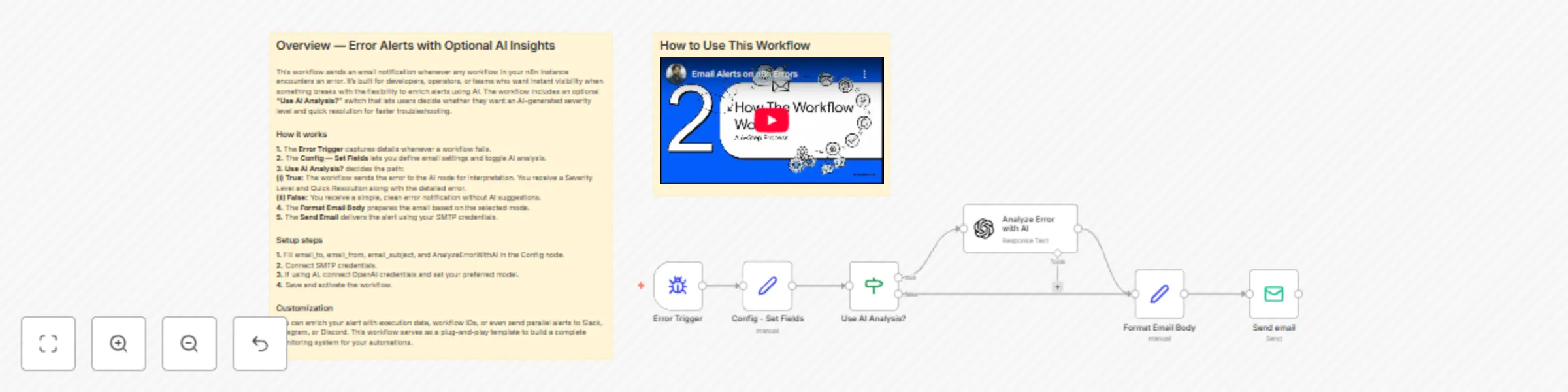
1. Error Trigger activates when any workflow fails. 2. Config — Set Fields stores your SMTP settings and the AnalyzeErrorWithAI toggle. 3. Use AI Analysis? decides whether to run the AI node. 4. If enabled, Analyze Error with AI generates structured recommendations. 5. Format Email Body builds the message based on the selected mode. 6. Send Email delivers the notification.
++Requirements++
1. SMTP credentials 2. A valid sender & recipient email 3. Optional: OpenAI credentials if using AI analysis
++How to set up++
1. Open the Config node and fill in email settings and the AI toggle. 2. Add your SMTP and (optional) OpenAI credentials. 3. Save, activate, and test the workflow.
This catalog entry is organized from the workflow JSON. The node-level section below shows the executable blocks available for review before importing the template.
| Workflow | Automated error notifications with optional GPT-4o diagnostics via email |
|---|---|
| Complexity | intermediate |
| Nodes | 8 |
| Categories | DevOps, AI Summarization |
| Author | Chandan Singh |
| Published | 04 Dec 2025 |
Use the JSON export at /data/workflows/11507/11507.json as the source template for this automation.
Open n8n, import the downloaded JSON, and review each node before activating the workflow.
Replace placeholder credentials, API keys, webhook URLs, account IDs, and environment-specific values with your own settings.
Run the workflow manually or in a staging workspace, inspect node output, and confirm downstream systems receive the expected data.
Enable the workflow only after testing, then monitor executions, errors, and rate limits during the first production runs.
Review imported nodes carefully before activation. This catalog entry is intended to help you inspect the workflow structure, understand required services, and find related templates faster.
Node names, credentials, schedules, webhook paths, and external service limits may need adjustment for your workspace.
++Who’s it for++ This template is ideal for anyone who needs reliable, real time visibility into failed executions in n8n. Whether you’re a developer, operator, founder, or part of a small team, th...
Review the workflow JSON, configure any required credentials in n8n, and test the automation in a safe workspace before using it in production.
Yes. Use the block-by-block analysis and the downloadable JSON to inspect each node, then adjust credentials, prompts, schedules, filters, or destinations for your DevOps, AI Summarization use case.