Automated daily workflow backup to GitHub
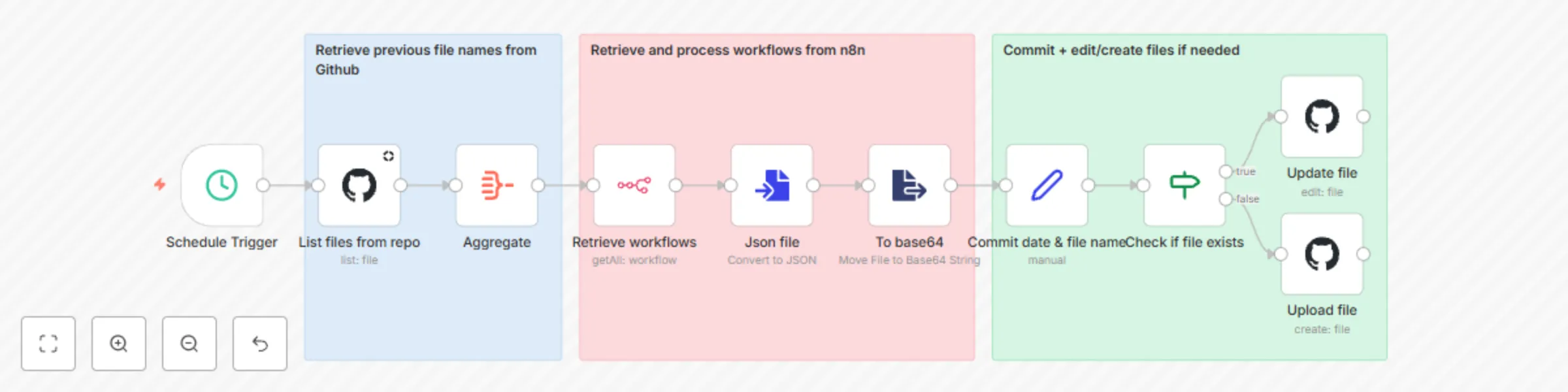
Workflow preview


 Early Deal
DISCOUNT 20%

Important notice
This workflow is provided as-is. Please review and test before using in production.
Overview
This workflow provides a robust solution for automatically backing up all your n8n workflows to a designated GitHub repository on a daily basis. By leveraging the n8n API and GitHub API, it ensures your workflows are version-controlled and securely stored, safeguarding against data loss and facilitating disaster recovery.
How it works
The automation follows these key steps:
- Scheduled trigger: The workflow is initiated automatically every day at a pre-configured time.
- List existing backups: It first connects to your GitHub repository to retrieve a list of already backed-up workflow files. This helps in determining whether a workflow's backup file needs to be created or updated.
- Retrieve n8n workflows: The workflow then fetches all current workflows directly from your n8n instance using the n8n REST API.
- Process and prepare: Each retrieved workflow is individually processed. Its data is converted into JSON format. This JSON content is then encoded to base64, a format suitable for GitHub API file operations.
- Commit to GitHub: For each n8n workflow:
- A standardized filename is generated (e.g.,
workflow-name-tag.json). - The workflow checks if a file with this name already exists in the GitHub repository (based on the list fetched in step 2).
- If the file exists: It updates the existing file with the latest version of the workflow.
- If it's a new workflow (file doesn't exist): A new file is created in the repository.
- Each commit is timestamped for clarity.
- A standardized filename is generated (e.g.,
This process ensures that you always have an up-to-date version of all your n8n workflows stored securely in your GitHub version control system, providing peace of mind and a reliable backup history.
Pre-requisites
Before you can use this template, please ensure you have the following:
- An active n8n instance (self-hosted or cloud).
- A GitHub account.
- A GitHub repository created where you want to store the workflow backups.
- A GitHub Personal Access Token with
reposcope (or fine-grained token with read/write access to the specific backup repository). This token will be used for GitHub API authentication. - n8n API credentials (API key) for your n8n instance.
Set up steps
Setting up this workflow should take approximately 10-15 minutes if you have your credentials ready.
- Import the template: Import this workflow into your n8n instance.
- Configure n8n API credentials:
- Locate the "Retrieve workflows" node.
- In the "Credentials" section for "n8n API", create new credentials (or select existing ones).
- Enter your n8n instance URL and your n8n API Key (you can create your n8n api key in the settings of your n8n instance)
- Configure GitHub credentials:
- Locate the "List files from repo" node (and subsequently "Update file" / "Upload file" nodes which will use the same credential).
- In the "Credentials" section for "GitHub API", create new credentials.
- Select OAuth2/Personal Access Token authentication method.
- Enter the GitHub Personal Access Token you generated as per the pre-requisites.
- Specify repository details:
- In the "List files from repo", "Update file", and "Upload file" GitHub nodes:
- Set the
Owner: Your GitHub username or organization name. - Set the
Repository: The name of your GitHub repository dedicated to backups. - Set the
Branch(e.g.,mainormaster) where backups should be stored. - (Optional) Specify a
Pathwithin the repository if you want backups in a specific folder (e.g.,n8n_backups/). Leave blank to store in the root.
- Set the
- In the "List files from repo", "Update file", and "Upload file" GitHub nodes:
- Adjust schedule (Optional):
- Select the "Schedule Trigger" node.
- Modify the trigger interval (e.g., change the time of day or frequency) as needed. By default, it's set for a daily run.
- Activate the workflow: Save and activate the workflow.
Explanation of nodes
Here's a detailed breakdown of each node used in this workflow:
- Schedule trigger
- Type:
n8n-nodes-base.scheduleTrigger - Purpose: This node automatically starts the workflow based on a defined schedule (e.g., daily at midnight).
- Type:
- List files from repo
- Type:
n8n-nodes-base.github - Purpose: Connects to your specified GitHub repository and lists all files, primarily to check for existing workflow backups.
- Type:
- Aggregate
- Type:
n8n-nodes-base.aggregate - Purpose: Consolidates the list of file names obtained from the "List files from repo" node into a single item for easier lookup later in the "Check if file exists" node.
- Type:
- Retrieve workflows
- Type:
n8n-nodes-base.n8n - Purpose: Uses the n8n API to fetch a list of all workflows currently present in your n8n instance.
- Type:
- Json file
- Type:
n8n-nodes-base.convertToFile - Purpose: Takes the data of each workflow (retrieved by the "Retrieve workflows" node) and converts it into a structured JSON file format.
- Type:
- To base64
- Type:
n8n-nodes-base.extractFromFile - Purpose: Converts the binary content of the JSON file (from the "Json file" node) into a base64 encoded string. This encoding is required by the GitHub API for file content.
- Type:
- Commit date & file name
- Type:
n8n-nodes-base.set - Purpose: Prepares metadata for the GitHub commit. It generates:
commitDate: The current date and time for the commit message.fileName: A standardized file name for the workflow backup (e.g.,my-workflow-vps-backups.json), typically using the workflow's name and its first tag.
- Type:
- Check if file exists
- Type:
n8n-nodes-base.if - Purpose: A conditional node. It checks if the
fileName(generated by "Commit date & file name") is present in the list of files aggregated by the "Aggregate" node. This determines if the workflow backup already exists in GitHub.
- Type:
- Update file
- Type:
n8n-nodes-base.github - Purpose: If the "Check if file exists" node determines the file does exist, this node updates that existing file in your GitHub repository with the latest workflow content (base64 encoded) and a commit message.
- Type:
- Upload file
- Type:
n8n-nodes-base.github - Purpose: If the "Check if file exists" node determines the file does not exist, this node creates and uploads a new file to your GitHub repository with the workflow content and a commit message.
- Type:
Customization
Here are a few ways you can customize this template to better fit your needs:
- Backup path: In the GitHub nodes ("List files from repo", "Update file", "Upload file"), you can specify a
Pathparameter to store backups in a specific folder within your repository (e.g.,workflows/ordaily_backups/). - Filename convention: Modify the "Commit date & file name" node (specifically the expression for
fileName) to change how backup files are named. For example, you might want to include the workflow ID or a different date format. - Commit messages: Customize the commit messages in the "Update file" and "Upload file" GitHub nodes to include more specific information if needed.
- Error handling: Consider adding error handling branches (e.g., using the "Error Trigger" node or checking for node execution failures) to notify you if a backup fails for any reason.
- Filtering workflows: If you only want to back up specific workflows (e.g., those with a particular tag or name pattern), you can add a "Filter" node after "Retrieve workflows" to include only the desired workflows in the backup process.
- Backup frequency: Adjust the "Schedule Trigger" node to change how often the backup runs (e.g., hourly, weekly, or on specific days).
Template was created in n8n v1.92.2