Automated daily Outlook calendar meeting digest
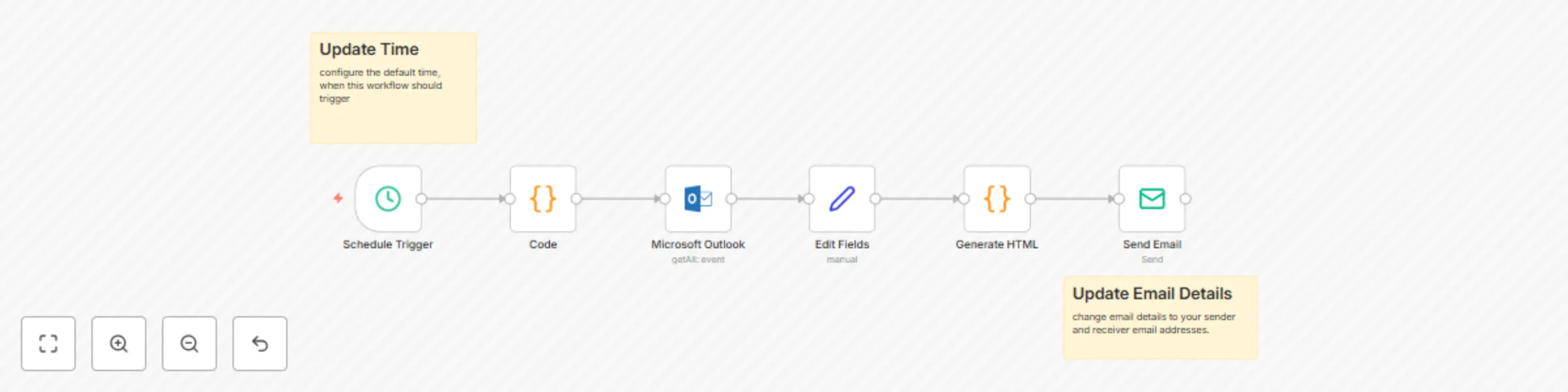
Workflow preview


 Early Deal
DISCOUNT 20%

Important notice
This workflow is provided as-is. Please review and test before using in production.
Overview
Automated Daily Outlook Calendar Meeting Digest
Overall Goal
This workflow automatically runs at a scheduled time (daily at 8 AM by default), calculates the current day's date range, fetches all calendar events from a specified Microsoft Outlook account for that day, formats these events into a user-friendly HTML email, and then sends this digest to a designated email address.
How it Works (Step-by-Step Breakdown):
Node: Schedule Trigger (Schedule Trigger Node)
- Type:
n8n-nodes-base.scheduleTrigger - Purpose: Automatically starts the workflow at a predefined time.
- Configuration:
- Rule > Interval > Trigger At Hour: 8
(Triggers every day at 8:00 AM according to the n8n server's timezone)
- Rule > Interval > Trigger At Hour: 8
- Output: Triggers the workflow execution at the scheduled time.
Node: Code (Code Node)
- Type:
n8n-nodes-base.code - Purpose: Dynamically calculates the start and end timestamps for "today," based on when the workflow is triggered.
- Configuration (JS Code):
- Gets the current date and time (workflow runtime).
- Sets
todayto beginning of current day (00:00:00). - Sets
tomorrowto beginning of next day (00:00:00). - Converts these to ISO string format (e.g.,
2023-10-27T00:00:00Z).
- Output: JSON object with
todayandtomorrowISO date strings.
Node: Microsoft Outlook (Microsoft Outlook Node)
- Type:
n8n-nodes-base.microsoftOutlook - Purpose: Fetch calendar events from Outlook within the calculated date range.
- Configuration:
- Resource: Event
- Filters (Custom):
start/dateTime ge '{{$json.today}}' and start/dateTime lt '{{$json.tomorrow}}'
(OData filter to fetch events starting on or after today and before tomorrow, i.e., all today's events.)
- Output: List of event objects from Outlook.
Node: Edit Fields (Set Node)
- Type:
n8n-nodes-base.set - Purpose: Transform and simplify the event data structure from Outlook.
- Configuration: Maps fields from Outlook event to new field names:
idsubjectdescription(frombodyPreview)meeting_startmeeting_endattendeesmeeting_organizermeeting_organizer_emailmeeting_link
- Output: List of JSON objects with simplified meeting details.
Node: Generate HTML (Code Node)
- Type:
n8n-nodes-base.code - Purpose: Generate a single HTML email body summarizing all meetings and create the email subject line.
- Configuration (JS Code):
- Processes all meeting items from "Edit Fields" node.
- Defines
generateMeetingReminderEmailfunction to format each meeting into an HTML "card." - Escapes HTML special characters, formats times, attendees, etc.
- Concatenates all cards into a full HTML document.
- Generates subject line (e.g., "🗓️ Your Meetings Today – Friday, Oct 27").
- Output: JSON object with:
{
  "subject": "email subject string",
  "html": "generated HTML content string"
}
Node: Send Email (Email Send Node)
- Type:
n8n-nodes-base.emailSend - Purpose: Send the generated HTML digest email to the designated recipient.
- Configuration:
- From Email:
[email protected] - To Email:
[email protected] - Subject:
{{ $json.subject }}(dynamic from Generate HTML node) - HTML:
{{ $json.html }}(dynamic from Generate HTML node)
- From Email:
- Output: Email sending status.
Sticky Notes
- Update Time: Near "Schedule Trigger" node; configure trigger time as needed.
- Update Email Details: Near "Send Email" node; change sender and receiver email addresses.
How to Customize It
Schedule (Schedule Trigger node):
Modify the trigger hour, minutes, or days of week to change when the workflow runs.Date Range (Code node):
Adjust JS to change date range (e.g., next business day, upcoming week).Outlook Calendar (Microsoft Outlook node):
Specify Calendar ID or refine OData filters for event selection.Event Details (Edit Fields node):
Add/remove/modify event fields extracted.Email Appearance and Content (Generate HTML node):
Change CSS styling, meeting details, or subject line logic.No Meetings Scenario:
Use an "If" node after "Edit Fields" to handle no-meeting days (e.g., send "No meetings today!" email or skip email).Email Recipients (Send Email node):
Update "From" and "To" emails; multiple recipients separated by commas.
Error Handling
- Use "Error Trigger" nodes to catch and handle failures (Outlook API, SMTP errors).
- Send alerts or log errors accordingly.
Use Cases
- Automated Daily Personal Meeting Briefing: Get daily email summaries of your meetings.
- Automated Team Meeting Digest: Send daily team calendar digest emails.
- Proactive Daily Planning: Automatically stay informed of your day’s schedule.
Required Credentials
Add these credentials in your n8n instance under Credentials:
Microsoft Outlook (OAuth2 API):
- Used by: "Microsoft Outlook" node
- Credential Name in Workflow:
Outlook(ID:JcYqVJwcwZIhB8oy) - Requires OAuth2 with
Calendars.Readpermission.
SMTP:
- Used by: "Send Email" node
- Credential Name in Workflow:
SMTP account(ID:vCexcphurglwGBfk) - Requires SMTP server details (host, port, username, password).
Ensure these credentials are configured correctly with required permissions. Activate the workflow for scheduled execution.
Made with ❤️ using n8n by Akhil.