
Automate web research with GPT-4, Claude & Apify for content analysis and insights

Workflow preview
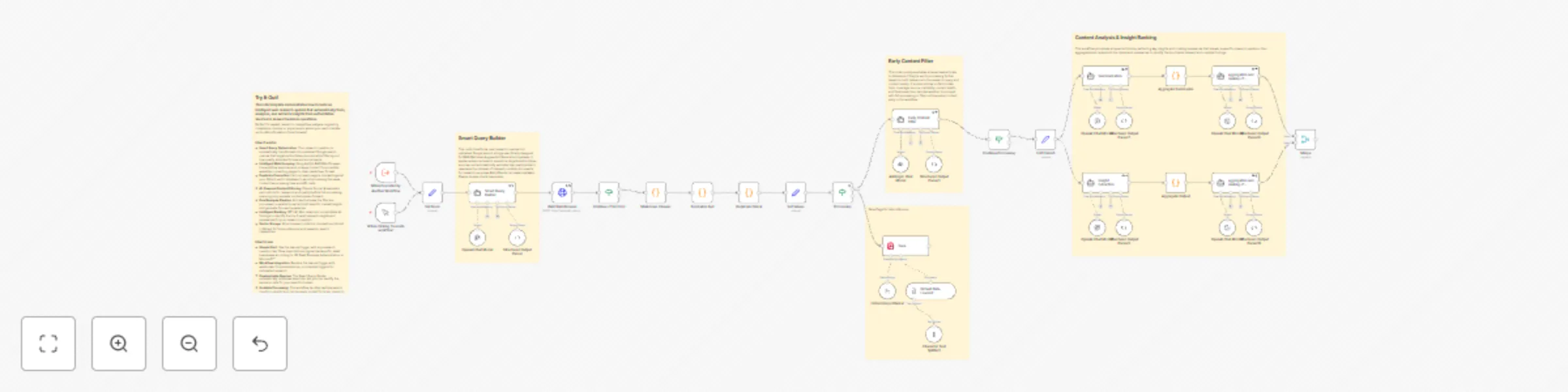
Workflow preview
100%
Automate web research with GPT-4, Claude & Apify for content analysis and insights preview
Open on n8n.io

Important notice

This workflow is provided as-is. Please review and test before using in production.

1. Workflow Overview

This n8n template demonstrates how to automate comprehensive web research using multiple AI models to find, analyze, and extract insights from authoritative sources. Use cases are many: Try automat...

Best for

  • Market Research automation workflows
  • AI RAG automation workflows
  • advanced n8n builders looking for reusable templates

Tools used

n8n-nodes-base.httprequest, n8n-nodes-base.manualtrigger, n8n-nodes-base.executeworkflowtrigger, n8n-nodes-base.set, @n8n/n8n-nodes-langchain.outputparserstructured, @n8n/n8n-nodes-langchain.agent, n8n-nodes-base.code, @n8n/n8n-nodes-langchain.vectorstoreqdrant

Source and attribution

This workflow is cataloged by N8N Workflows and links back to its original n8n.io source page by Peter Zendzian.

Original n8n.io source

1.1 Workflow description

Title
Automate web research with GPT-4, Claude & Apify for content analysis and insights
Workflow name
Automate web research with GPT-4, Claude & Apify for content analysis and insights

This n8n template demonstrates how to automate comprehensive web research using multiple AI models to find, analyze, and extract insights from authoritative sources.

Use cases are many: Try automating competitive analysis research, finding latest regulatory guidance from official sources, gathering authoritative content for reports, or conducting market research on industry developments!

Good to know

Each research query typically costs $0.08-$0.34 depending on the number of sources found and processed. The workflow includes smart filtering to minimize unnecessary API calls.

The workflow requires multiple AI services and may need additional setup time compared to simpler templates.

Qdrant storage is optional and can be removed without affecting performance.

How it works

Your research question gets transformed into optimized Google search queries that target authoritative sources while filtering out low-quality sites.

Apify's RAG Web Browser scrapes the content and converts pages to clean markdown format.

Claude Sonnet 4 evaluates each article for relevance and quality before full processing.

Articles that pass the filter get analyzed in parallel - one pipeline creates focused summaries while another extracts specific claims and evidence.

GPT-4.1 Mini ranks all findings and presents the top 3 most valuable insights and summaries.

All processed content gets stored in your Qdrant vector database to prevent duplicate processing and enable future reference.

How to use

The manual trigger node is used as an example but feel free to replace this with other triggers such as webhook, form submissions, or scheduled research.

You can modify the configuration variables in the Set Node to customize Qdrant URLs, collection names, and quality thresholds for your specific needs.

Requirements

OpenAI API account for GPT-4.1 Mini (query optimization, summarization, ranking) Anthropic API account for Claude Sonnet 4 (content filtering) Apify account for web scraping capabilities Qdrant vector database instance (local or cloud) Ollama with nomic-embed-text model for embeddings

Customizing this workflow

Web research automation can be adapted for many specialized use cases. Try focusing on specific domains like legal research (targeting .gov and .edu sites), medical research (PubMed and health authorities), or financial analysis (SEC filings and analyst reports).

1.2 Logical Blocks

This catalog entry is organized from the workflow JSON. The node-level section below shows the executable blocks available for review before importing the template.

2. Block-by-Block Analysis

Block 1 - RAG Web Browser

Type / Role
n8n-nodes-base.httpRequest - httpRequest
Config choices
Version 4.2

Block 2 - When clicking ‘Execute workflow’

Type / Role
n8n-nodes-base.manualTrigger - manualTrigger
Config choices
Version 1

Block 3 - When Executed by Another Workflow

Type / Role
n8n-nodes-base.executeWorkflowTrigger - executeWorkflowTrigger
Config choices
Version 1.1

Block 4 - Set Node

Type / Role
n8n-nodes-base.set - set
Config choices
Version 3.4

Block 5 - Structured Output Parser

Type / Role
@n8n/n8n-nodes-langchain.outputParserStructured - outputParserStructured
Config choices
Version 1.3

Block 6 - Early Content Filter

Type / Role
@n8n/n8n-nodes-langchain.agent - agent
Config choices
Version 2

Block 7 - Structured Output Parser1

Type / Role
@n8n/n8n-nodes-langchain.outputParserStructured - outputParserStructured
Config choices
Version 1.3

Block 8 - Duplicate Check

Type / Role
n8n-nodes-base.code - code
Config choices
Version 2

Block 9 - Normalize text

Type / Role
n8n-nodes-base.code - code
Config choices
Version 2

Block 10 - Edit Fields5

Type / Role
n8n-nodes-base.set - set
Config choices
Version 3.4

Block 11 - Structured Output Parser3

Type / Role
@n8n/n8n-nodes-langchain.outputParserStructured - outputParserStructured
Config choices
Version 1.3

Block 12 - Structured Output Parser7

Type / Role
@n8n/n8n-nodes-langchain.outputParserStructured - outputParserStructured
Config choices
Version 1.3

Block 13 - Insight Extraction

Type / Role
@n8n/n8n-nodes-langchain.agent - agent
Config choices
Version 2

Block 14 - Summarization

Type / Role
@n8n/n8n-nodes-langchain.agent - agent
Config choices
Version 2

Block 15 - Structured Output Parser9

Type / Role
@n8n/n8n-nodes-langchain.outputParserStructured - outputParserStructured
Config choices
Version 1.3

Block 16 - Structured Output Parser10

Type / Role
@n8n/n8n-nodes-langchain.outputParserStructured - outputParserStructured
Config choices
Version 1.3

Block 17 - aggregation and ranking of extracted claims

Type / Role
@n8n/n8n-nodes-langchain.agent - agent
Config choices
Version 2

Block 18 - aggregation and ranking of extracted summaries

Type / Role
@n8n/n8n-nodes-langchain.agent - agent
Config choices
Version 2

Block 19 - Save

Type / Role
@n8n/n8n-nodes-langchain.vectorStoreQdrant - vectorStoreQdrant
Config choices
Version 1.3

Block 20 - Embeddings Ollama1

Type / Role
@n8n/n8n-nodes-langchain.embeddingsOllama - embeddingsOllama
Config choices
Version 1

Block 21 - Character Text Splitter2

Type / Role
@n8n/n8n-nodes-langchain.textSplitterCharacterTextSplitter - textSplitterCharacterTextSplitter
Config choices
Version 1

Block 22 - Default Data Loader2

Type / Role
@n8n/n8n-nodes-langchain.documentDefaultDataLoader - documentDefaultDataLoader
Config choices
Version 1.1

Block 23 - OpenAI Chat Model

Type / Role
@n8n/n8n-nodes-langchain.lmChatOpenAi - lmChatOpenAi
Config choices
Version 1.2

Block 24 - OpenAI Chat Model4

Type / Role
@n8n/n8n-nodes-langchain.lmChatOpenAi - lmChatOpenAi
Config choices
Version 1.2

Showing the first 24 of 42 workflow blocks. Download the JSON for the full node graph.

3. Summary Table

Workflow Automate web research with GPT-4, Claude & Apify for content analysis and insights
Complexity advanced
Nodes 42
Categories Market Research, AI RAG
Author Peter Zendzian
Published 01 Aug 2025

4. Reproducing the Workflow from Scratch

  1. 1. Download the workflow JSON

    Use the JSON export at /data/workflows/6822/6822.json as the source template for this automation.

  2. 2. Import the template into n8n

    Open n8n, import the downloaded JSON, and review each node before activating the workflow.

  3. 3. Configure credentials and variables

    Replace placeholder credentials, API keys, webhook URLs, account IDs, and environment-specific values with your own settings.

  4. 4. Test with sample data

    Run the workflow manually or in a staging workspace, inspect node output, and confirm downstream systems receive the expected data.

  5. 5. Activate and monitor

    Enable the workflow only after testing, then monitor executions, errors, and rate limits during the first production runs.

5. General Notes & Resources

Review imported nodes carefully before activation. This catalog entry is intended to help you inspect the workflow structure, understand required services, and find related templates faster.

Node names, credentials, schedules, webhook paths, and external service limits may need adjustment for your workspace.

Frequently asked questions

What does Automate web research with GPT-4, Claude & Apify for content analysis and insights do?

This n8n template demonstrates how to automate comprehensive web research using multiple AI models to find, analyze, and extract insights from authoritative sources. Use cases are many: Try automat...

What do I need before importing this workflow?

Review the workflow JSON, configure any required credentials in n8n, and test the automation in a safe workspace before using it in production.

Can I customize this workflow?

Yes. Use the block-by-block analysis and the downloadable JSON to inspect each node, then adjust credentials, prompts, schedules, filters, or destinations for your Market Research, AI RAG use case.



