Automate Wazuh alert triage and reporting with GPT-4o-mini and Telegram
Workflow preview


 Early Deal
DISCOUNT 20%

Important notice
This workflow is provided as-is. Please review and test before using in production.
Overview
🚨Are alert storms overwhelming your Security Operations workflows?
This n8n workflow supercharges your SOC by fully automating triage, analysis, and notification for Wazuh alerts—blending event-driven automation, OpenAI-powered contextual analysis, and real-time collaboration for incident response.
🔑 Key Features:
✅ Automated Triage:
Instantly filters Wazuh alerts by severity to focus analyst effort on the signals that matter.
🤖 AI-Driven Investigation Reports:
Uses OpenAI's GPT-4o-mini to auto-generate context-rich incident reports, including:
- MITRE Tactic & Technique mapping
- Impacted scope (IP addresses, hostnames)
- External artifact reputation checks
- Actionable security recommendations
- Fully customizable prompt format aligned with your SOC playbooks
📡 Multi-Channel Notification
Delivers clean, actionable reports directly to your SOC team via Telegram. Easily extendable to Slack, Outlook, Gmail, Discord, or any other preferred channel.
🔇 Noise Reduction
Eliminates alert fatigue using smart filters and custom AI prompts that suppress false positives and highlight real threats.
🔧 Fully Customizable
Tweak severity thresholds, update prompt logic, or integrate additional data sources and channels — all with minimal effort
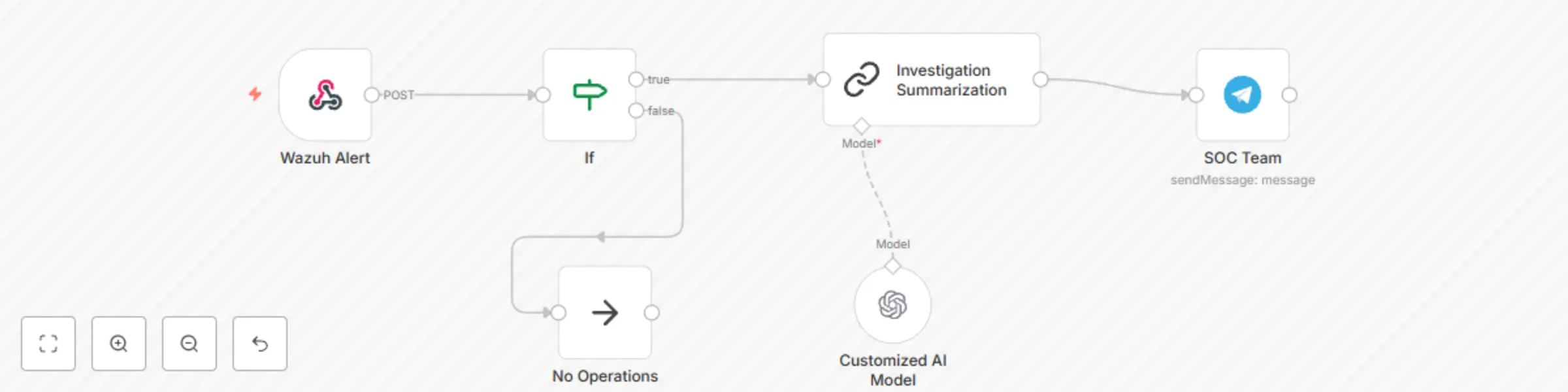
⚙️ How It Works
Webhook
Listens for incoming Wazuh alerts in real time.If Condition
Filters based on severity (1 low,2 medium, etc.) or other logic you define.AI Investigation (LangChain + OpenAI)
Summarizes full alert logs and context using custom prompts to generate:- Incident Overview
- Key Indicators
- Log Analysis
- Threat Classification
- Risk Assessment
- Security Recommendations
Notification Delivery
The report is parsed, cleaned, and sent to your SOC team in real-time, enabling rapid response — even during high-alert volumes.No-Op Path
Efficiently discards irrelevant alerts without breaking the flow.
🧠 Why n8n + AI?
Traditional alert triage is manual, slow, and error-prone — leading to analyst burnout and missed critical threats.
This workflow shows how combining workflow automation with a tailored AI model enables your SOC to shift from reactive to proactive. Analysts can now:
- Focus on critical investigations
- Respond to alerts faster
- Eliminate copy-paste fatigue
- Get instant contextual summaries
> ⚠️ Note: We learned that generic AI isn’t enough. Context-rich prompts and alignment with your actual SOC processes are key to meaningful, scalable automation.
🚀 Ready to build a smarter, less stressful SOC?
Clone this workflow, adapt it to your processes, and never miss a critical alert again.
📬 Contributions welcome!
Feel free to raise PRs, suggest new enhancements, or fork for your own use cases.
Created by Mariskarthick M
Senior Security Analyst | Detection Engineer | Threat Hunter | Open-Source Enthusiast