
Automate random chore assignments with Google Sheets and Gmail notifications

Workflow preview
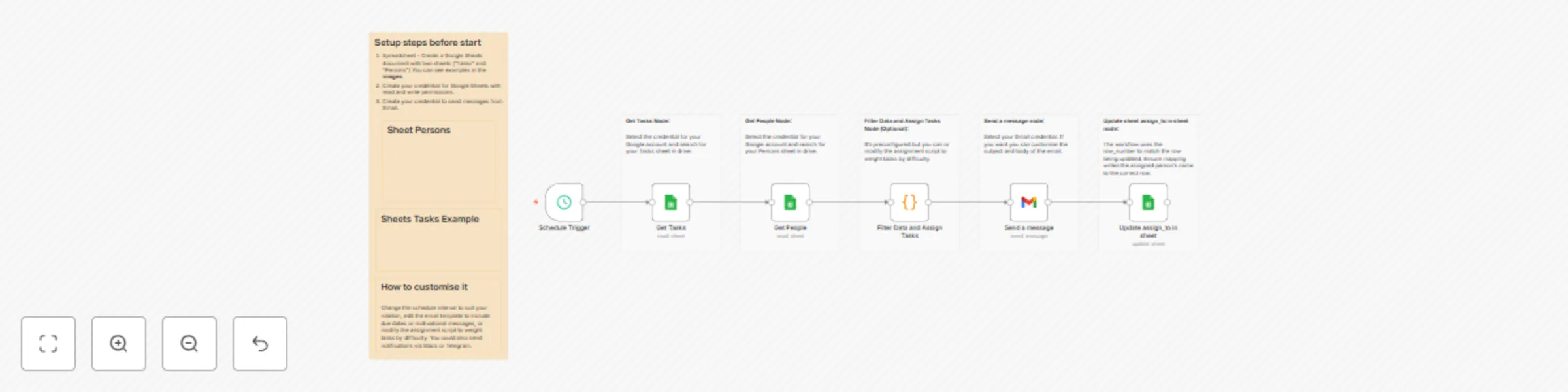
Workflow preview
100%
Automate random chore assignments with Google Sheets and Gmail notifications preview
Open on n8n.io

Important notice

This workflow is provided as-is. Please review and test before using in production.

1. Workflow Overview

This workflow automates the assignment of household chores. It reads tasks and a list of people from Google Sheets, pairs each task with someone, updates the spreadsheet with the assignments and em...

Best for

  • Personal Productivity automation workflows
  • advanced n8n builders looking for reusable templates

Tools used

n8n-nodes-base.scheduletrigger, n8n-nodes-base.googlesheets, n8n-nodes-base.gmail, n8n-nodes-base.code, n8n-nodes-base.stickynote

Source and attribution

This workflow is cataloged by N8N Workflows and links back to its original n8n.io source page by Adrian.

Original n8n.io source

1.1 Workflow description

Title
Automate random chore assignments with Google Sheets and Gmail notifications
Workflow name
Automate random chore assignments with Google Sheets and Gmail notifications

This workflow automates the assignment of household chores. It reads tasks and a list of people from Google Sheets, pairs each task with someone, updates the spreadsheet with the assignments and emails each person their chores.

Each run makes a random assignment so you don’t have to decide who does what. By running on a schedule, it keeps your chore rotation automated.

Who is it for?

Designed for families, roommates, flat‑shares or property managers who want to keep track of recurring chores without endless group chats or arguments. It’s also helpful for anyone coordinating a team of cleaners or volunteers and wishing to automate a fair distribution of tasks.

How it works

  1. A Schedule Trigger starts the workflow at a regular interval (default every seven days).
  2. Google Sheets node reads the “Tasks” sheet from your spreadsheet. Each row contains a chore with a task.
  3. Another Google Sheets node reads the “Persons” sheet to obtain the list of people available to do chores.
  4. Next a Code node filters out any people without an email address and any tasks without a task name, then selects a random person for each task.
  5. A Gmail node sends each person an email summarising the chore they’ve been assigned.
  6. The last Google Sheets node updates the “Tasks” sheet, writing the assigned person’s name into the assigned_to column.

Setup steps

  1. Spreadsheet – Create a Google Sheets document with two sheets. The first sheet “Tasks” should have columns for task, description, assigned_to and a “hidden row_number”. The second sheet “Persons” should have columns for name and email and “hidden row_number”. Fill them with your current chores and household members.
  2. Connect your Google account – In the Get Tasks and Get People nodes, select the credential for your Google account and search for your sheets.
  3. Configure the Schedule Trigger – Set the trigger interval (for example, every seven days on a Sunday evening).
  4. Edit the assignment logic (optional) – The Code node is preconfigured to filter data and assign tasks randomly. You can modify this script if you prefer a round‑robin approach, weighting by difficulty, or any other logic.
  5. Configure Gmail – In the Send a message node, select your Gmail credential. If you want you can customise the subject and body of the email.
  6. Update sheet mapping – In the Update assign_to node, ensure the assigned_to column mapping writes the assigned person’s name back to the correct row. The workflow uses the row_number to match the row being updated.
  7. Test and activate – Run the workflow manually to verify it reads your sheets, assigns tasks and sends emails. Once satisfied, activate the schedule so it runs automatically.

Requirements

· A Google account with access to Google Sheets and Gmail. · A spreadsheet containing two sheets as described above (see images), with headers matching the field names used in the workflow.

How to customise it

Change the schedule interval to suit your rotation, edit the email template to include due dates or motivational messages, or modify the assignment script to weight tasks by difficulty. You could also send notifications via Slack or Telegram.

1.2 Logical Blocks

This catalog entry is organized from the workflow JSON. The node-level section below shows the executable blocks available for review before importing the template.

2. Block-by-Block Analysis

Block 1 - Schedule Trigger

Type / Role
n8n-nodes-base.scheduleTrigger - scheduleTrigger
Config choices
Version 1

Block 2 - Get Tasks

Type / Role
n8n-nodes-base.googleSheets - googleSheets
Config choices
Version 3

Block 3 - Get People

Type / Role
n8n-nodes-base.googleSheets - googleSheets
Config choices
Version 3

Block 4 - Send a message

Type / Role
n8n-nodes-base.gmail - gmail
Config choices
Version 2.1

Block 5 - Filter Data and Assign Tasks

Type / Role
n8n-nodes-base.code - code
Config choices
Version 2

Block 6 - Update assign_to in sheet

Type / Role
n8n-nodes-base.googleSheets - googleSheets
Config choices
Version 4.7

Block 7 - Sticky Note1

Type / Role
n8n-nodes-base.stickyNote - stickyNote
Config choices
Version 1

Block 8 - Sticky Note2

Type / Role
n8n-nodes-base.stickyNote - stickyNote
Config choices
Version 1

Block 9 - Sticky Note

Type / Role
n8n-nodes-base.stickyNote - stickyNote
Config choices
Version 1

Block 10 - Sticky Note3

Type / Role
n8n-nodes-base.stickyNote - stickyNote
Config choices
Version 1

Block 11 - Sticky Note5

Type / Role
n8n-nodes-base.stickyNote - stickyNote
Config choices
Version 1

Block 12 - Sticky Note6

Type / Role
n8n-nodes-base.stickyNote - stickyNote
Config choices
Version 1

Block 13 - Sticky Note7

Type / Role
n8n-nodes-base.stickyNote - stickyNote
Config choices
Version 1

Block 14 - Sticky Note8

Type / Role
n8n-nodes-base.stickyNote - stickyNote
Config choices
Version 1

Block 15 - Sticky Note9

Type / Role
n8n-nodes-base.stickyNote - stickyNote
Config choices
Version 1

3. Summary Table

Workflow Automate random chore assignments with Google Sheets and Gmail notifications
Complexity advanced
Nodes 15
Categories Personal Productivity
Author Adrian
Published 09 Oct 2025

4. Reproducing the Workflow from Scratch

  1. 1. Download the workflow JSON

    Use the JSON export at /data/workflows/9409/9409.json as the source template for this automation.

  2. 2. Import the template into n8n

    Open n8n, import the downloaded JSON, and review each node before activating the workflow.

  3. 3. Configure credentials and variables

    Replace placeholder credentials, API keys, webhook URLs, account IDs, and environment-specific values with your own settings.

  4. 4. Test with sample data

    Run the workflow manually or in a staging workspace, inspect node output, and confirm downstream systems receive the expected data.

  5. 5. Activate and monitor

    Enable the workflow only after testing, then monitor executions, errors, and rate limits during the first production runs.

5. General Notes & Resources

Review imported nodes carefully before activation. This catalog entry is intended to help you inspect the workflow structure, understand required services, and find related templates faster.

Node names, credentials, schedules, webhook paths, and external service limits may need adjustment for your workspace.

Frequently asked questions

What does Automate random chore assignments with Google Sheets and Gmail notifications do?

This workflow automates the assignment of household chores. It reads tasks and a list of people from Google Sheets, pairs each task with someone, updates the spreadsheet with the assignments and em...

What do I need before importing this workflow?

Review the workflow JSON, configure any required credentials in n8n, and test the automation in a safe workspace before using it in production.

Can I customize this workflow?

Yes. Use the block-by-block analysis and the downloadable JSON to inspect each node, then adjust credentials, prompts, schedules, filters, or destinations for your Personal Productivity use case.



