
Automate property inspections and reporting with OpenAI, Google Sheets and Slack

Workflow preview
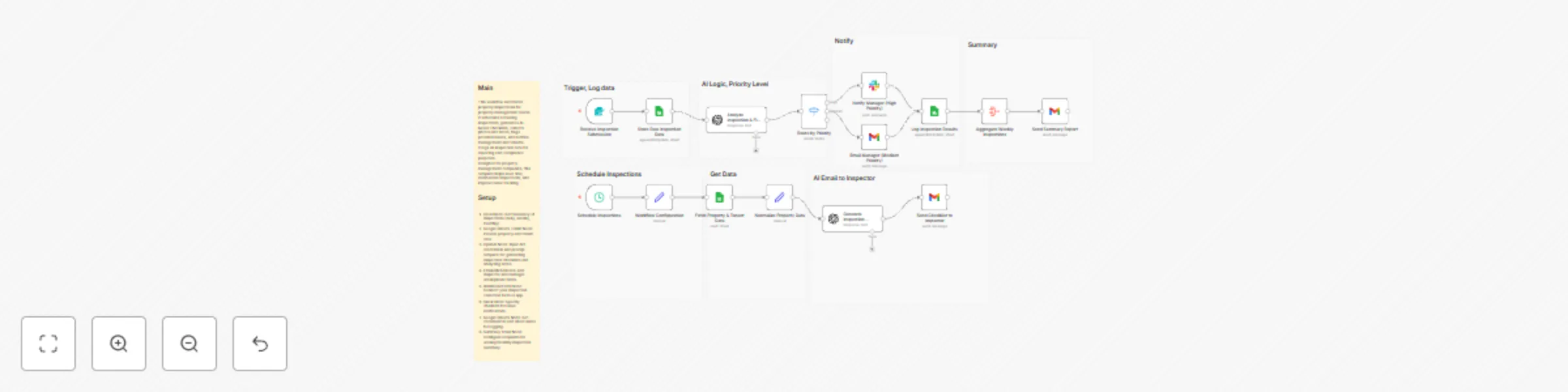
Workflow preview
100%
Automate property inspections and reporting with OpenAI, Google Sheets and Slack preview
Open on n8n.io

Important notice

This workflow is provided as-is. Please review and test before using in production.

1. Workflow Overview

Who’s it for Property management companies, building managers, and inspection teams who want to automate recurring property inspections, improve issue tracking, and streamline reporting. How it wor...

Best for

  • Document Extraction automation workflows
  • AI Summarization automation workflows
  • advanced n8n builders looking for reusable templates

Tools used

n8n-nodes-base.scheduletrigger, n8n-nodes-base.set, n8n-nodes-base.googlesheets, @n8n/n8n-nodes-langchain.openai, n8n-nodes-base.gmail, n8n-nodes-base.formtrigger, n8n-nodes-base.switch, n8n-nodes-base.slack

Source and attribution

This workflow is cataloged by N8N Workflows and links back to its original n8n.io source page by Hyrum Hurst.

Original n8n.io source

1.1 Workflow description

Title
Automate property inspections and reporting with OpenAI, Google Sheets and Slack
Workflow name
Automate property inspections and reporting with OpenAI, Google Sheets and Slack

Who’s it for

Property management companies, building managers, and inspection teams who want to automate recurring property inspections, improve issue tracking, and streamline reporting.

How it works / What it does

This n8n workflow schedules periodic property inspections using a Cron trigger. AI generates customized inspection checklists for each property, which are sent to assigned inspectors. Inspectors submit photos and notes via a connected form or mobile app. AI analyzes these submissions to flag issues based on priority (high, medium, low). High-priority issues are routed to managers via Slack/email, while routine notes are logged for reporting. The workflow also generates weekly or monthly summary reports and can optionally notify tenants of resolved issues.

How to set up

  • Configure the Cron trigger with your desired inspection frequency.
  • Connect Google Sheets or your CRM to fetch property and tenant data.
  • Set up OpenAI node with your API key and checklist generation prompts.
  • Configure email/SMS notifications for inspectors.
  • Connect a form or mobile app via Webhook to collect inspection data.
  • Set up Slack/email notifications for managers.
  • Log all inspection results, photos, and flagged issues into Google Sheets.
  • Configure summary report email recipients.

Requirements

  • n8n account with Google Sheets, Email, Slack, Webhook, and OpenAI nodes.
  • Property and tenant data stored in Google Sheets or CRM.
  • OpenAI API credentials for AI checklist generation and note analysis.

How to customize the workflow

  • Adjust Cron frequency to match inspection schedule.
  • Customize AI prompts for property-specific checklist items.
  • Add or remove branches for issue severity (high/medium/low).
  • Include additional notification channels if needed (Teams, SMS, etc.).

Workflow Use Case

Automates property inspections for property management teams, ensuring no inspections are missed, AI-generated checklists standardize the process, and potential issues are flagged and routed efficiently. Saves time, improves compliance, and increases tenant satisfaction.

Created by QuarterSmart | Hyrum Hurst

1.2 Logical Blocks

This catalog entry is organized from the workflow JSON. The node-level section below shows the executable blocks available for review before importing the template.

2. Block-by-Block Analysis

Block 1 - Schedule Inspections

Type / Role
n8n-nodes-base.scheduleTrigger - scheduleTrigger
Config choices
Version 1.3

Block 2 - Workflow Configuration

Type / Role
n8n-nodes-base.set - set
Config choices
Version 3.4

Block 3 - Fetch Property & Tenant Data

Type / Role
n8n-nodes-base.googleSheets - googleSheets
Config choices
Version 4.7

Block 4 - Normalize Property Data

Type / Role
n8n-nodes-base.set - set
Config choices
Version 3.4

Block 5 - Generate Inspection Checklist

Type / Role
@n8n/n8n-nodes-langchain.openAi - openAi
Config choices
Version 2

Block 6 - Send Checklist to Inspector

Type / Role
n8n-nodes-base.gmail - gmail
Config choices
Version 2.1

Block 7 - Receive Inspection Submission

Type / Role
n8n-nodes-base.formTrigger - formTrigger
Config choices
Version 2.3

Block 8 - Store Raw Inspection Data

Type / Role
n8n-nodes-base.googleSheets - googleSheets
Config choices
Version 4.7

Block 9 - Analyze Inspection & Flag Issues

Type / Role
@n8n/n8n-nodes-langchain.openAi - openAi
Config choices
Version 2

Block 10 - Route by Priority

Type / Role
n8n-nodes-base.switch - switch
Config choices
Version 3.3

Block 11 - Notify Manager (High Priority)

Type / Role
n8n-nodes-base.slack - slack
Config choices
Version 2.3

Block 12 - Email Manager (Medium Priority)

Type / Role
n8n-nodes-base.gmail - gmail
Config choices
Version 2.1

Block 13 - Log Inspection Results

Type / Role
n8n-nodes-base.googleSheets - googleSheets
Config choices
Version 4.7

Block 14 - Aggregate Weekly Inspections

Type / Role
n8n-nodes-base.aggregate - aggregate
Config choices
Version 1

Block 15 - Send Summary Report

Type / Role
n8n-nodes-base.gmail - gmail
Config choices
Version 2.1

Block 16 - Sticky Note

Type / Role
n8n-nodes-base.stickyNote - stickyNote
Config choices
Version 1

Block 17 - Sticky Note1

Type / Role
n8n-nodes-base.stickyNote - stickyNote
Config choices
Version 1

Block 18 - Sticky Note2

Type / Role
n8n-nodes-base.stickyNote - stickyNote
Config choices
Version 1

Block 19 - Sticky Note3

Type / Role
n8n-nodes-base.stickyNote - stickyNote
Config choices
Version 1

Block 20 - Sticky Note4

Type / Role
n8n-nodes-base.stickyNote - stickyNote
Config choices
Version 1

Block 21 - Sticky Note5

Type / Role
n8n-nodes-base.stickyNote - stickyNote
Config choices
Version 1

Block 22 - Sticky Note6

Type / Role
n8n-nodes-base.stickyNote - stickyNote
Config choices
Version 1

Block 23 - Sticky Note7

Type / Role
n8n-nodes-base.stickyNote - stickyNote
Config choices
Version 1

3. Summary Table

Workflow Automate property inspections and reporting with OpenAI, Google Sheets and Slack
Complexity advanced
Nodes 23
Categories Document Extraction, AI Summarization
Author Hyrum Hurst
Published 03 Jan 2026

4. Reproducing the Workflow from Scratch

  1. 1. Download the workflow JSON

    Use the JSON export at /data/workflows/12431/12431.json as the source template for this automation.

  2. 2. Import the template into n8n

    Open n8n, import the downloaded JSON, and review each node before activating the workflow.

  3. 3. Configure credentials and variables

    Replace placeholder credentials, API keys, webhook URLs, account IDs, and environment-specific values with your own settings.

  4. 4. Test with sample data

    Run the workflow manually or in a staging workspace, inspect node output, and confirm downstream systems receive the expected data.

  5. 5. Activate and monitor

    Enable the workflow only after testing, then monitor executions, errors, and rate limits during the first production runs.

5. General Notes & Resources

Review imported nodes carefully before activation. This catalog entry is intended to help you inspect the workflow structure, understand required services, and find related templates faster.

Node names, credentials, schedules, webhook paths, and external service limits may need adjustment for your workspace.

Frequently asked questions

What does Automate property inspections and reporting with OpenAI, Google Sheets and Slack do?

Who’s it for Property management companies, building managers, and inspection teams who want to automate recurring property inspections, improve issue tracking, and streamline reporting. How it wor...

What do I need before importing this workflow?

Review the workflow JSON, configure any required credentials in n8n, and test the automation in a safe workspace before using it in production.

Can I customize this workflow?

Yes. Use the block-by-block analysis and the downloadable JSON to inspect each node, then adjust credentials, prompts, schedules, filters, or destinations for your Document Extraction, AI Summarization use case.



