
Automate patient intake and AI risk triage with Azure OpenAI, Google, and Slack

Workflow preview
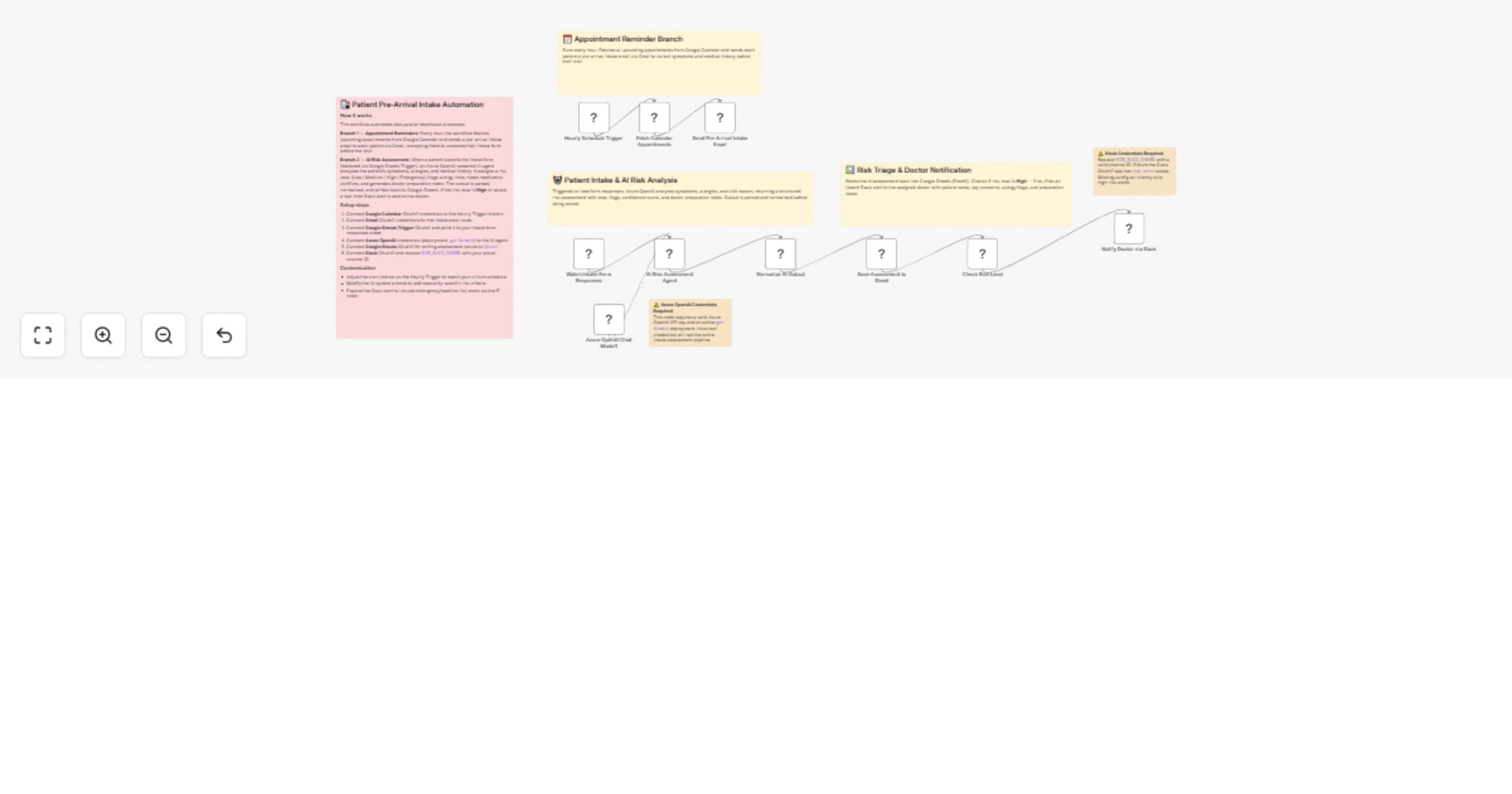
Workflow preview
100%
Automate patient intake and AI risk triage with Azure OpenAI, Google, and Slack preview
Open on n8n.io

1. Workflow Overview

Description Automate patient pre arrival intake, AI risk assessment, and real time doctor alerts in one seamless healthcare workflow. This automation sends scheduled intake reminders before ...

Best for

  • Document Extraction automation workflows
  • AI Summarization automation workflows
  • advanced n8n builders looking for reusable templates

Tools used

n8n-nodes-base.stickynote, n8n-nodes-base.cron, n8n-nodes-base.googlecalendar, n8n-nodes-base.gmail, n8n-nodes-base.googlesheetstrigger, @n8n/n8n-nodes-langchain.agent, n8n-nodes-base.code, n8n-nodes-base.googlesheets

Source and attribution

This workflow is cataloged by N8N Workflows and links back to its original n8n.io source page by Rahul Joshi.

Original n8n.io source

1.1 Workflow description

Title
Automate patient intake and AI risk triage with Azure OpenAI, Google, and Slack
Workflow name
Automate patient intake and AI risk triage with Azure OpenAI, Google, and Slack

πŸ“Š Description

Automate patient pre-arrival intake, AI risk assessment, and real-time doctor alerts in one seamless healthcare workflow. β°πŸ“§ This automation sends scheduled intake reminders before appointments, analyzes submitted patient data using AI, and flags high-risk cases instantly via Slack. Powered by Azure OpenAI, it evaluates symptoms, allergies, and medical history to generate structured risk levels and doctor preparation notes. Reduce manual triage work, improve patient safety, and ensure physicians are fully prepared before every visit. πŸ€–πŸš¨

πŸ”„ What This Template Does

⏰ Runs hourly to fetch upcoming appointments from Google Calendar. πŸ“§ Sends pre-arrival intake emails to patients via Gmail. πŸ“Š Monitors new intake form submissions in Google Sheets. πŸ€– Analyzes symptoms and medical history using Azure OpenAI (GPT-4o-mini). 🧹 Parses and normalizes structured AI output for consistency. πŸ“ Stores risk level and doctor notes back into Google Sheets. 🚨 Sends instant Slack alerts if a patient is classified as High risk.

βœ… Key Benefits

βœ… Automates pre-visit intake collection with zero manual follow-up βœ… Uses AI-powered risk triage to support clinical decision-making βœ… Flags high-risk or urgent cases instantly βœ… Reduces front-desk workload and manual screening time βœ… Improves patient safety through structured early assessment βœ… Ensures doctors are prepared before appointments begin

βš™οΈ Features

  • Google Calendar hourly appointment trigger
  • Gmail automated intake reminder emails
  • Google Sheets real-time form monitoring
  • Azure OpenAI GPT-4o-mini risk assessment engine
  • Structured JSON AI output with confidence scoring
  • Automatic data normalization and formatting
  • Conditional risk triage logic (Low / Medium / High / Emergency)
  • Slack instant doctor notifications for critical cases

πŸ” Requirements

  • Google Calendar OAuth2 credentials
  • Gmail OAuth2 credentials
  • Google Sheets OAuth2 credentials
  • Azure OpenAI API credentials (GPT-4o-mini deployment)
  • Slack OAuth2 credentials

🎯 Target Audience

  • Private clinics and healthcare providers
  • Telemedicine platforms
  • Medical practices handling high patient volume
  • Healthcare automation consultants and digital health startups

1.2 Logical Blocks

This catalog entry is organized from the workflow JSON. The node-level section below shows the executable blocks available for review before importing the template.

2. Block-by-Block Analysis

Block 1 - πŸ“‹ Overview

Type / Role
n8n-nodes-base.stickyNote - stickyNote
Config choices
Version 1

Block 2 - Section: Appointment Reminder

Type / Role
n8n-nodes-base.stickyNote - stickyNote
Config choices
Version 1

Block 3 - Section: Intake & AI Analysis

Type / Role
n8n-nodes-base.stickyNote - stickyNote
Config choices
Version 1

Block 4 - Section: Risk Triage & Notification

Type / Role
n8n-nodes-base.stickyNote - stickyNote
Config choices
Version 1

Block 5 - ⚠️ Warning: Slack Config

Type / Role
n8n-nodes-base.stickyNote - stickyNote
Config choices
Version 1

Block 6 - ⚠️ Warning: Azure OpenAI

Type / Role
n8n-nodes-base.stickyNote - stickyNote
Config choices
Version 1

Block 7 - Hourly Schedule Trigger

Type / Role
n8n-nodes-base.cron - cron
Config choices
Version 1

Block 8 - Fetch Calendar Appointments

Type / Role
n8n-nodes-base.googleCalendar - googleCalendar
Config choices
Version 1

Block 9 - Send Pre-Arrival Intake Email

Type / Role
n8n-nodes-base.gmail - gmail
Config choices
Version 1

Block 10 - Watch Intake Form Responses

Type / Role
n8n-nodes-base.googleSheetsTrigger - googleSheetsTrigger
Config choices
Version 1

Block 11 - AI Risk Assessment Agent

Type / Role
@n8n/n8n-nodes-langchain.agent - agent
Config choices
Version 3

Block 12 - Normalize AI Output

Type / Role
n8n-nodes-base.code - code
Config choices
Version 2

Block 13 - Save Assessment to Sheet

Type / Role
n8n-nodes-base.googleSheets - googleSheets
Config choices
Version 4.7

Block 14 - Check Risk Level

Type / Role
n8n-nodes-base.if - if
Config choices
Version 1

Block 15 - Notify Doctor via Slack

Type / Role
n8n-nodes-base.slack - slack
Config choices
Version 1

Block 16 - Azure OpenAI Chat Model1

Type / Role
@n8n/n8n-nodes-langchain.lmChatAzureOpenAi - lmChatAzureOpenAi
Config choices
Version 1

3. Summary Table

Workflow Automate patient intake and AI risk triage with Azure OpenAI, Google, and Slack
Complexity advanced
Nodes 16
Categories Document Extraction, AI Summarization
Author Rahul Joshi
Published 19 Feb 2026

4. Reproducing the Workflow from Scratch

  1. 1. Download the workflow JSON

    Use the JSON export at /data/workflows/13520/13520.json as the source template for this automation.

  2. 2. Import the template into n8n

    Open n8n, import the downloaded JSON, and review each node before activating the workflow.

  3. 3. Configure credentials and variables

    Replace placeholder credentials, API keys, webhook URLs, account IDs, and environment-specific values with your own settings.

  4. 4. Test with sample data

    Run the workflow manually or in a staging workspace, inspect node output, and confirm downstream systems receive the expected data.

  5. 5. Activate and monitor

    Enable the workflow only after testing, then monitor executions, errors, and rate limits during the first production runs.

5. General Notes & Resources

Review imported nodes carefully before activation. This catalog entry is intended to help you inspect the workflow structure, understand required services, and find related templates faster.

Node names, credentials, schedules, webhook paths, and external service limits may need adjustment for your workspace.

Frequently asked questions

What does Automate patient intake and AI risk triage with Azure OpenAI, Google, and Slack do?

Description Automate patient pre arrival intake, AI risk assessment, and real time doctor alerts in one seamless healthcare workflow. This automation sends scheduled intake reminders before ...

What do I need before importing this workflow?

Review the workflow JSON, configure any required credentials in n8n, and test the automation in a safe workspace before using it in production.

Can I customize this workflow?

Yes. Use the block-by-block analysis and the downloadable JSON to inspect each node, then adjust credentials, prompts, schedules, filters, or destinations for your Document Extraction, AI Summarization use case.



