Block 1 - Portainer Webhook
- Type / Role
- n8n-nodes-base.httpRequest - httpRequest
- Config choices
- Version 4.2
This workflow is provided as-is. Please review and test before using in production.
Purpose of the Workflow: The Update N8N workflow is designed to automatically trigger a (Portainer) webhook to update an N8N container, but only if a new version of N8N is available. ️ Detailed...
n8n-nodes-base.httprequest, n8n-nodes-base.scheduletrigger, n8n-nodes-base.if, n8n-nodes-base.code, n8n-nodes-base.stickynote
This workflow is cataloged by N8N Workflows and links back to its original n8n.io source page by Dominic Spatz.
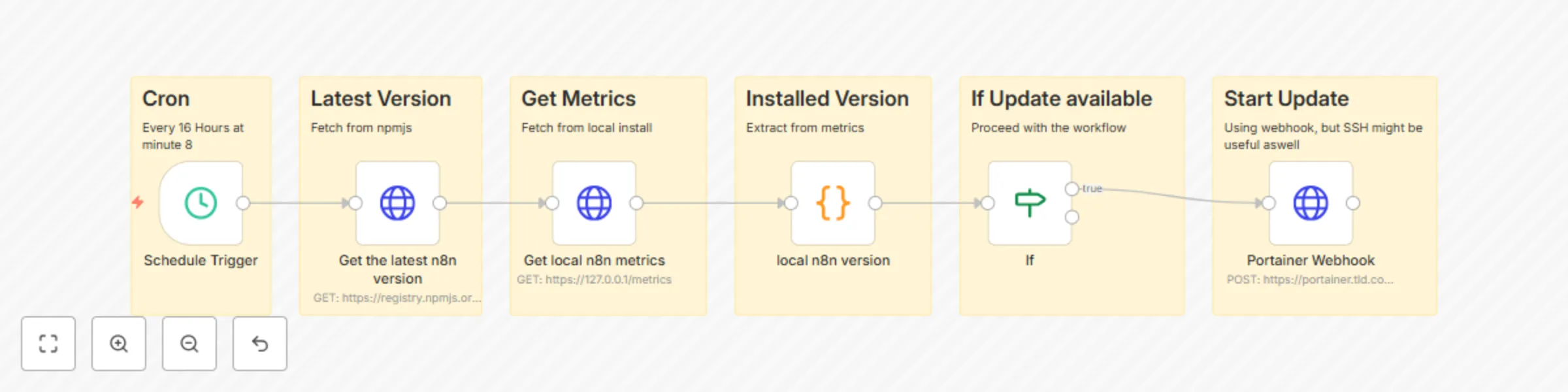
Original n8n.io source🔄 Purpose of the Workflow: The Update-N8N workflow is designed to automatically trigger a (Portainer) webhook to update an N8N container, but only if a new version of N8N is available.
⚙️ Detailed Workflow Steps: 🕒 Scheduled Trigger The workflow runs every 16 hours at minute 8 using a schedule trigger node.
🌐 Fetch Latest N8N Version It sends an HTTP GET request to https://registry.npmjs.org/n8n/latest to retrieve the latest published N8N version from the npm registry.
📈 Get Currently Running Local Version Another HTTP GET request is sent to https://127.0.0.1/metrics (likely the Prometheus metrics endpoint of the local N8N instance) to extract the currently installed N8N version.
🧠 Version Comparison The workflow compares the local version (parsed from metrics) with the latest available version.
📬 Trigger Portainer Webhook If the versions do not match (i.e., an update is available), a POST request is sent to a webhook URL, which might be a Portainer webhook that redeploys or updates the N8N container/stack.
✅ Key Benefits: No manual checks or updates needed.
Triggers only when a new version is available.
Integrates seamlessly with Portainer via webhook.
Secure configuration, e.g., disallowing unauthorized TLS certs for external requests.
This catalog entry is organized from the workflow JSON. The node-level section below shows the executable blocks available for review before importing the template.
| Workflow | Automate n8n updates with version checking and Portainer webhook |
|---|---|
| Complexity | intermediate |
| Nodes | 12 |
| Categories | DevOps |
| Author | Dominic Spatz |
| Published | 06 Aug 2025 |
Use the JSON export at /data/workflows/7061/7061.json as the source template for this automation.
Open n8n, import the downloaded JSON, and review each node before activating the workflow.
Replace placeholder credentials, API keys, webhook URLs, account IDs, and environment-specific values with your own settings.
Run the workflow manually or in a staging workspace, inspect node output, and confirm downstream systems receive the expected data.
Enable the workflow only after testing, then monitor executions, errors, and rate limits during the first production runs.
Review imported nodes carefully before activation. This catalog entry is intended to help you inspect the workflow structure, understand required services, and find related templates faster.
Node names, credentials, schedules, webhook paths, and external service limits may need adjustment for your workspace.
Purpose of the Workflow: The Update N8N workflow is designed to automatically trigger a (Portainer) webhook to update an N8N container, but only if a new version of N8N is available. ️ Detailed...
Review the workflow JSON, configure any required credentials in n8n, and test the automation in a safe workspace before using it in production.
Yes. Use the block-by-block analysis and the downloadable JSON to inspect each node, then adjust credentials, prompts, schedules, filters, or destinations for your DevOps use case.