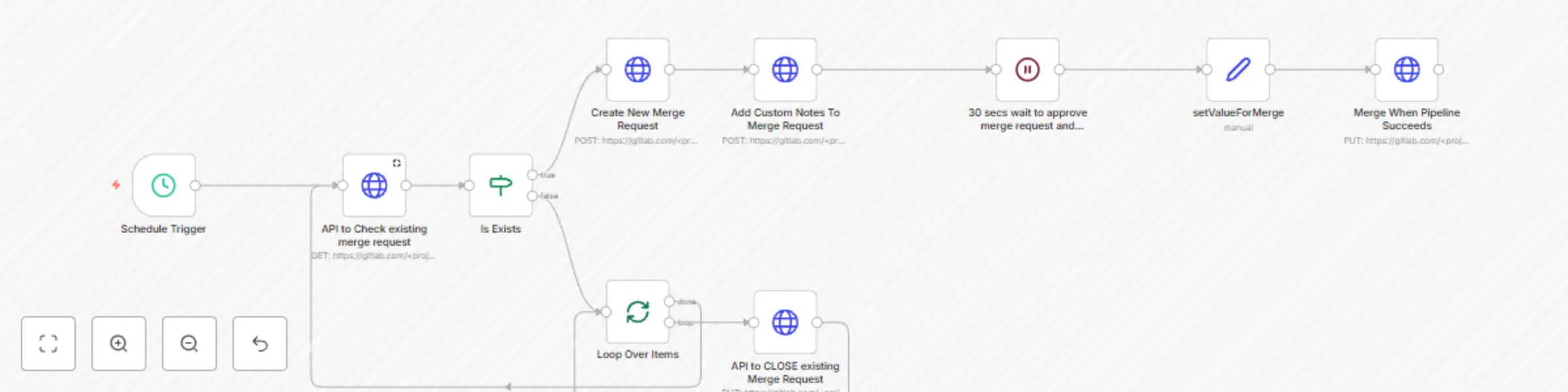
Block 1 - API to Check existing merge request
- Type / Role
- n8n-nodes-base.httpRequest - httpRequest
- Config choices
- Version 4.2
This workflow is provided as-is. Please review and test before using in production.
Who is this template for? This template is designed for developers, DevOps engineers, and automation enthusiasts who want to streamline their GitLab merge request process using n8n, a low code work...
n8n-nodes-base.httprequest, n8n-nodes-base.if, n8n-nodes-base.splitinbatches, n8n-nodes-base.wait, n8n-nodes-base.set, n8n-nodes-base.scheduletrigger
This workflow is cataloged by N8N Workflows and links back to its original n8n.io source page by Aditya Gaur.
Original n8n.io sourceThis template is designed for developers, DevOps engineers, and automation enthusiasts who want to streamline their GitLab merge request process using n8n, a low-code workflow automation tool. It eliminates manual intervention by automating the merging of GitLab branches through API calls.
Trigger the workflow: The workflow can be triggered by a webhook, a scheduled event, or a GitLab event (e.g., a new merge request is created or approved).
Fetch Merge Request Details: n8n makes an API call to GitLab to retrieve merge request details.
Check Merge Conditions: The workflow validates whether the merge request meets predefined conditions (e.g., approvals met, CI/CD pipelines passed).
Perform the Merge: If all conditions are met, n8n sends a request to the GitLab API to merge the branch automatically.
1. Prerequisites
An n8n instance (Self-hosted or Cloud)
A GitLab personal access token with API access
A GitLab repository with merge requests enabled
2. Create the n8n Workflow
Set up a trigger: Choose a trigger node (Webhook, Cron, or GitLab Trigger).
Fetch merge request details: Add an HTTP Request node to call GET /merge_requests/:id from GitLab API.
Validate conditions:
Check if the merge request has necessary approvals.
Ensure CI/CD pipelines have passed.
Merge the request:
Use an HTTP Request node to call PUT /merge_requests/:id/merge API.
3. Test the Workflow
Create a test merge request.
Check if the workflow triggers and merges automatically.
Debug using n8n logs if needed.
4. Deploy and Monitor
Deploy the workflow in production.
Use n8n’s monitoring features to track execution.
This template enables seamless GitLab merge automation, improving efficiency and reducing manual work!
Never hard code API token or secret in your https request.
This catalog entry is organized from the workflow JSON. The node-level section below shows the executable blocks available for review before importing the template.
| Workflow | Automate GitLab merge requests using APIs with n8n |
|---|---|
| Complexity | intermediate |
| Nodes | 10 |
| Categories | DevOps |
| Author | Aditya Gaur |
| Published | 07 Feb 2025 |
Use the JSON export at /data/workflows/2858/2858.json as the source template for this automation.
Open n8n, import the downloaded JSON, and review each node before activating the workflow.
Replace placeholder credentials, API keys, webhook URLs, account IDs, and environment-specific values with your own settings.
Run the workflow manually or in a staging workspace, inspect node output, and confirm downstream systems receive the expected data.
Enable the workflow only after testing, then monitor executions, errors, and rate limits during the first production runs.
Review imported nodes carefully before activation. This catalog entry is intended to help you inspect the workflow structure, understand required services, and find related templates faster.
Node names, credentials, schedules, webhook paths, and external service limits may need adjustment for your workspace.
Who is this template for? This template is designed for developers, DevOps engineers, and automation enthusiasts who want to streamline their GitLab merge request process using n8n, a low code work...
Review the workflow JSON, configure any required credentials in n8n, and test the automation in a safe workspace before using it in production.
Yes. Use the block-by-block analysis and the downloadable JSON to inspect each node, then adjust credentials, prompts, schedules, filters, or destinations for your DevOps use case.