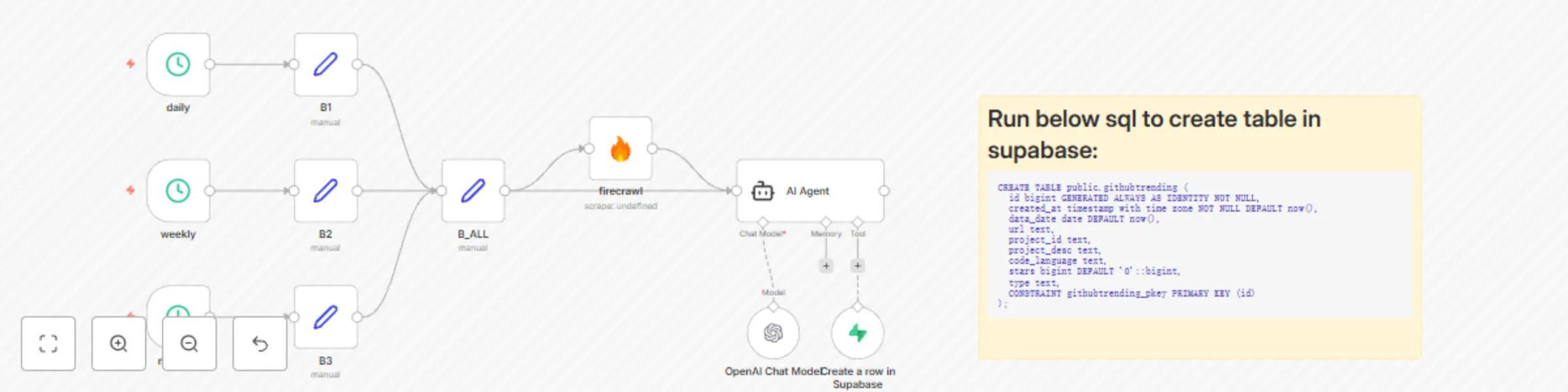
Block 1 - AI Agent
- Type / Role
- @n8n/n8n-nodes-langchain.agent - agent
- Config choices
- Version 2.2
This workflow is provided as-is. Please review and test before using in production.
GitHub Trending to Supabase (Daily, Weekly, Monthly) Who is this for? This workflow is for developers, researchers, founders, and data analysts who want a historical dataset of GitHub Trending repo...
@n8n/n8n-nodes-langchain.agent, n8n-nodes-base.supabasetool, @n8n/n8n-nodes-langchain.lmchatopenai, n8n-nodes-base.scheduletrigger, @mendable/n8n-nodes-firecrawl.firecrawl, n8n-nodes-base.stickynote, n8n-nodes-base.set
This workflow is cataloged by N8N Workflows and links back to its original n8n.io source page by Cai Yongji.
Original n8n.io sourceThis workflow is for developers, researchers, founders, and data analysts who want a historical dataset of GitHub Trending repositories without manual scraping. It’s ideal for building dashboards, newsletters, or trend analytics on top of a clean Supabase table.
Checking GitHub Trending by hand (daily/weekly/monthly) is repetitive and error-prone. This workflow automates collection, parsing, and storage so you can reliably track changes over time and query them from Supabase.
name, url, description, language, stars.type dimension (daily / weekly / monthly) to each row.Ensure you have an n8n instance (Cloud or self-hosted).
Create credentials:
Prepare a Supabase table (example):
CREATE TABLE public.githubtrending (
id bigint GENERATED ALWAYS AS IDENTITY NOT NULL,
created_at timestamp with time zone NOT NULL DEFAULT now(),
data_date date DEFAULT now(),
url text,
project_id text,
project_desc text,
code_language text,
stars bigint DEFAULT '0'::bigint,
type text,
CONSTRAINT githubtrending_pkey PRIMARY KEY (id)
);
Import this workflow JSON into n8n.
Run once to validate, then schedule (e.g., daily at 08:00).
This catalog entry is organized from the workflow JSON. The node-level section below shows the executable blocks available for review before importing the template.
| Workflow | Automate GitHub trending data collection with FireCrawl, GPT and Supabase |
|---|---|
| Complexity | intermediate |
| Nodes | 12 |
| Categories | Engineering, Multimodal AI |
| Author | Cai Yongji |
| Published | 14 Aug 2025 |
Use the JSON export at /data/workflows/7394/7394.json as the source template for this automation.
Open n8n, import the downloaded JSON, and review each node before activating the workflow.
Replace placeholder credentials, API keys, webhook URLs, account IDs, and environment-specific values with your own settings.
Run the workflow manually or in a staging workspace, inspect node output, and confirm downstream systems receive the expected data.
Enable the workflow only after testing, then monitor executions, errors, and rate limits during the first production runs.
Review imported nodes carefully before activation. This catalog entry is intended to help you inspect the workflow structure, understand required services, and find related templates faster.
Node names, credentials, schedules, webhook paths, and external service limits may need adjustment for your workspace.
GitHub Trending to Supabase (Daily, Weekly, Monthly) Who is this for? This workflow is for developers, researchers, founders, and data analysts who want a historical dataset of GitHub Trending repo...
Review the workflow JSON, configure any required credentials in n8n, and test the automation in a safe workspace before using it in production.
Yes. Use the block-by-block analysis and the downloadable JSON to inspect each node, then adjust credentials, prompts, schedules, filters, or destinations for your Engineering, Multimodal AI use case.