
Automate GitHub, JIRA release notes with Google Gemini & notification over email

Workflow preview
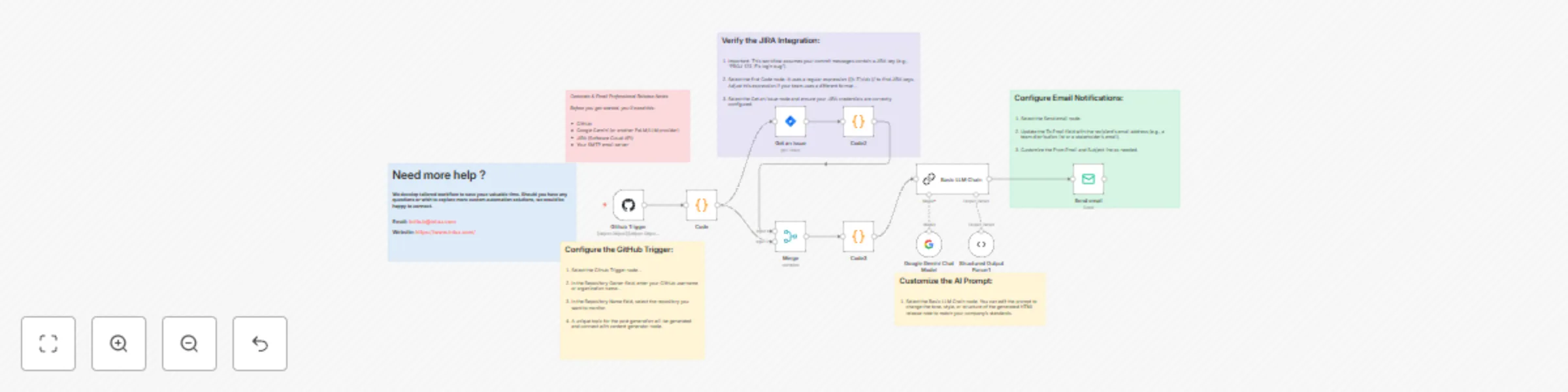
Workflow preview
100%
Automate GitHub, JIRA release notes with Google Gemini & notification over email preview
Open on n8n.io

Important notice

This workflow is provided as-is. Please review and test before using in production.

1. Workflow Overview

This n8n template from Intuz provides a complete and automated solution for creating and distributing sophisticated release notes. It connects to GitHub and JIR...

Best for

  • DevOps automation workflows
  • AI Summarization automation workflows
  • advanced n8n builders looking for reusable templates

Tools used

n8n-nodes-base.githubtrigger, n8n-nodes-base.code, @n8n/n8n-nodes-langchain.chainllm, @n8n/n8n-nodes-langchain.lmchatgooglegemini, n8n-nodes-base.emailsend, n8n-nodes-base.jira, n8n-nodes-base.merge, @n8n/n8n-nodes-langchain.outputparserstructured

Source and attribution

This workflow is cataloged by N8N Workflows and links back to its original n8n.io source page by Intuz .

Original n8n.io source

1.1 Workflow description

Title
Automate GitHub, JIRA release notes with Google Gemini & notification over email
Workflow name
Automate GitHub, JIRA release notes with Google Gemini & notification over email

This n8n template from Intuz provides a complete and automated solution for creating and distributing sophisticated release notes.

It connects to GitHub and JIRA to gather data from recent commits and completed tickets, using specific keywords or labels to identify key features for inclusion.

This information is then processed by Google Gemini to automatically generate well-written, human-like release notes, which are then distributed via email to stakeholders, creating a complete, end-to-end communication pipeline for every new software release.

This template is perfect for development teams looking to streamline their release process, ensure consistent communication, and eliminate the manual effort of writing release notes.

How to use

1. Set up Credentials:

  • GitHub
  • JIRA (Software Cloud API)
  • Google Gemini (or another PaLM/LLM provider)
  • Your SMTP email server.

2. Configure the GitHub Trigger:

  • Select the Github Trigger node.
  • In the Repository Owner field, enter your GitHub username or organization name.
  • In the Repository Name field, select the repository you want to monitor.

3. Verify the JIRA Integration:

  • Important: This workflow assumes your commit messages contain a JIRA key (e.g., "PROJ-123: Fix login bug").
  • Select the first Code node. It uses a regular expression ([A-Z]+-\d+)/i to find JIRA keys. Adjust this expression if your team uses a different format.
  • Select the Get an issue node and ensure your JIRA credentials are correctly configured.

4. Customize the AI Prompt:

  • Select the Basic LLM Chain node. You can edit the prompt to change the tone, style, or structure of the generated HTML release note to match your company's standards.

5. Configure Email Notifications:

  • Select the Send email node.
  • Update the To Email field with the recipient's email address (e.g., a team distribution list or a stakeholder's email).
  • Customize the From Email and Subject line as needed.

6. Activate Workflow:

  • Save your changes and activate the workflow. Now, every push to your configured repository will trigger the automated generation and sending of release notes.

Required Tools

  • GitHub: To trigger the workflow on code pushes.
  • JIRA: To fetch details about the tasks and bugs included in the release.
  • Google Gemini: To intelligently generate the release note content. (You can swap this for another LLM supported by n8n).
  • SMTP Provider: To send the final release note via email.

Connect with us

For Custom Worflow Automation

Click here- Get Started

1.2 Logical Blocks

This catalog entry is organized from the workflow JSON. The node-level section below shows the executable blocks available for review before importing the template.

2. Block-by-Block Analysis

Block 1 - Github Trigger

Type / Role
n8n-nodes-base.githubTrigger - githubTrigger
Config choices
Version 1

Block 2 - Code

Type / Role
n8n-nodes-base.code - code
Config choices
Version 2

Block 3 - Basic LLM Chain

Type / Role
@n8n/n8n-nodes-langchain.chainLlm - chainLlm
Config choices
Version 1.7

Block 4 - Google Gemini Chat Model

Type / Role
@n8n/n8n-nodes-langchain.lmChatGoogleGemini - lmChatGoogleGemini
Config choices
Version 1

Block 5 - Send email

Type / Role
n8n-nodes-base.emailSend - emailSend
Config choices
Version 2.1

Block 6 - Get an issue

Type / Role
n8n-nodes-base.jira - jira
Config choices
Version 1

Block 7 - Code2

Type / Role
n8n-nodes-base.code - code
Config choices
Version 2

Block 8 - Merge

Type / Role
n8n-nodes-base.merge - merge
Config choices
Version 3.2

Block 9 - Code3

Type / Role
n8n-nodes-base.code - code
Config choices
Version 2

Block 10 - Structured Output Parser1

Type / Role
@n8n/n8n-nodes-langchain.outputParserStructured - outputParserStructured
Config choices
Version 1.3

Block 11 - Sticky Note

Type / Role
n8n-nodes-base.stickyNote - stickyNote
Config choices
Version 1

Block 12 - Sticky Note1

Type / Role
n8n-nodes-base.stickyNote - stickyNote
Config choices
Version 1

Block 13 - Sticky Note2

Type / Role
n8n-nodes-base.stickyNote - stickyNote
Config choices
Version 1

Block 14 - Sticky Note3

Type / Role
n8n-nodes-base.stickyNote - stickyNote
Config choices
Version 1

Block 15 - Sticky Note4

Type / Role
n8n-nodes-base.stickyNote - stickyNote
Config choices
Version 1

Block 16 - Sticky Note9

Type / Role
n8n-nodes-base.stickyNote - stickyNote
Config choices
Version 1

3. Summary Table

Workflow Automate GitHub, JIRA release notes with Google Gemini & notification over email
Complexity advanced
Nodes 16
Categories DevOps, AI Summarization
Author Intuz
Published 18 Jul 2025

4. Reproducing the Workflow from Scratch

  1. 1. Download the workflow JSON

    Use the JSON export at /data/workflows/6129/6129.json as the source template for this automation.

  2. 2. Import the template into n8n

    Open n8n, import the downloaded JSON, and review each node before activating the workflow.

  3. 3. Configure credentials and variables

    Replace placeholder credentials, API keys, webhook URLs, account IDs, and environment-specific values with your own settings.

  4. 4. Test with sample data

    Run the workflow manually or in a staging workspace, inspect node output, and confirm downstream systems receive the expected data.

  5. 5. Activate and monitor

    Enable the workflow only after testing, then monitor executions, errors, and rate limits during the first production runs.

5. General Notes & Resources

Review imported nodes carefully before activation. This catalog entry is intended to help you inspect the workflow structure, understand required services, and find related templates faster.

Node names, credentials, schedules, webhook paths, and external service limits may need adjustment for your workspace.

Frequently asked questions

What does Automate GitHub, JIRA release notes with Google Gemini & notification over email do?

This n8n template from Intuz provides a complete and automated solution for creating and distributing sophisticated release notes. It connects to GitHub and JIR...

What do I need before importing this workflow?

Review the workflow JSON, configure any required credentials in n8n, and test the automation in a safe workspace before using it in production.

Can I customize this workflow?

Yes. Use the block-by-block analysis and the downloadable JSON to inspect each node, then adjust credentials, prompts, schedules, filters, or destinations for your DevOps, AI Summarization use case.



