
Automate daily signup stats from PostgreSQL to Slack, Teams & Telegram

Workflow preview
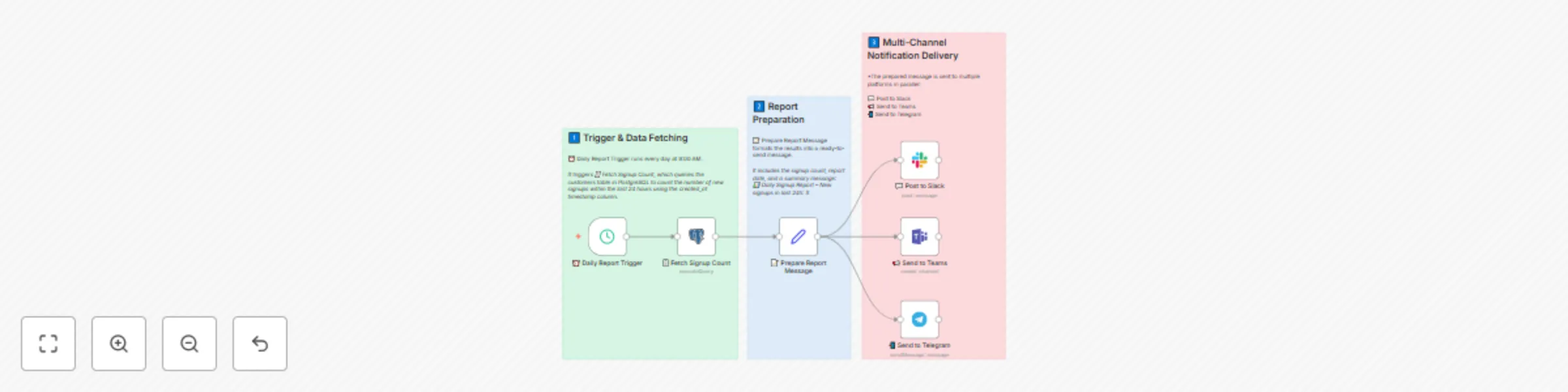
Workflow preview
100%
Automate daily signup stats from PostgreSQL to Slack, Teams & Telegram preview
Open on n8n.io

Important notice

This workflow is provided as-is. Please review and test before using in production.

1. Workflow Overview

How it works This workflow automatically pulls daily signup stats from your PostgreSQL database and shares them with your team across multiple channels. Every morning, it counts the number of new s...

Best for

  • Social Media automation workflows
  • intermediate n8n builders looking for reusable templates

Tools used

n8n-nodes-base.stickynote, n8n-nodes-base.scheduletrigger, n8n-nodes-base.postgres, n8n-nodes-base.set, n8n-nodes-base.slack, n8n-nodes-base.microsoftteams, n8n-nodes-base.telegram

Source and attribution

This workflow is cataloged by N8N Workflows and links back to its original n8n.io source page by Avkash Kakdiya.

Original n8n.io source

1.1 Workflow description

Title
Automate daily signup stats from PostgreSQL to Slack, Teams & Telegram
Workflow name
Automate daily signup stats from PostgreSQL to Slack, Teams & Telegram

How it works

This workflow automatically pulls daily signup stats from your PostgreSQL database and shares them with your team across multiple channels. Every morning, it counts the number of new signups in the last 24 hours, formats the results into a concise report, and posts it to Slack, Microsoft Teams, and Telegram. This ensures your entire team stays updated on customer growth without manual queries or reporting.

Step-by-step

Daily Trigger & Data Fetching

  • The Daily Report Trigger runs at 9:00 AM each day.

  • The Fetch Signup Count node queries the customers table in PostgreSQL.

  • It calculates the number of new signups in the last 24 hours using the created_at timestamp column.

Report Preparation

  • The Prepare Report Message node formats the results into a structured message:

    • Report date

    • Signup count

    • A clear summary line:

Daily Signup Report – New signups in the last 24h: X

Multi-Channel Delivery

  • The prepared message is sent to multiple platforms simultaneously:

    • Slack

    • Microsoft Teams

    • Telegram

  • This ensures all teams receive the update in their preferred communication tool.

Why use this?

  • Automates daily customer growth reporting.

  • Eliminates manual SQL queries and report sharing.

  • Keeps the whole team aligned with real-time growth metrics.

  • Delivers updates across Slack, Teams, and Telegram at once.

  • Provides simple, consistent reporting every day.

1.2 Logical Blocks

This catalog entry is organized from the workflow JSON. The node-level section below shows the executable blocks available for review before importing the template.

2. Block-by-Block Analysis

Block 1 - Database Config Instructions

Type / Role
n8n-nodes-base.stickyNote - stickyNote
Config choices
Version 1

Block 2 - Messaging Config Instructions

Type / Role
n8n-nodes-base.stickyNote - stickyNote
Config choices
Version 1

Block 3 - ⏰ Daily Report Trigger

Type / Role
n8n-nodes-base.scheduleTrigger - scheduleTrigger
Config choices
Version 1.2

Block 4 - 🗄️ Fetch Signup Count

Type / Role
n8n-nodes-base.postgres - postgres
Config choices
Version 2.4

Block 5 - 📝 Prepare Report Message

Type / Role
n8n-nodes-base.set - set
Config choices
Version 2

Block 6 - 💬 Post to Slack

Type / Role
n8n-nodes-base.slack - slack
Config choices
Version 1

Block 7 - 📢 Send to Teams

Type / Role
n8n-nodes-base.microsoftTeams - microsoftTeams
Config choices
Version 1

Block 8 - 📲 Send to Telegram

Type / Role
n8n-nodes-base.telegram - telegram
Config choices
Version 1.1

Block 9 - Messaging Config Instructions1

Type / Role
n8n-nodes-base.stickyNote - stickyNote
Config choices
Version 1

3. Summary Table

Workflow Automate daily signup stats from PostgreSQL to Slack, Teams & Telegram
Complexity intermediate
Nodes 9
Categories Social Media
Author Avkash Kakdiya
Published 08 Sept 2025

4. Reproducing the Workflow from Scratch

  1. 1. Download the workflow JSON

    Use the JSON export at /data/workflows/8362/8362.json as the source template for this automation.

  2. 2. Import the template into n8n

    Open n8n, import the downloaded JSON, and review each node before activating the workflow.

  3. 3. Configure credentials and variables

    Replace placeholder credentials, API keys, webhook URLs, account IDs, and environment-specific values with your own settings.

  4. 4. Test with sample data

    Run the workflow manually or in a staging workspace, inspect node output, and confirm downstream systems receive the expected data.

  5. 5. Activate and monitor

    Enable the workflow only after testing, then monitor executions, errors, and rate limits during the first production runs.

5. General Notes & Resources

Review imported nodes carefully before activation. This catalog entry is intended to help you inspect the workflow structure, understand required services, and find related templates faster.

Node names, credentials, schedules, webhook paths, and external service limits may need adjustment for your workspace.

Frequently asked questions

What does Automate daily signup stats from PostgreSQL to Slack, Teams & Telegram do?

How it works This workflow automatically pulls daily signup stats from your PostgreSQL database and shares them with your team across multiple channels. Every morning, it counts the number of new s...

What do I need before importing this workflow?

Review the workflow JSON, configure any required credentials in n8n, and test the automation in a safe workspace before using it in production.

Can I customize this workflow?

Yes. Use the block-by-block analysis and the downloadable JSON to inspect each node, then adjust credentials, prompts, schedules, filters, or destinations for your Social Media use case.



