Automate academic literature reviews with GPT-4 and multi-database search
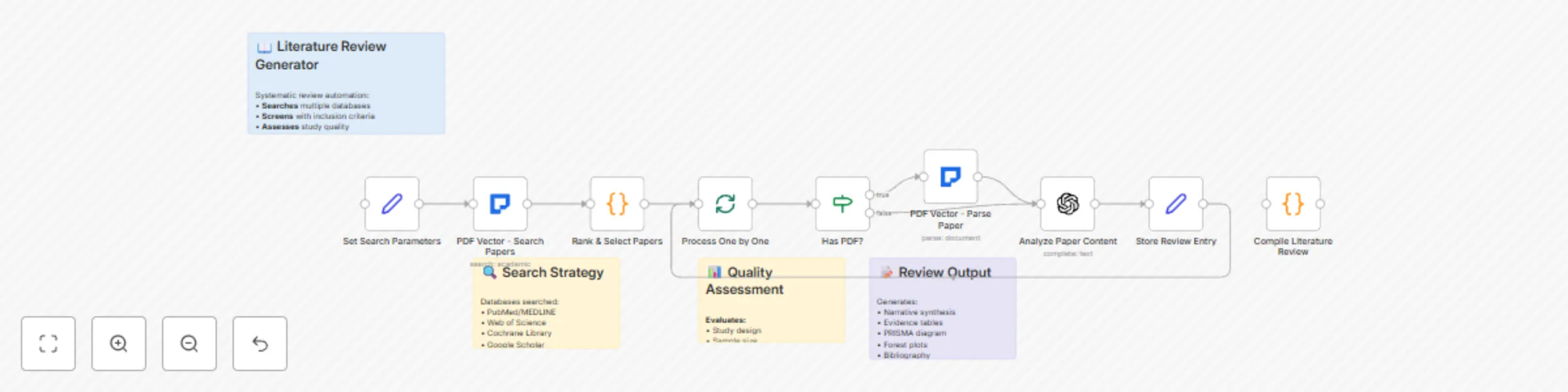
Workflow preview


 Early Deal
DISCOUNT 20%

Important notice
This workflow is provided as-is. Please review and test before using in production.
Overview
Overview
Conducting comprehensive literature reviews is one of the most time-consuming aspects of academic research. This workflow revolutionizes the process by automating literature search, paper analysis, and review generation across multiple academic databases. It handles both digital papers and scanned documents (PDFs, JPGs, PNGs), using OCR technology for older publications or image-based content.
What You Can Do
- Automate searches across multiple academic databases simultaneously
- Analyze and rank papers by relevance, citations, and impact
- Generate comprehensive literature reviews with proper citations
- Process both digital and scanned documents with OCR
- Identify research gaps and emerging trends systematically
Who It's For
Researchers, graduate students, academic institutions, literature review teams, and academic writers who need to conduct comprehensive literature reviews efficiently while maintaining high quality and thoroughness.
The Problem It Solves
Manual literature reviews are extremely time-consuming and often miss relevant papers across different databases. Researchers struggle to synthesize large volumes of academic papers, track citations properly, and identify research gaps systematically. This template automates the entire process from search to synthesis, ensuring comprehensive coverage and proper citation management.
Setup Instructions:
- Configure PDF Vector API credentials with academic search access
- Set up search parameters including databases and date ranges
- Define inclusion and exclusion criteria for paper selection
- Choose citation style (APA, MLA, Chicago, etc.)
- Configure output format preferences
- Set up reference management software integration if needed
- Define research topic and keywords for search
Key Features:
- Simultaneous search across PubMed, arXiv, Semantic Scholar, and other databases
- Intelligent paper ranking based on citation count, recency, and relevance
- OCR support for scanned documents and older publications
- Automatic extraction of methodologies, findings, and limitations
- Citation network analysis to identify seminal works
- Automatic theme organization and research gap identification
- Multiple citation format support (APA, MLA, Chicago)
- Quality scoring based on journal impact factors
Customization Options:
- Configure search parameters for specific research domains
- Set up automated searches for ongoing literature monitoring
- Integrate with reference management software (Zotero, Mendeley)
- Customize output format and structure
- Add collaborative review features for research teams
- Set up quality filters based on journal rankings
- Configure notification systems for new relevant papers
Implementation Details: The workflow uses advanced algorithms to search multiple academic databases simultaneously, ranking papers by relevance and impact. It processes full-text PDFs when available and uses OCR for scanned documents. The system automatically extracts key information, organizes findings by themes, and generates structured literature reviews with proper citations and reference management.
Note: This workflow uses the PDF Vector community node. Make sure to install it from the n8n community nodes collection before using this template.