
Auto-heal failing workflows with Azure OpenAI, n8n API, and Slack alerts

Workflow preview
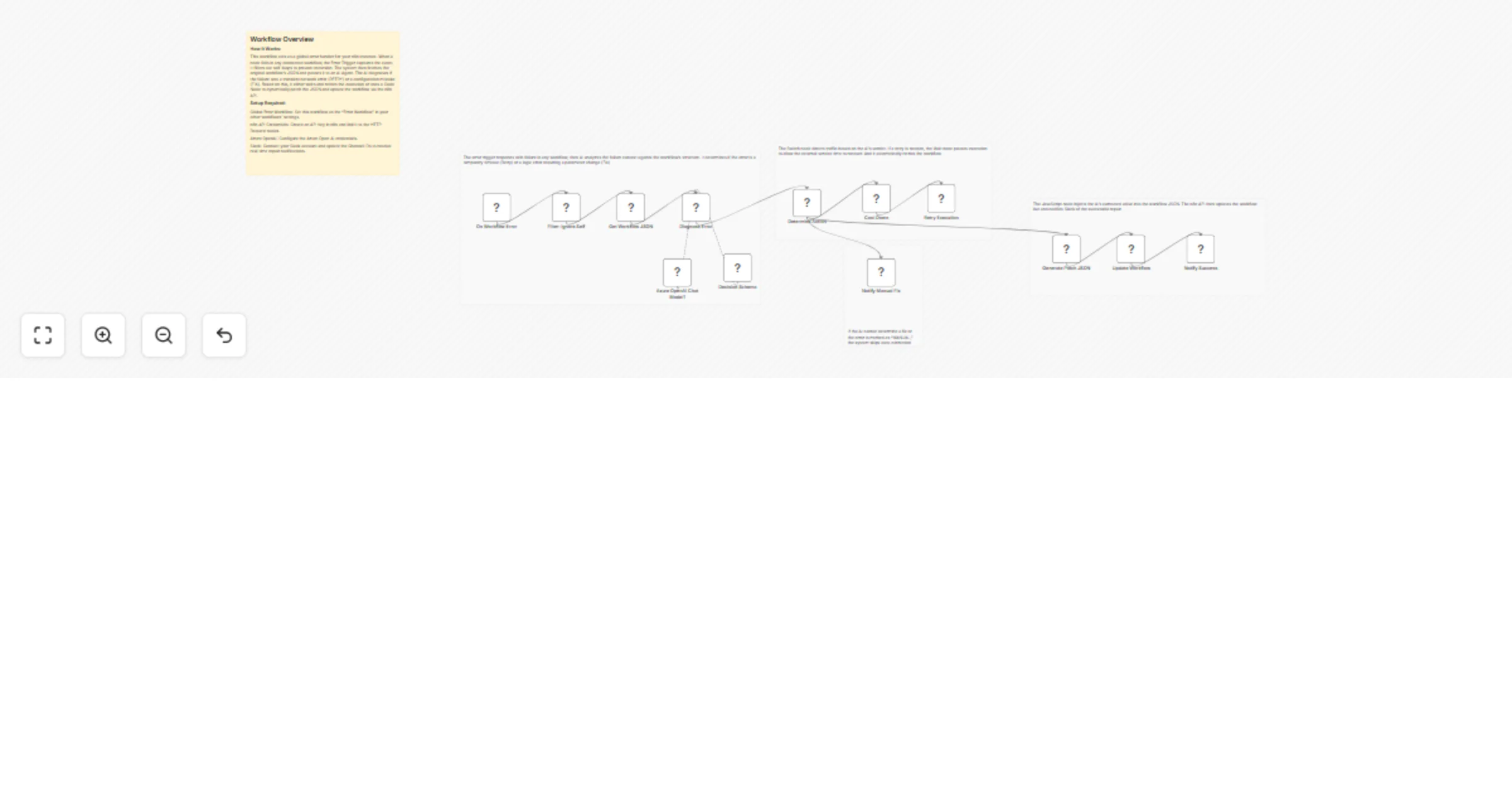
Workflow preview
100%
Auto-heal failing workflows with Azure OpenAI, n8n API, and Slack alerts preview
Open on n8n.io

1. Workflow Overview

Description Eliminate manual troubleshooting with an AI powered autonomous recovery engine for n8n . This system monitors your entire n8n instance for failures, analyzes the root cause using A...

Best for

  • DevOps automation workflows
  • AI Summarization automation workflows
  • advanced n8n builders looking for reusable templates

Tools used

@n8n/n8n-nodes-langchain.lmchatazureopenai, n8n-nodes-base.errortrigger, n8n-nodes-base.filter, n8n-nodes-base.httprequest, @n8n/n8n-nodes-langchain.agent, @n8n/n8n-nodes-langchain.outputparserstructured, n8n-nodes-base.switch, n8n-nodes-base.wait

Source and attribution

This workflow is cataloged by N8N Workflows and links back to its original n8n.io source page by Rahul Joshi.

Original n8n.io source

1.1 Workflow description

Title
Auto-heal failing workflows with Azure OpenAI, n8n API, and Slack alerts
Workflow name
Auto-heal failing workflows with Azure OpenAI, n8n API, and Slack alerts

📊 Description

Eliminate manual troubleshooting with an AI-powered autonomous recovery engine for n8n 🤖. This system monitors your entire n8n instance for failures, analyzes the root cause using Azure OpenAI, and automatically repairs broken workflows in real-time. By distinguishing between temporary network glitches and logic errors, it either retries the execution or dynamically patches the workflow JSON via the n8n API. It provides a "closed-loop" automation experience, ensuring your mission-critical processes stay online without human intervention 🔍⚡.

What This Template Does

  • Monitors All Workflows: Captures errors globally across your instance via the Error Trigger.
  • Prevents Infinite Loops: Automatically filters out errors originating from the healing system itself.
  • Fetches Live Context: Pulls the complete, latest JSON structure of the failing workflow for analysis.
  • AI Root Cause Analysis: Uses Azure OpenAI (GPT-4o) to diagnose if the issue is a "RETRY" (timeout/rate limit) or a "FIX" (invalid parameter/logic).
  • Autonomous Patching: For logic errors, a JavaScript engine injects the AI's corrected values directly into the workflow code.
  • Human-in-the-Loop Alerts: Sends detailed Slack notifications for successful auto-fixes or requests manual help if the error is too complex.

Key Benefits

✅ 24/7 Autonomous Reliability: Workflows fix themselves while you sleep, reducing downtime significantly. ✅ Intelligent Recovery: Moves beyond simple retries by actually correcting "hard" errors like broken IDs or missing parameters. ✅ Production-Grade Governance: Adds a safety layer to your automation stack that learns and adapts to errors.

Features

  • Global Error Listener: Catch-all trigger for instance-wide monitoring.
  • Dual-Path Recovery: Distinct logic branches for transient vs. permanent failures.
  • Wait-State Logic: Built-in "cool down" periods to respect external API rate limits during retries.
  • AI Patching Engine: Structured output parsing ensures the AI provides valid, deployable code changes.
  • Slack Integration: Real-time visibility into the "healing" process with deep-links to specific executions.

Requirements

  • n8n Instance: (Cloud or Self-hosted) with API access enabled.
  • Azure OpenAI Account: With GPT-4o deployment and valid API credentials.
  • n8n API Key: To allow the system to read and update workflows.
  • Slack App: For receiving diagnostic alerts and success notifications.

Target Audience

  • Enterprise Automation Teams: Managing high volumes of mission-critical workflows.
  • n8n Power Users: Looking to build "bulletproof" automation infrastructure.
  • SaaS Founders: Ensuring customer-facing integrations remain stable.
  • Managed Service Providers (MSPs): Offering proactive automation monitoring and maintenance.

1.2 Logical Blocks

This catalog entry is organized from the workflow JSON. The node-level section below shows the executable blocks available for review before importing the template.

2. Block-by-Block Analysis

Block 1 - Azure OpenAI Chat Model1

Type / Role
@n8n/n8n-nodes-langchain.lmChatAzureOpenAi - lmChatAzureOpenAi
Config choices
Version 1

Block 2 - On Workflow Error

Type / Role
n8n-nodes-base.errorTrigger - errorTrigger
Config choices
Version 1

Block 3 - Filter: Ignore Self

Type / Role
n8n-nodes-base.filter - filter
Config choices
Version 1

Block 4 - Get Workflow JSON

Type / Role
n8n-nodes-base.httpRequest - httpRequest
Config choices
Version 4.1

Block 5 - Diagnose Error

Type / Role
@n8n/n8n-nodes-langchain.agent - agent
Config choices
Version 2

Block 6 - Decision Schema

Type / Role
@n8n/n8n-nodes-langchain.outputParserStructured - outputParserStructured
Config choices
Version 1.1

Block 7 - Determine Action

Type / Role
n8n-nodes-base.switch - switch
Config choices
Version 3.4

Block 8 - Cool Down

Type / Role
n8n-nodes-base.wait - wait
Config choices
Version 1.1

Block 9 - Generate Patch JSON

Type / Role
n8n-nodes-base.code - code
Config choices
Version 2

Block 10 - Retry Execution

Type / Role
n8n-nodes-base.httpRequest - httpRequest
Config choices
Version 4.1

Block 11 - Update Workflow

Type / Role
n8n-nodes-base.httpRequest - httpRequest
Config choices
Version 4.1

Block 12 - Notify Success

Type / Role
n8n-nodes-base.slack - slack
Config choices
Version 2.1

Block 13 - Notify Manual Fix

Type / Role
n8n-nodes-base.slack - slack
Config choices
Version 2.1

Block 14 - Sticky Note

Type / Role
n8n-nodes-base.stickyNote - stickyNote
Config choices
Version 1

Block 15 - Sticky Note1

Type / Role
n8n-nodes-base.stickyNote - stickyNote
Config choices
Version 1

Block 16 - Sticky Note2

Type / Role
n8n-nodes-base.stickyNote - stickyNote
Config choices
Version 1

Block 17 - Sticky Note3

Type / Role
n8n-nodes-base.stickyNote - stickyNote
Config choices
Version 1

Block 18 - Sticky Note4

Type / Role
n8n-nodes-base.stickyNote - stickyNote
Config choices
Version 1

3. Summary Table

Workflow Auto-heal failing workflows with Azure OpenAI, n8n API, and Slack alerts
Complexity advanced
Nodes 18
Categories DevOps, AI Summarization
Author Rahul Joshi
Published 02 Mar 2026

4. Reproducing the Workflow from Scratch

  1. 1. Download the workflow JSON

    Use the JSON export at /data/workflows/13791/13791.json as the source template for this automation.

  2. 2. Import the template into n8n

    Open n8n, import the downloaded JSON, and review each node before activating the workflow.

  3. 3. Configure credentials and variables

    Replace placeholder credentials, API keys, webhook URLs, account IDs, and environment-specific values with your own settings.

  4. 4. Test with sample data

    Run the workflow manually or in a staging workspace, inspect node output, and confirm downstream systems receive the expected data.

  5. 5. Activate and monitor

    Enable the workflow only after testing, then monitor executions, errors, and rate limits during the first production runs.

5. General Notes & Resources

Review imported nodes carefully before activation. This catalog entry is intended to help you inspect the workflow structure, understand required services, and find related templates faster.

Node names, credentials, schedules, webhook paths, and external service limits may need adjustment for your workspace.

Frequently asked questions

What does Auto-heal failing workflows with Azure OpenAI, n8n API, and Slack alerts do?

Description Eliminate manual troubleshooting with an AI powered autonomous recovery engine for n8n . This system monitors your entire n8n instance for failures, analyzes the root cause using A...

What do I need before importing this workflow?

Review the workflow JSON, configure any required credentials in n8n, and test the automation in a safe workspace before using it in production.

Can I customize this workflow?

Yes. Use the block-by-block analysis and the downloadable JSON to inspect each node, then adjust credentials, prompts, schedules, filters, or destinations for your DevOps, AI Summarization use case.



