
Audio transcription with Telegram and Groq Whisper

Workflow preview
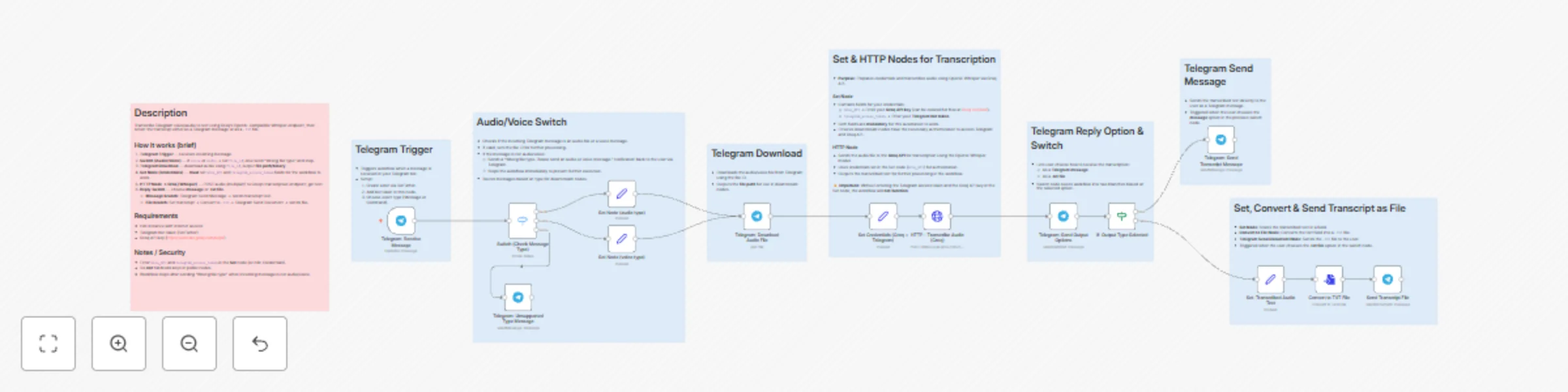
Workflow preview
100%
Audio transcription with Telegram and Groq Whisper preview
Open on n8n.io

Important notice

This workflow is provided as-is. Please review and test before using in production.

1. Workflow Overview

Short description Transcribe Telegram voice/audio messages to text using Groq’s OpenAI compatible Whisper endpoint. Replies are delivered either as a Telegram message or as a downloadable file, plu...

Best for

  • Document Extraction automation workflows
  • Multimodal AI automation workflows
  • advanced n8n builders looking for reusable templates

Tools used

n8n-nodes-base.telegramtrigger, n8n-nodes-base.switch, n8n-nodes-base.telegram, n8n-nodes-base.set, n8n-nodes-base.httprequest, n8n-nodes-base.if, n8n-nodes-base.converttofile, n8n-nodes-base.stickynote

Source and attribution

This workflow is cataloged by N8N Workflows and links back to its original n8n.io source page by Abhiman.

Original n8n.io source

1.1 Workflow description

Title
Audio transcription with Telegram and Groq Whisper
Workflow name
Audio transcription with Telegram and Groq Whisper

Short description

Transcribe Telegram voice/audio messages to text using Groq’s OpenAI-compatible Whisper endpoint. Replies are delivered either as a Telegram message or as a downloadable .txt file, plug-and-play for n8n with minimal setup.

Who’s it for / Uses

  • Educators, podcasters, interviewers, and support teams who need quick voice → text conversions.
  • Automating meeting notes, voice feedback, voicemail transcription, or speech logging.
  • Useful when you want transcripts pushed to chat or saved as files for archiving.

How it works (overview)

  1. Telegram Trigger — workflow starts on incoming message.
  2. Switch (Audio/Voice) — detects voice or audio. If neither, replies “Wrong file type” and stops.
  3. Telegram Download — downloads the audio using the file_id, outputs file path/binary.
  4. Set Node (credentials + options) — stores Groq_API and Telegram_access_token (required) and transcript_output_format (message or file).
  5. HTTP Request → Groq (Whisper) — uploads audio (multipart/form-data) to Groq’s transcription endpoint and receives text.
  6. Reply Switch — routes to either:
    • Message branch: send transcribed text as a Telegram message.
    • File branch: convert transcript to .txt and send as a document.

Requirements

  • n8n instance (cloud or self-hosted) with internet access
  • Telegram bot token (create via BotFather)
  • Groq API key (create at https://console.groq.com/keys)
  • Basic n8n nodes: Telegram Trigger, Switch, Telegram Download, Set, HTTP Request, Convert to File, Telegram Send Message/Document

Important setup & notes

  • Mandatory: Add Groq_API and Telegram_access_token in the Set node (or use n8n Credentials). The workflow will fail without them.
  • Do not hardcode keys in HTTP node fields that will be exported/shared. Use Set fields or n8n Credentials.
  • Include sticky notes explaining each node (yellow note with full description recommended). Sticky notes should show setup steps and required fields.
  • Before publishing: remove personal IDs and secrets, test with sample voice messages, and verify Groq response schema to map the transcript field correctly.

Security & best practices

  • Use n8n Credentials or environment variables in production.
  • Rotate API keys if they become exposed.
  • Keep the Set node private when sharing templates; instruct users to replace keys with their own.

1.2 Logical Blocks

This catalog entry is organized from the workflow JSON. The node-level section below shows the executable blocks available for review before importing the template.

2. Block-by-Block Analysis

Block 1 - Telegram: Receive Message

Type / Role
n8n-nodes-base.telegramTrigger - telegramTrigger
Config choices
Version 1.2

Block 2 - Switch (Check Message Type)

Type / Role
n8n-nodes-base.switch - switch
Config choices
Version 3.3

Block 3 - Telegram: Unsupported Type Message

Type / Role
n8n-nodes-base.telegram - telegram
Config choices
Version 1.2

Block 4 - Set Node (audio type)

Type / Role
n8n-nodes-base.set - set
Config choices
Version 3.4

Block 5 - Set Node (voice type)

Type / Role
n8n-nodes-base.set - set
Config choices
Version 3.4

Block 6 - Telegram: Download Audio File

Type / Role
n8n-nodes-base.telegram - telegram
Config choices
Version 1.2

Block 7 - HTTP - Transcribe Audio (Groq)

Type / Role
n8n-nodes-base.httpRequest - httpRequest
Config choices
Version 4.2

Block 8 - Set Credentials (Groq + Telegram)

Type / Role
n8n-nodes-base.set - set
Config choices
Version 3.4

Block 9 - Telegram: Send Output Options

Type / Role
n8n-nodes-base.telegram - telegram
Config choices
Version 1.2

Block 10 - If: Output Type Selected

Type / Role
n8n-nodes-base.if - if
Config choices
Version 2.2

Block 11 - Telegram: Send Transcript Message

Type / Role
n8n-nodes-base.telegram - telegram
Config choices
Version 1.2

Block 12 - Set: Transcribed Audio Text

Type / Role
n8n-nodes-base.set - set
Config choices
Version 3.4

Block 13 - Convert to TXT File

Type / Role
n8n-nodes-base.convertToFile - convertToFile
Config choices
Version 1.1

Block 14 - Send Transcript File

Type / Role
n8n-nodes-base.telegram - telegram
Config choices
Version 1.2

Block 15 - Sticky Note

Type / Role
n8n-nodes-base.stickyNote - stickyNote
Config choices
Version 1

Block 16 - Sticky Note1

Type / Role
n8n-nodes-base.stickyNote - stickyNote
Config choices
Version 1

Block 17 - Sticky Note2

Type / Role
n8n-nodes-base.stickyNote - stickyNote
Config choices
Version 1

Block 18 - Sticky Note3

Type / Role
n8n-nodes-base.stickyNote - stickyNote
Config choices
Version 1

Block 19 - Sticky Note4

Type / Role
n8n-nodes-base.stickyNote - stickyNote
Config choices
Version 1

Block 20 - Sticky Note5

Type / Role
n8n-nodes-base.stickyNote - stickyNote
Config choices
Version 1

Block 21 - Sticky Note6

Type / Role
n8n-nodes-base.stickyNote - stickyNote
Config choices
Version 1

Block 22 - Sticky Note7

Type / Role
n8n-nodes-base.stickyNote - stickyNote
Config choices
Version 1

3. Summary Table

Workflow Audio transcription with Telegram and Groq Whisper
Complexity advanced
Nodes 22
Categories Document Extraction, Multimodal AI
Author Abhiman
Published 22 Oct 2025

4. Reproducing the Workflow from Scratch

  1. 1. Download the workflow JSON

    Use the JSON export at /data/workflows/10037/10037.json as the source template for this automation.

  2. 2. Import the template into n8n

    Open n8n, import the downloaded JSON, and review each node before activating the workflow.

  3. 3. Configure credentials and variables

    Replace placeholder credentials, API keys, webhook URLs, account IDs, and environment-specific values with your own settings.

  4. 4. Test with sample data

    Run the workflow manually or in a staging workspace, inspect node output, and confirm downstream systems receive the expected data.

  5. 5. Activate and monitor

    Enable the workflow only after testing, then monitor executions, errors, and rate limits during the first production runs.

5. General Notes & Resources

Review imported nodes carefully before activation. This catalog entry is intended to help you inspect the workflow structure, understand required services, and find related templates faster.

Node names, credentials, schedules, webhook paths, and external service limits may need adjustment for your workspace.

Frequently asked questions

What does Audio transcription with Telegram and Groq Whisper do?

Short description Transcribe Telegram voice/audio messages to text using Groq’s OpenAI compatible Whisper endpoint. Replies are delivered either as a Telegram message or as a downloadable file, plu...

What do I need before importing this workflow?

Review the workflow JSON, configure any required credentials in n8n, and test the automation in a safe workspace before using it in production.

Can I customize this workflow?

Yes. Use the block-by-block analysis and the downloadable JSON to inspect each node, then adjust credentials, prompts, schedules, filters, or destinations for your Document Extraction, Multimodal AI use case.



