
Assess blockchain smart contract and tokenomics risk with GPT-4o and Gmail

Workflow preview
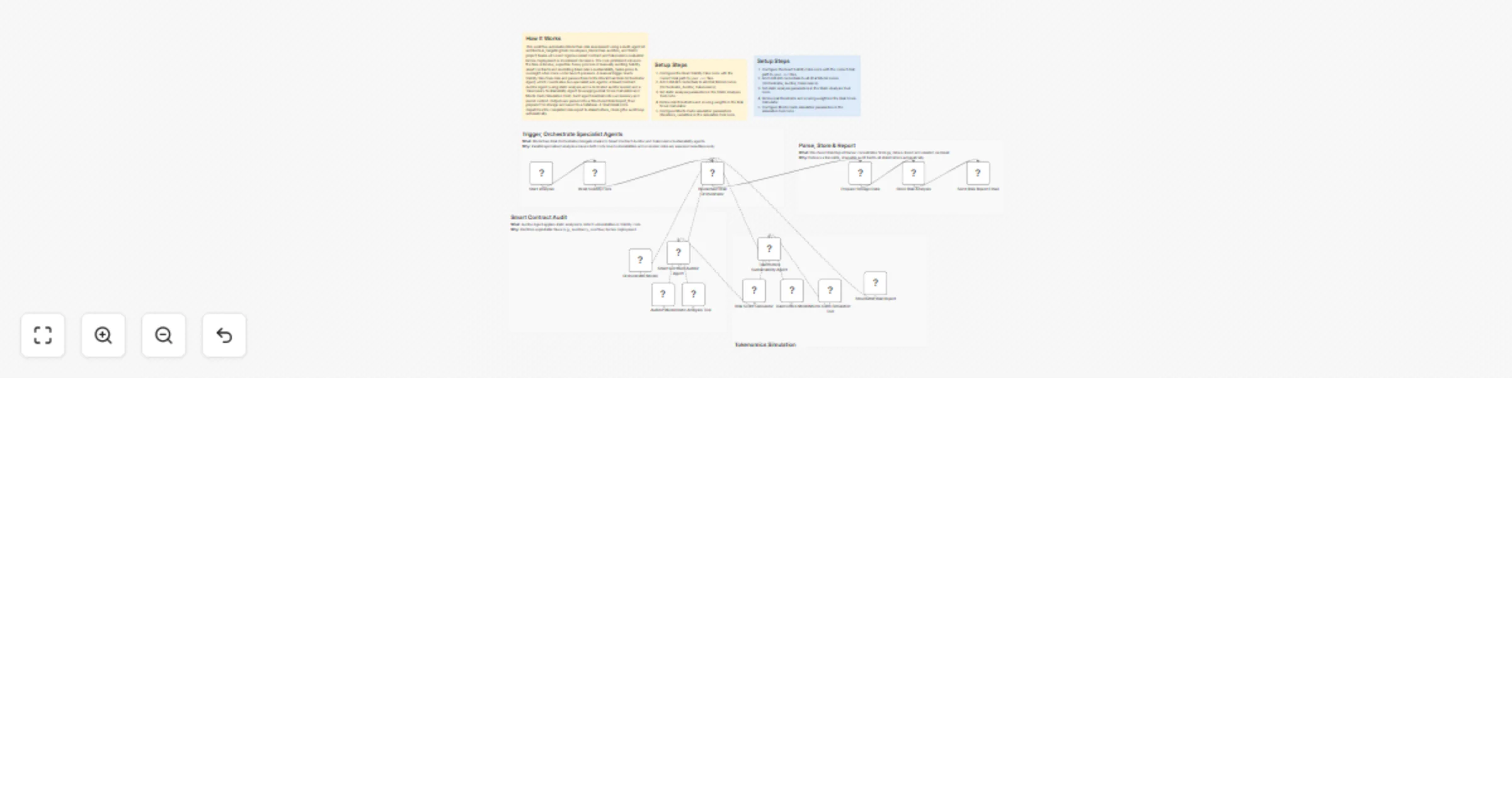
Workflow preview
100%
Assess blockchain smart contract and tokenomics risk with GPT-4o and Gmail preview
Open on n8n.io

1. Workflow Overview

How It Works This workflow automates blockchain risk assessment using a multi agent AI architecture, targeting DeFi developers, blockchain auditors, and Web3 project teams who need rigorous smart c...

Best for

  • SecOps automation workflows
  • AI RAG automation workflows
  • advanced n8n builders looking for reusable templates

Tools used

n8n-nodes-base.manualtrigger, n8n-nodes-base.readwritefile, @n8n/n8n-nodes-langchain.agent, @n8n/n8n-nodes-langchain.lmchatopenai, @n8n/n8n-nodes-langchain.agenttool, @n8n/n8n-nodes-langchain.toolcode, @n8n/n8n-nodes-langchain.toolcalculator, @n8n/n8n-nodes-langchain.outputparserstructured

Source and attribution

This workflow is cataloged by N8N Workflows and links back to its original n8n.io source page by Cheng Siong Chin.

Original n8n.io source

1.1 Workflow description

Title
Assess blockchain smart contract and tokenomics risk with GPT-4o and Gmail
Workflow name
Assess blockchain smart contract and tokenomics risk with GPT-4o and Gmail

How It Works

This workflow automates blockchain risk assessment using a multi-agent AI architecture, targeting DeFi developers, blockchain auditors, and Web3 project teams who need rigorous smart contract and tokenomics evaluation before deployment or investment decisions. The core problem it solves is the time-intensive, expertise-heavy process of manually auditing Solidity smart contracts and modelling tokenomics sustainability, tasks prone to oversight when done under launch pressure. A manual trigger reads Solidity files from disk and passes them to the Blockchain Risk Orchestrator Agent, which coordinates two specialist sub-agents: a Smart Contract Auditor Agent (using static analysis and a dedicated auditor model) and a Tokenomics Sustainability Agent (leveraging a Risk Score Calculator and Monte Carlo Simulation Tool). Each agent maintains its own memory and model context. Outputs are parsed into a Structured Risk Report, then prepared for storage and saved to a database. A final Gmail node dispatches the completed risk report to stakeholders, closing the audit loop automatically.

Setup Steps

  1. Configure the Read Solidity Files node with the correct disk path to your .sol files.
  2. Add LLM API credentials to all Chat Model nodes (Orchestrator, Auditor, Tokenomics).
  3. Set static analysis parameters in the Static Analysis Tool node.
  4. Define risk thresholds and scoring weights in the Risk Score Calculator.
  5. Configure Monte Carlo simulation parameters in the simulation tool node.

Prerequisites

  • LLM API key (OpenAI or compatible)
  • Solidity .sol files accessible on disk
  • Static analysis tool configuration
  • Gmail account with OAuth2 credentials
  • Target database or storage destination

Use Cases

  • Audit smart contracts before mainnet deployment to catch critical vulnerabilities.

Customisation

  • Extend to support multiple Solidity file batches or GitHub repository inputs.

Benefits

  • Reduces smart contract audit time from days to minutes.

1.2 Logical Blocks

This catalog entry is organized from the workflow JSON. The node-level section below shows the executable blocks available for review before importing the template.

2. Block-by-Block Analysis

Block 1 - Start Analysis

Type / Role
n8n-nodes-base.manualTrigger - manualTrigger
Config choices
Version 1

Block 2 - Read Solidity Files

Type / Role
n8n-nodes-base.readWriteFile - readWriteFile
Config choices
Version 1.1

Block 3 - Blockchain Risk Orchestrator

Type / Role
@n8n/n8n-nodes-langchain.agent - agent
Config choices
Version 3.1

Block 4 - Orchestrator Model

Type / Role
@n8n/n8n-nodes-langchain.lmChatOpenAi - lmChatOpenAi
Config choices
Version 1.3

Block 5 - Smart Contract Auditor Agent

Type / Role
@n8n/n8n-nodes-langchain.agentTool - agentTool
Config choices
Version 3

Block 6 - Auditor Model

Type / Role
@n8n/n8n-nodes-langchain.lmChatOpenAi - lmChatOpenAi
Config choices
Version 1.3

Block 7 - Static Analysis Tool

Type / Role
@n8n/n8n-nodes-langchain.toolCode - toolCode
Config choices
Version 1.3

Block 8 - Risk Score Calculator

Type / Role
@n8n/n8n-nodes-langchain.toolCalculator - toolCalculator
Config choices
Version 1

Block 9 - Tokenomics Sustainability Agent

Type / Role
@n8n/n8n-nodes-langchain.agentTool - agentTool
Config choices
Version 3

Block 10 - Tokenomics Model

Type / Role
@n8n/n8n-nodes-langchain.lmChatOpenAi - lmChatOpenAi
Config choices
Version 1.3

Block 11 - Monte Carlo Simulation Tool

Type / Role
@n8n/n8n-nodes-langchain.toolCode - toolCode
Config choices
Version 1.3

Block 12 - Structured Risk Report

Type / Role
@n8n/n8n-nodes-langchain.outputParserStructured - outputParserStructured
Config choices
Version 1.3

Block 13 - Prepare Storage Data

Type / Role
n8n-nodes-base.set - set
Config choices
Version 3.4

Block 14 - Store Risk Analysis

Type / Role
n8n-nodes-base.dataTable - dataTable
Config choices
Version 1.1

Block 15 - Send Risk Report Email

Type / Role
n8n-nodes-base.gmail - gmail
Config choices
Version 2.2

Block 16 - Sticky Note

Type / Role
n8n-nodes-base.stickyNote - stickyNote
Config choices
Version 1

Block 17 - Sticky Note1

Type / Role
n8n-nodes-base.stickyNote - stickyNote
Config choices
Version 1

Block 18 - Sticky Note2

Type / Role
n8n-nodes-base.stickyNote - stickyNote
Config choices
Version 1

Block 19 - Sticky Note3

Type / Role
n8n-nodes-base.stickyNote - stickyNote
Config choices
Version 1

Block 20 - Sticky Note4

Type / Role
n8n-nodes-base.stickyNote - stickyNote
Config choices
Version 1

Block 21 - Sticky Note5

Type / Role
n8n-nodes-base.stickyNote - stickyNote
Config choices
Version 1

Block 22 - Sticky Note6

Type / Role
n8n-nodes-base.stickyNote - stickyNote
Config choices
Version 1

3. Summary Table

Workflow Assess blockchain smart contract and tokenomics risk with GPT-4o and Gmail
Complexity advanced
Nodes 22
Categories SecOps, AI RAG
Author Cheng Siong Chin
Published 28 Mar 2026

4. Reproducing the Workflow from Scratch

  1. 1. Download the workflow JSON

    Use the JSON export at /data/workflows/14413/14413.json as the source template for this automation.

  2. 2. Import the template into n8n

    Open n8n, import the downloaded JSON, and review each node before activating the workflow.

  3. 3. Configure credentials and variables

    Replace placeholder credentials, API keys, webhook URLs, account IDs, and environment-specific values with your own settings.

  4. 4. Test with sample data

    Run the workflow manually or in a staging workspace, inspect node output, and confirm downstream systems receive the expected data.

  5. 5. Activate and monitor

    Enable the workflow only after testing, then monitor executions, errors, and rate limits during the first production runs.

5. General Notes & Resources

Review imported nodes carefully before activation. This catalog entry is intended to help you inspect the workflow structure, understand required services, and find related templates faster.

Node names, credentials, schedules, webhook paths, and external service limits may need adjustment for your workspace.

Frequently asked questions

What does Assess blockchain smart contract and tokenomics risk with GPT-4o and Gmail do?

How It Works This workflow automates blockchain risk assessment using a multi agent AI architecture, targeting DeFi developers, blockchain auditors, and Web3 project teams who need rigorous smart c...

What do I need before importing this workflow?

Review the workflow JSON, configure any required credentials in n8n, and test the automation in a safe workspace before using it in production.

Can I customize this workflow?

Yes. Use the block-by-block analysis and the downloadable JSON to inspect each node, then adjust credentials, prompts, schedules, filters, or destinations for your SecOps, AI RAG use case.



