
AI SEO readability audit: Check website friendliness for LLMs

Workflow preview
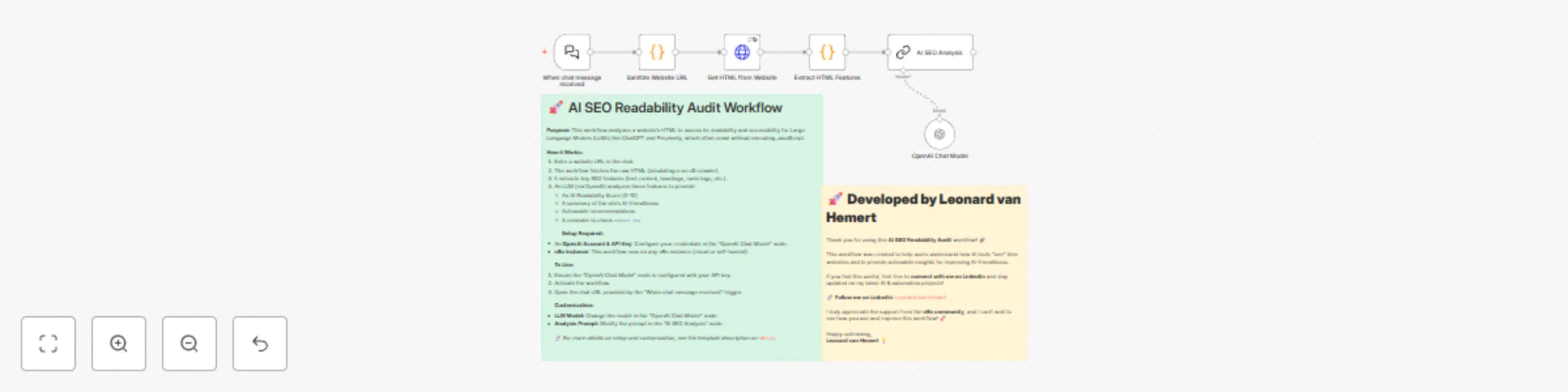
Workflow preview
100%
AI SEO readability audit: Check website friendliness for LLMs preview
Open on n8n.io

Important notice

This workflow is provided as-is. Please review and test before using in production.

1. Workflow Overview

Who is this for? This workflow is designed for SEO specialists, content creators, marketers, and website developers who want to ensure their web content is easily accessible, understandable, and in...

Best for

  • Market Research automation workflows
  • AI Summarization automation workflows
  • intermediate n8n builders looking for reusable templates

Tools used

@n8n/n8n-nodes-langchain.chattrigger, n8n-nodes-base.httprequest, n8n-nodes-base.code, @n8n/n8n-nodes-langchain.chainllm, n8n-nodes-base.stickynote, @n8n/n8n-nodes-langchain.lmchatopenai

Source and attribution

This workflow is cataloged by N8N Workflows and links back to its original n8n.io source page by Leonard.

Original n8n.io source

1.1 Workflow description

Title
AI SEO readability audit: Check website friendliness for LLMs
Workflow name
AI SEO readability audit: Check website friendliness for LLMs

Who is this for?

This workflow is designed for SEO specialists, content creators, marketers, and website developers who want to ensure their web content is easily accessible, understandable, and indexable by Large Language Models (LLMs) like ChatGPT, Perplexity, and Google AI Overviews. If you're looking to optimize your site for the evolving AI-driven search landscape, this template is for you.

What problem is this workflow solving? / Use case

Modern AI tools often crawl websites without executing JavaScript. This can lead to them "seeing" a very different version of your page than a human user or traditional search engine bot might. This workflow helps you:

  • Identify how much of your content is visible without JavaScript.
  • Check for crucial on-page SEO elements that AI relies on (headings, meta descriptions, structured data).
  • Detect if your site presents JavaScript-blocking warnings.
  • Get an AI-generated readability score and actionable recommendations to improve AI-friendliness.

What this workflow does

  1. Receives a URL via a chat interface.
  2. Sanitizes the input URL to ensure it's correctly formatted.
  3. Fetches the website's HTML content, simulating a non-JavaScript crawler (like Googlebot).
  4. Extracts key HTML features: visible text length, presence of H1/H2/H3 tags, meta description, Open Graph data, structured data (JSON-LD), and <noscript> tags. It also checks for common JavaScript-blocking messages.
  5. Performs an AI SEO Analysis using an LLM (via OpenAI) based on the extracted features.
  6. Provides a report including an AI Readability Score (0-10), a summary, actionable recommendations, and a reminder to check the robots.txt file for AI bot access.

Setup

  • Estimated setup time: 2-5 minutes.
  1. Import this workflow into your n8n instance.
  2. Ensure you have an OpenAI account and API key.
  3. Configure the "OpenAI Chat Model" node with your OpenAI API credentials. If you don't have credentials set up yet, create new ones in n8n.
  4. Activate the workflow.
  5. Interact with the chat interface provided by the "When chat message received" trigger node (you can access this via its webhook URL).

How to customize this workflow to your needs

  • Change LLM Model: In the "OpenAI Chat Model" node, you can select a different model that suits your needs or budget.
  • Adjust AI Prompt: Modify the prompt in the "AI SEO Analysis" node (Chain Llm) to change the focus of the analysis or the format of the report. For example, you could ask for more technical details or a different scoring system.
  • User-Agent: The "Get HTML from Website" node uses a Googlebot User-Agent. You can change this to simulate other bots if needed.
  • JS Block Indicators: The "Extract HTML Features" node contains a list of common JavaScript-blocking phrases. You can expand this list with other languages or specific messages relevant to your checks.

1.2 Logical Blocks

This catalog entry is organized from the workflow JSON. The node-level section below shows the executable blocks available for review before importing the template.

2. Block-by-Block Analysis

Block 1 - When chat message received

Type / Role
@n8n/n8n-nodes-langchain.chatTrigger - chatTrigger
Config choices
Version 1.1

Block 2 - Get HTML from Website

Type / Role
n8n-nodes-base.httpRequest - httpRequest
Config choices
Version 4.2

Block 3 - Sanitize Website URL

Type / Role
n8n-nodes-base.code - code
Config choices
Version 2

Block 4 - Extract HTML Features

Type / Role
n8n-nodes-base.code - code
Config choices
Version 2

Block 5 - AI SEO Analysis

Type / Role
@n8n/n8n-nodes-langchain.chainLlm - chainLlm
Config choices
Version 1.6

Block 6 - Sticky Note

Type / Role
n8n-nodes-base.stickyNote - stickyNote
Config choices
Version 1

Block 7 - Sticky Note1

Type / Role
n8n-nodes-base.stickyNote - stickyNote
Config choices
Version 1

Block 8 - OpenAI Chat Model

Type / Role
@n8n/n8n-nodes-langchain.lmChatOpenAi - lmChatOpenAi
Config choices
Version 1.2

3. Summary Table

Workflow AI SEO readability audit: Check website friendliness for LLMs
Complexity intermediate
Nodes 8
Categories Market Research, AI Summarization
Author Leonard
Published 17 May 2025

4. Reproducing the Workflow from Scratch

  1. 1. Download the workflow JSON

    Use the JSON export at /data/workflows/4151/4151.json as the source template for this automation.

  2. 2. Import the template into n8n

    Open n8n, import the downloaded JSON, and review each node before activating the workflow.

  3. 3. Configure credentials and variables

    Replace placeholder credentials, API keys, webhook URLs, account IDs, and environment-specific values with your own settings.

  4. 4. Test with sample data

    Run the workflow manually or in a staging workspace, inspect node output, and confirm downstream systems receive the expected data.

  5. 5. Activate and monitor

    Enable the workflow only after testing, then monitor executions, errors, and rate limits during the first production runs.

5. General Notes & Resources

Review imported nodes carefully before activation. This catalog entry is intended to help you inspect the workflow structure, understand required services, and find related templates faster.

Node names, credentials, schedules, webhook paths, and external service limits may need adjustment for your workspace.

Frequently asked questions

What does AI SEO readability audit: Check website friendliness for LLMs do?

Who is this for? This workflow is designed for SEO specialists, content creators, marketers, and website developers who want to ensure their web content is easily accessible, understandable, and in...

What do I need before importing this workflow?

Review the workflow JSON, configure any required credentials in n8n, and test the automation in a safe workspace before using it in production.

Can I customize this workflow?

Yes. Use the block-by-block analysis and the downloadable JSON to inspect each node, then adjust credentials, prompts, schedules, filters, or destinations for your Market Research, AI Summarization use case.



