Aggregate error alerts and send consolidated reports via Email and Jira
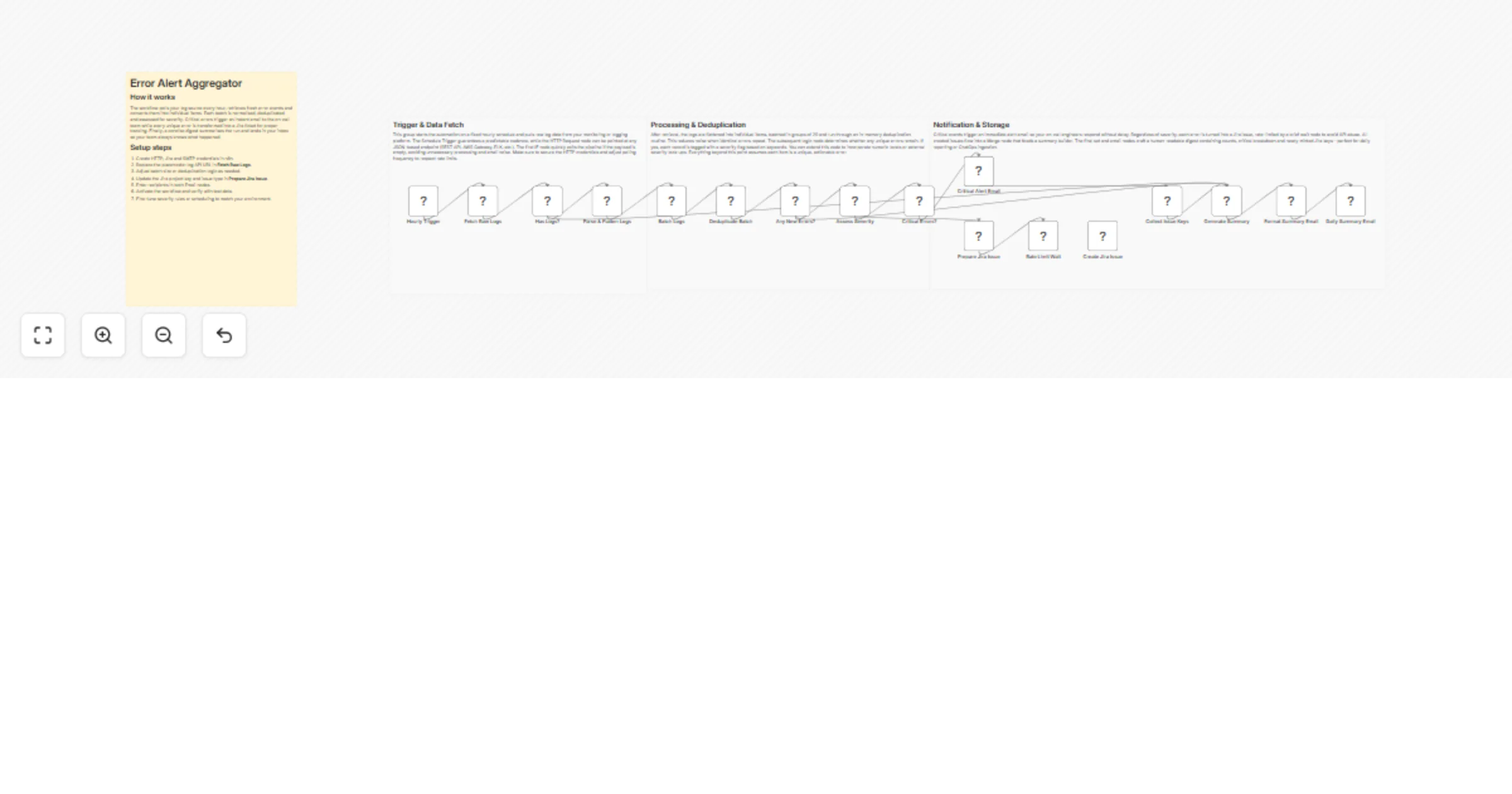
Workflow preview


 Early Deal
DISCOUNT 20%

Overview
Error Alert Aggregator – Email and Jira
This workflow aggregates error logs arriving from multiple sources, deduplicates identical events within a configurable time-window, and sends a single consolidated notification via Email and Jira. It prevents alert fatigue by batching similar errors and guarantees that responsible teams are informed through both channels.
Pre-conditions/Requirements
Prerequisites
- n8n instance (self-hosted ≥ v1.0 or n8n.cloud account)
- Basic understanding of your log source’s payload structure
- SMTP server or n8n Email credentials configured
- Jira Cloud or Jira Server account with API access
Required Credentials
- Email (SMTP/IMAP or n8n Email node credential) — to dispatch alert emails
- Jira — Create issues automatically in the chosen project
- HTTP Request Auth (optional) — If your log endpoint requires authentication
Specific Setup Requirements
| Setting | Recommended Value | Notes |
|---|---|---|
| Batch window (Wait node) | 10 minutes | Time allowed to collect & deduplicate errors |
| Deduplication key (Code) | error_id or message field |
Choose a unique attribute representing the same incident |
| Email recipients | Security & DevOps distribution list | Use semicolons for multiple addresses |
| Jira project key | SEC |
Project where alert tickets should be filed |
How it works
This workflow aggregates error logs arriving from multiple sources, deduplicates identical events within a configurable time-window, and sends a single consolidated notification via Email and Jira. It prevents alert fatigue by batching similar errors and guarantees that responsible teams are informed through both channels.
Key Steps:
- Schedule Trigger: Runs every X minutes to poll/collect new log items.
- HTTP Request: Pulls error events from your monitoring or log system.
- IF Node: Quickly filters out non-error or resolved events.
- Code Node (Deduplicator): Hashes & stores unique error signatures, skipping already-seen items.
- Wait Node: Holds processing for the batching period (e.g., 10 min).
- Merge Node: Combines all unique errors gathered during the window.
- Set Node: Formats the consolidated message for Email & Jira.
- Email Send: Dispatches the summary email.
- Jira Node: Creates (or updates) an issue with the same summary.
- Sticky Notes: Provide inline documentation right inside the workflow for easier maintenance.
Set up steps
Setup Time: 15-20 minutes
- Import template: Download the JSON template and drag & drop it into your n8n editor.
- Configure Schedule Trigger: Set polling interval (e.g., every 5 minutes).
- HTTP Request Node:
- Enter the URL of your log endpoint.
- Add authentication if required.
- Adjust IF filter: Modify the condition to match your log’s error severity field (
status === "error"). - Customize Code Node:
- Replace
error_idwith the field that uniquely identifies an error. - Optionally tweak deduplication TTL.
- Wait Node: Set the batch time (e.g., 600 seconds).
- Set Node: Edit the email subject/body and Jira issue summary/description placeholders.
- Credentials:
- Add or select your Email credential in Email Send.
- Add or select your Jira credential in Jira node.
- Test run the workflow to verify that:
- Duplicate events are collapsed.
- Email and Jira tickets show combined information.
- Activate the workflow to start production monitoring.
Node Descriptions
Core Workflow Nodes:
- Schedule Trigger – Initiates workflow on a fixed interval.
- HTTP Request – Retrieves fresh error logs from an external API.
- IF – Only lets true error events proceed.
- Code (Deduplicator) – Uses JavaScript to remove already-known errors via n8n static data.
- Wait – Creates a batching window for aggregation.
- Merge (Queue mode) – Joins events accumulated during the wait.
- Set – Crafts a human-readable report for Email & Jira.
- Email Send – Dispatches the consolidated message to stakeholders.
- Jira – Opens/updates an issue containing the same error digest.
- Sticky Note – Provides inline explanations for future maintainers.
Data Flow:
- Schedule Trigger → HTTP Request → IF → Code
- Code → Wait → Merge → Set
- Set → Email Send & Jira
Customization Examples
Change Deduplication Strategy
// Code Node snippet
// Use error 'stacktrace' + 'service' for uniqueness
const signature = `${item.json.stacktrace}_${item.json.service}`;
if ($workflow.staticData.signatureCache?.includes(signature)) {
 // duplicate, skip
 return [];
}
$workflow.staticData.signatureCache = [
 ...( $workflow.staticData.signatureCache || [] ),
 signature
];
return item;
Update Existing Jira Issue Instead of Creating New
// Jira Node settings
// Search for an open ticket with the same summary
// If found, add a comment instead of creating
{
 "operation": "comment",
 "issueKey": "={{$node['Set'].json['jiraIssueKey']}}",
 "comment": "New occurrences: {{$json.errorCount}}"
}
Data Output Format
The workflow outputs structured JSON data:
{
 "errors": [
 {
 "id": "ERR123",
 "message": "Database timeout",
 "count": 5,
 "firstSeen": "2024-03-14T10:12:00Z",
 "lastSeen": "2024-03-14T10:22:00Z"
 }
 ],
 "emailStatus": "success",
 "jiraStatus": "issue_created"
}
Troubleshooting
Common Issues
- No data returned from HTTP Request – Verify endpoint URL, authentication headers, and that your monitoring tool actually has recent error events.
- Duplicate alerts still coming through – Increase the Wait node’s batching window or refine the deduplication key in the Code node.
Performance Tips
- Cache HTTP responses if the log API supports it to reduce bandwidth.
- Use selective fields in the HTTP Request’s
queryparameters to limit payload size.
Pro Tips:
- Store a rolling hash list in external Redis or DB for large-scale deduplication.
- Add a second IF branch to auto-resolve Jira tickets when an error disappears for X hours.
- Use Slack or Microsoft Teams nodes in parallel to broaden alert coverage.
This is a community-contributed n8n workflow template provided “as-is.” Thoroughly test in a non-production environment before deploying to production.