
Validate JSON payloads against a schema with detailed error messages (no AI)

Workflow preview
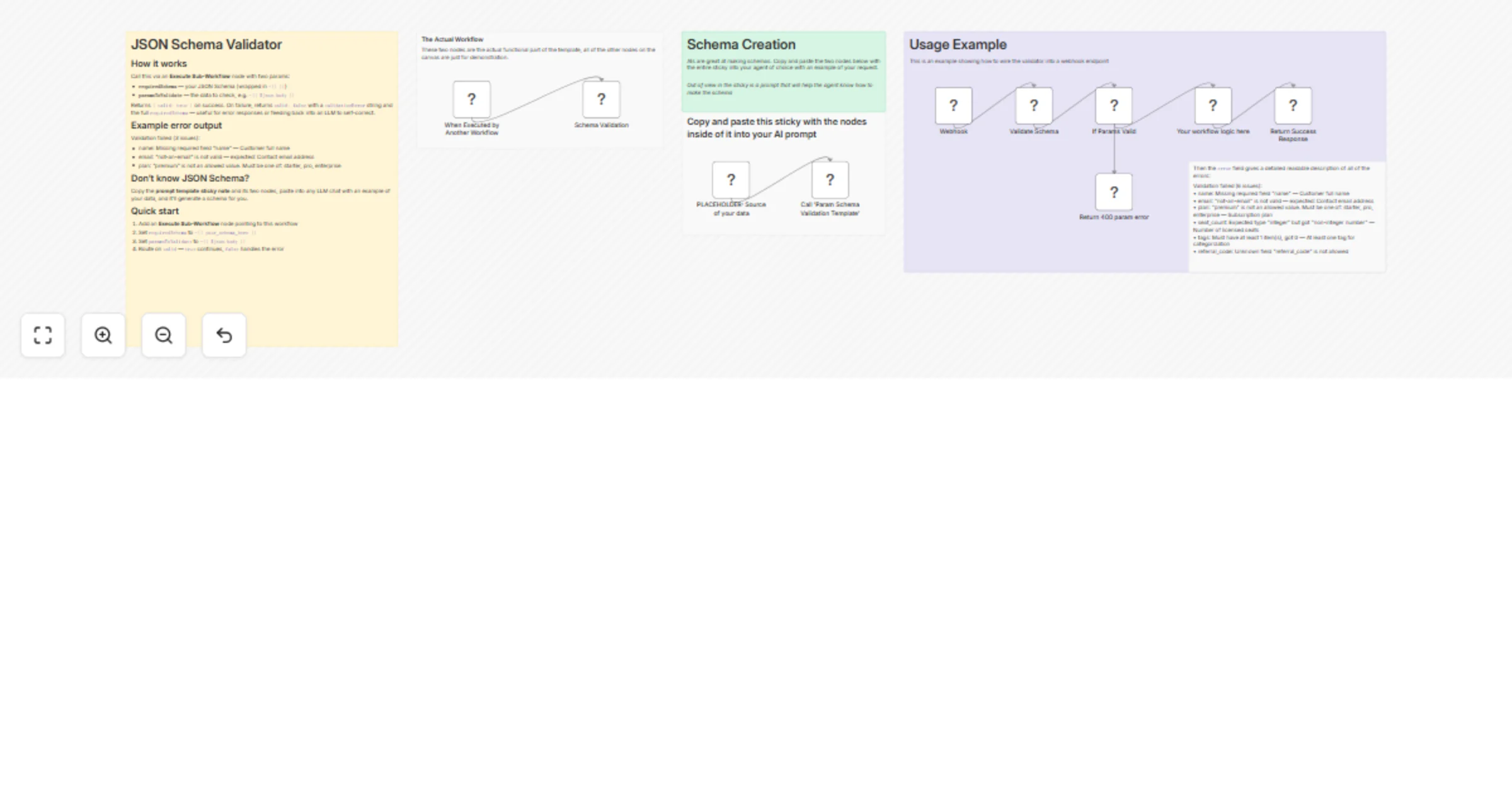
Workflow preview
100%
Validate JSON payloads against a schema with detailed error messages (no AI) preview
Open on n8n.io

1. Workflow Overview

What is this? A modular schema checker that returns detailed error messages on validation failure. Stop your workflows from breaking due to bad input. This subworkflow validates incoming JSON again...

Best for

  • Document Extraction automation workflows
  • advanced n8n builders looking for reusable templates

Tools used

n8n-nodes-base.executeworkflowtrigger, n8n-nodes-base.code, n8n-nodes-base.set, n8n-nodes-base.stickynote, n8n-nodes-base.webhook, n8n-nodes-base.if, n8n-nodes-base.respondtowebhook, n8n-nodes-base.noop

Source and attribution

This workflow is cataloged by N8N Workflows and links back to its original n8n.io source page by Liam McGarrigle.

Original n8n.io source

1.1 Workflow description

Title
Validate JSON payloads against a schema with detailed error messages (no AI)
Workflow name
Validate JSON payloads against a schema with detailed error messages (no AI)

What is this?

A modular schema checker that returns detailed error messages on validation failure.

Stop your workflows from breaking due to bad input. This subworkflow validates incoming JSON against a schema you define and returns clear, human readable errors before anything has the chance to break.

The most common use: a webhook receives data, you validate it, and either continue or return a 400 with exactly what was wrong. This is how production APIs handle input validation, and this template brings that same reliability to webhooks in n8n.

Works anywhere you need to check data: webhook payloads, form submissions, API requests, or LLM outputs.

Supports: type checks, required fields, enums, regex patterns, numeric ranges, array constraints, conditional logic (oneOf / anyOf / allOf), and rejection of unknown fields.

Why use this?

Bad input breaks workflows and is a nightmare to debug. This catches it upfront so you can error fast, fail safe, and return useful messages instead of breaking down.

It also makes a self documenting API. The error messages are so clear that the caller doesn't even need to check docs, they're given the fix right in the error.

How it works

Call this workflow via an Execute Sub-Workflow node with two params:

  • requiredSchema - the JSON Schema defining what valid data looks like
  • paramsToValidate - the actual JSON to check (for instance, $json.body)

requiredSchema must be an expression wrapped in {{ }} to be treated like an object.

Returns { valid: true } on success. On failure, returns valid: false with a validationError string and the full requiredSchema so you know exactly what went wrong and what was expected.

see the "Usage Example" in the template

Example error output

Validation failed (3 issues):
• name: Missing required field "name" - Customer full name
• email: "not-an-email" is not valid - expected: Contact email address
• plan: "premium" is not an allowed value. Must be one of: starter, pro, enterprise

Every error includes the field path, what went wrong, and the description from your schema.

Don't know JSON Schema?

The template includes a prompt template sticky note. Copy it into any LLM chat with an example of your data and it'll generate a ready-to-use schema for you.

Quick start

  1. Add an Execute Sub-Workflow node pointing to this workflow
  2. Set requiredSchema to ={{ your_schema_here }}
  3. Set paramsToValidate to ={{ $json.body }}
  4. Route on valid: true continues, false handles the error

1.2 Logical Blocks

This catalog entry is organized from the workflow JSON. The node-level section below shows the executable blocks available for review before importing the template.

2. Block-by-Block Analysis

Block 1 - When Executed by Another Workflow

Type / Role
n8n-nodes-base.executeWorkflowTrigger - executeWorkflowTrigger
Config choices
Version 1.1

Block 2 - Schema Validation

Type / Role
n8n-nodes-base.code - code
Config choices
Version 2

Block 3 - PLACEHOLDER: Source of your data

Type / Role
n8n-nodes-base.set - set
Config choices
Version 3.4

Block 4 - Sticky Note2

Type / Role
n8n-nodes-base.stickyNote - stickyNote
Config choices
Version 1

Block 5 - Sticky Note

Type / Role
n8n-nodes-base.stickyNote - stickyNote
Config choices
Version 1

Block 6 - Sticky Note1

Type / Role
n8n-nodes-base.stickyNote - stickyNote
Config choices
Version 1

Block 7 - Sticky Note3

Type / Role
n8n-nodes-base.stickyNote - stickyNote
Config choices
Version 1

Block 8 - Webhook

Type / Role
n8n-nodes-base.webhook - webhook
Config choices
Version 2.1

Block 9 - If Params Valid

Type / Role
n8n-nodes-base.if - if
Config choices
Version 2.3

Block 10 - Return 400 param error

Type / Role
n8n-nodes-base.respondToWebhook - respondToWebhook
Config choices
Version 1.5

Block 11 - Your workflow logic here

Type / Role
n8n-nodes-base.noOp - noOp
Config choices
Version 1

Block 12 - Return Success Response

Type / Role
n8n-nodes-base.respondToWebhook - respondToWebhook
Config choices
Version 1.5

Block 13 - Validate Schema

Type / Role
n8n-nodes-base.executeWorkflow - executeWorkflow
Config choices
Version 1.3

Block 14 - Call 'Param Schema Validation Template'

Type / Role
n8n-nodes-base.executeWorkflow - executeWorkflow
Config choices
Version 1.3

Block 15 - Sticky Note4

Type / Role
n8n-nodes-base.stickyNote - stickyNote
Config choices
Version 1

Block 16 - Sticky Note5

Type / Role
n8n-nodes-base.stickyNote - stickyNote
Config choices
Version 1

3. Summary Table

Workflow Validate JSON payloads against a schema with detailed error messages (no AI)
Complexity advanced
Nodes 16
Categories Document Extraction
Author Liam McGarrigle
Published 20 Mar 2026

4. Reproducing the Workflow from Scratch

  1. 1. Download the workflow JSON

    Use the JSON export at /data/workflows/14208/14208.json as the source template for this automation.

  2. 2. Import the template into n8n

    Open n8n, import the downloaded JSON, and review each node before activating the workflow.

  3. 3. Configure credentials and variables

    Replace placeholder credentials, API keys, webhook URLs, account IDs, and environment-specific values with your own settings.

  4. 4. Test with sample data

    Run the workflow manually or in a staging workspace, inspect node output, and confirm downstream systems receive the expected data.

  5. 5. Activate and monitor

    Enable the workflow only after testing, then monitor executions, errors, and rate limits during the first production runs.

5. General Notes & Resources

Review imported nodes carefully before activation. This catalog entry is intended to help you inspect the workflow structure, understand required services, and find related templates faster.

Node names, credentials, schedules, webhook paths, and external service limits may need adjustment for your workspace.

Frequently asked questions

What does Validate JSON payloads against a schema with detailed error messages (no AI) do?

What is this? A modular schema checker that returns detailed error messages on validation failure. Stop your workflows from breaking due to bad input. This subworkflow validates incoming JSON again...

What do I need before importing this workflow?

Review the workflow JSON, configure any required credentials in n8n, and test the automation in a safe workspace before using it in production.

Can I customize this workflow?

Yes. Use the block-by-block analysis and the downloadable JSON to inspect each node, then adjust credentials, prompts, schedules, filters, or destinations for your Document Extraction use case.



