
Translate documents to multiple languages with Google Drive and DeepL

Workflow preview
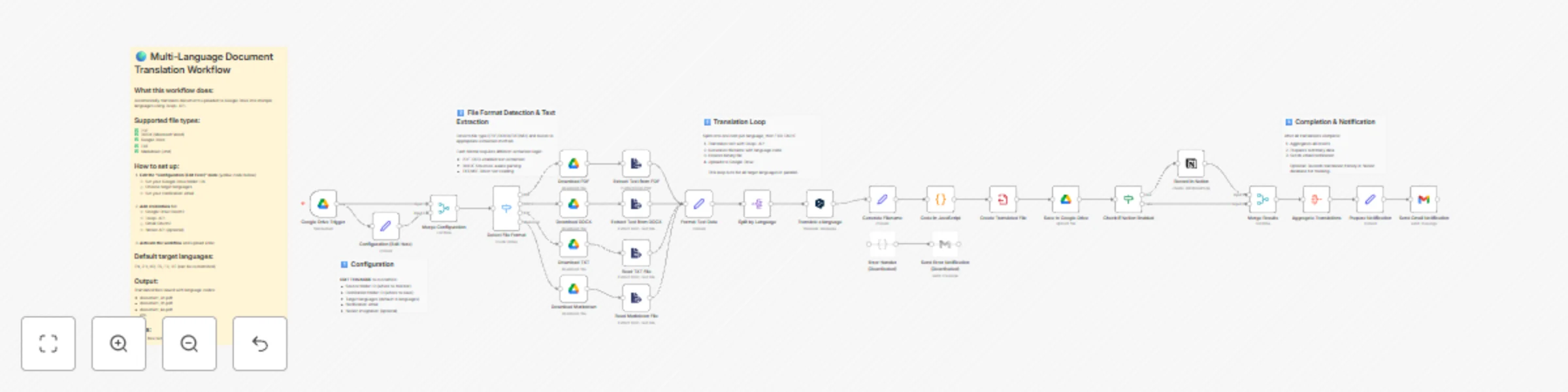
Workflow preview
100%
Translate documents to multiple languages with Google Drive and DeepL preview
Open on n8n.io

Important notice

This workflow is provided as-is. Please review and test before using in production.

1. Workflow Overview

Who's it for This workflow is perfect for content creators, international teams, and businesses that need to translate documents into multiple languages automatically. Whether you're localizing doc...

Best for

  • Document Extraction automation workflows
  • Multimodal AI automation workflows
  • advanced n8n builders looking for reusable templates

Tools used

n8n-nodes-base.googledrivetrigger, n8n-nodes-base.set, n8n-nodes-base.switch, n8n-nodes-base.googledrive, n8n-nodes-base.extractfromfile, n8n-nodes-base.splitout, n8n-nodes-base.writebinaryfile, n8n-nodes-base.if

Source and attribution

This workflow is cataloged by N8N Workflows and links back to its original n8n.io source page by Daiki Takayama.

Original n8n.io source

1.1 Workflow description

Title
Translate documents to multiple languages with Google Drive and DeepL
Workflow name
Translate documents to multiple languages with Google Drive and DeepL

Who's it for

This workflow is perfect for content creators, international teams, and businesses that need to translate documents into multiple languages automatically. Whether you're localizing documentation, translating marketing materials, or creating multilingual content, this workflow saves hours of manual work.

What it does

Automatically monitors a Google Drive folder for new documents (PDF, DOCX, TXT, or Markdown) and translates them into multiple languages using DeepL API. Each translated document is saved with a language-specific filename (e.g., document_en.pdf, document_zh.pdf) in a designated folder. You receive an email notification when all translations are complete.

How it works

  1. Monitors a Google Drive folder for new files
  2. Detects file format (PDF/DOCX/TXT/Markdown) and extracts text
  3. Translates the content into your chosen languages (default: English, Chinese, Korean, Spanish, French, German)
  4. Saves translated files with language codes in the filename
  5. Sends an email notification with translation summary
  6. Optional: Records translation history in Notion database

Set up instructions

Requirements

  • Google Drive account (for file storage)
  • DeepL API key (free tier: 500,000 characters/month)
  • Gmail account (for notifications)
  • Notion account (optional, for tracking translation history)

Setup steps

  1. Create Google Drive folders:

    • Create a "Source" folder for original files
    • Create a "Translated" folder for output
    • Copy the folder IDs from the URLs
  2. Get DeepL API key:

  3. Configure the workflow:

    • Open the "Configuration (Edit Here)" node (yellow node)
    • Replace folder IDs with your own
    • Set your notification email
    • Choose target languages
  4. Set up credentials:

    • Add Google Drive OAuth2 credentials
    • Add DeepL API credentials
    • Add Gmail OAuth2 credentials
  5. Activate the workflow and upload a test file!

Customization options

  • Change target languages: Edit the targetLanguages array in the Configuration node (supports 30+ languages)
  • Adjust polling frequency: Change trigger from "every minute" to hourly or daily for batch processing
  • Enable Notion tracking: Set enableNotion to true and provide your database ID
  • Add more file formats: Extend the Switch node to handle additional file types
  • Filter by file size: Add conditions to skip files larger than a certain size

Supported languages

EN (English), ZH (Chinese), KO (Korean), JA (Japanese), ES (Spanish), FR (French), DE (German), IT (Italian), PT (Portuguese), RU (Russian), and 20+ more.

Performance

  • Short files (1 page): ~30 seconds for 6 languages
  • Medium files (10 pages): ~2 minutes for 6 languages
  • Large files (100 pages): ~15 minutes for 6 languages

Technical Details

  • Trigger: Google Drive folder monitoring (1-minute polling)
  • Translation: DeepL API with automatic source language detection
  • Loop implementation: Split Out + Aggregate pattern for parallel translation
  • Error handling: Catches API failures and sends email alerts
  • Storage: Original file format preserved in translated outputs

Notes

  • DeepL free tier provides 500,000 characters/month (approximately 250 pages)
  • For high-volume translation, consider upgrading to DeepL Pro
  • The workflow creates new files instead of overwriting, preserving translation history
  • Google Docs are automatically converted to the appropriate format before translation

What You'll Learn

This workflow demonstrates several n8n patterns:

  • File format detection and routing (Switch node)
  • Loop implementation with Split Out + Aggregate
  • Binary data handling for file operations
  • Conditional logic with IF nodes (optional features)
  • Cross-node data references
  • Error handling and user notifications

Perfect for learning automation best practices while solving a real business problem!

1.2 Logical Blocks

This catalog entry is organized from the workflow JSON. The node-level section below shows the executable blocks available for review before importing the template.

2. Block-by-Block Analysis

Block 1 - Google Drive Trigger

Type / Role
n8n-nodes-base.googleDriveTrigger - googleDriveTrigger
Config choices
Version 1

Block 2 - Configuration (Edit Here)

Type / Role
n8n-nodes-base.set - set
Config choices
Version 3.3

Block 3 - Detect File Format

Type / Role
n8n-nodes-base.switch - switch
Config choices
Version 3

Block 4 - Download PDF

Type / Role
n8n-nodes-base.googleDrive - googleDrive
Config choices
Version 3

Block 5 - Download DOCX

Type / Role
n8n-nodes-base.googleDrive - googleDrive
Config choices
Version 3

Block 6 - Download TXT

Type / Role
n8n-nodes-base.googleDrive - googleDrive
Config choices
Version 3

Block 7 - Download Markdown

Type / Role
n8n-nodes-base.googleDrive - googleDrive
Config choices
Version 3

Block 8 - Extract Text from PDF

Type / Role
n8n-nodes-base.extractFromFile - extractFromFile
Config choices
Version 1

Block 9 - Extract Text from DOCX

Type / Role
n8n-nodes-base.extractFromFile - extractFromFile
Config choices
Version 1

Block 10 - Format Text Data

Type / Role
n8n-nodes-base.set - set
Config choices
Version 3.3

Block 11 - Split by Language

Type / Role
n8n-nodes-base.splitOut - splitOut
Config choices
Version 1

Block 12 - Generate Filename

Type / Role
n8n-nodes-base.set - set
Config choices
Version 3.3

Block 13 - Create Translated File

Type / Role
n8n-nodes-base.writeBinaryFile - writeBinaryFile
Config choices
Version 1

Block 14 - Save to Google Drive

Type / Role
n8n-nodes-base.googleDrive - googleDrive
Config choices
Version 3

Block 15 - Check if Notion Enabled

Type / Role
n8n-nodes-base.if - if
Config choices
Version 2

Block 16 - Record in Notion

Type / Role
n8n-nodes-base.notion - notion
Config choices
Version 2.2

Block 17 - Merge Results

Type / Role
n8n-nodes-base.merge - merge
Config choices
Version 2.1

Block 18 - Aggregate Translations

Type / Role
n8n-nodes-base.aggregate - aggregate
Config choices
Version 1

Block 19 - Prepare Notification

Type / Role
n8n-nodes-base.set - set
Config choices
Version 3.3

Block 20 - Send Gmail Notification

Type / Role
n8n-nodes-base.gmail - gmail
Config choices
Version 2.1

Block 21 - Error Handler

Type / Role
n8n-nodes-base.code - code
Config choices
Version 2

Block 22 - Send Error Notification

Type / Role
n8n-nodes-base.gmail - gmail
Config choices
Version 2.1

Block 23 - Translate a language

Type / Role
n8n-nodes-base.deepL - deepL
Config choices
Version 1

Block 24 - Merge Configuration

Type / Role
n8n-nodes-base.merge - merge
Config choices
Version 2.1

Showing the first 24 of 32 workflow blocks. Download the JSON for the full node graph.

3. Summary Table

Workflow Translate documents to multiple languages with Google Drive and DeepL
Complexity advanced
Nodes 32
Categories Document Extraction, Multimodal AI
Author Daiki Takayama
Published 29 Oct 2025

4. Reproducing the Workflow from Scratch

  1. 1. Download the workflow JSON

    Use the JSON export at /data/workflows/10264/10264.json as the source template for this automation.

  2. 2. Import the template into n8n

    Open n8n, import the downloaded JSON, and review each node before activating the workflow.

  3. 3. Configure credentials and variables

    Replace placeholder credentials, API keys, webhook URLs, account IDs, and environment-specific values with your own settings.

  4. 4. Test with sample data

    Run the workflow manually or in a staging workspace, inspect node output, and confirm downstream systems receive the expected data.

  5. 5. Activate and monitor

    Enable the workflow only after testing, then monitor executions, errors, and rate limits during the first production runs.

5. General Notes & Resources

Review imported nodes carefully before activation. This catalog entry is intended to help you inspect the workflow structure, understand required services, and find related templates faster.

Node names, credentials, schedules, webhook paths, and external service limits may need adjustment for your workspace.

Frequently asked questions

What does Translate documents to multiple languages with Google Drive and DeepL do?

Who's it for This workflow is perfect for content creators, international teams, and businesses that need to translate documents into multiple languages automatically. Whether you're localizing doc...

What do I need before importing this workflow?

Review the workflow JSON, configure any required credentials in n8n, and test the automation in a safe workspace before using it in production.

Can I customize this workflow?

Yes. Use the block-by-block analysis and the downloadable JSON to inspect each node, then adjust credentials, prompts, schedules, filters, or destinations for your Document Extraction, Multimodal AI use case.



