
Track food calories via Telegram with GPT-4 Vision and Google Sheets

Workflow preview
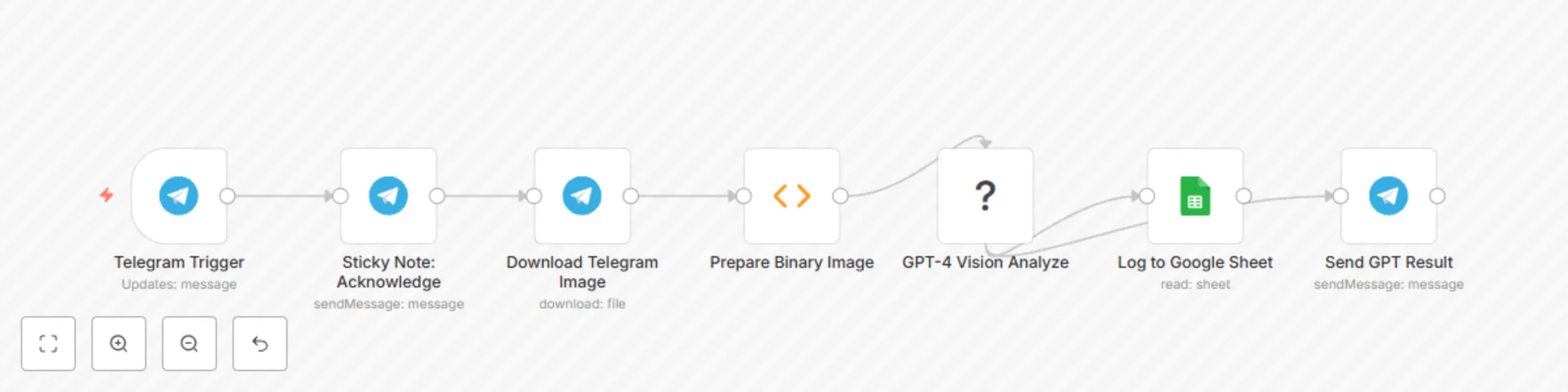
Workflow preview
100%
Track food calories via Telegram with GPT-4 Vision and Google Sheets preview
Open on n8n.io

Important notice

This workflow is provided as-is. Please review and test before using in production.

1. Workflow Overview

This workflow enables users to submit food images to a Telegram bot, which uses OpenAI’s GPT 4 Vision to identify the item and estimate its caloric value. The results are stored in Google Sheets an...

Best for

  • Personal Productivity automation workflows
  • Multimodal AI automation workflows
  • intermediate n8n builders looking for reusable templates

Tools used

n8n-nodes-base.telegramtrigger, n8n-nodes-base.telegram, n8n-nodes-base.function, n8n-nodes-base.openai, n8n-nodes-base.googlesheets

Source and attribution

This workflow is cataloged by N8N Workflows and links back to its original n8n.io source page by Shiva.

Original n8n.io source

1.1 Workflow description

Title
Track food calories via Telegram with GPT-4 Vision and Google Sheets
Workflow name
Track food calories via Telegram with GPT-4 Vision and Google Sheets

This workflow enables users to submit food images to a Telegram bot, which uses OpenAI’s GPT-4 Vision to identify the item and estimate its caloric value. The results are stored in Google Sheets and sent back to the user.

What it does:

  1. Triggers on a photo sent via Telegram.
  2. Acknowledges the user with a sticky note message.
  3. Downloads the image file securely using Telegram's API.
  4. Sends the image to GPT-4 Vision with a prompt: “Describe this food and estimate its calories.”
  5. Logs the GPT response to a Google Sheet (with timestamp).
  6. Replies to the user with the result (e.g., food name and estimated calories).

Use cases:

  • Personal food tracking
  • Nutrition logging via chat
  • Meal journaling for fitness or health

Requirements:

  • Telegram Bot Token (via credentials)
  • OpenAI GPT-4 Vision access
  • Google Sheets credential with access to the target sheet

Notes:

  • You can extend this template to calculate daily totals, categorize meals (breakfast/lunch/dinner), or even integrate with calorie goals.
  • The sticky note node confirms receipt to enhance UX.
  • Ideal for wellness apps, chat-based food journals, or AI-powered health bots.

1.2 Logical Blocks

This catalog entry is organized from the workflow JSON. The node-level section below shows the executable blocks available for review before importing the template.

2. Block-by-Block Analysis

Block 1 - Telegram Trigger

Type / Role
n8n-nodes-base.telegramTrigger - telegramTrigger
Config choices
Version 1

Block 2 - Sticky Note: Acknowledge

Type / Role
n8n-nodes-base.telegram - telegram
Config choices
Version 1

Block 3 - Download Telegram Image

Type / Role
n8n-nodes-base.telegram - telegram
Config choices
Version 1

Block 4 - Prepare Binary Image

Type / Role
n8n-nodes-base.function - function
Config choices
Version 1

Block 5 - GPT-4 Vision Analyze

Type / Role
n8n-nodes-base.openai - openai
Config choices
Version 1

Block 6 - Log to Google Sheet

Type / Role
n8n-nodes-base.googleSheets - googleSheets
Config choices
Version 2

Block 7 - Send GPT Result

Type / Role
n8n-nodes-base.telegram - telegram
Config choices
Version 1

3. Summary Table

Workflow Track food calories via Telegram with GPT-4 Vision and Google Sheets
Complexity intermediate
Nodes 7
Categories Personal Productivity, Multimodal AI
Author Shiva
Published 05 Aug 2025

4. Reproducing the Workflow from Scratch

  1. 1. Download the workflow JSON

    Use the JSON export at /data/workflows/7006/7006.json as the source template for this automation.

  2. 2. Import the template into n8n

    Open n8n, import the downloaded JSON, and review each node before activating the workflow.

  3. 3. Configure credentials and variables

    Replace placeholder credentials, API keys, webhook URLs, account IDs, and environment-specific values with your own settings.

  4. 4. Test with sample data

    Run the workflow manually or in a staging workspace, inspect node output, and confirm downstream systems receive the expected data.

  5. 5. Activate and monitor

    Enable the workflow only after testing, then monitor executions, errors, and rate limits during the first production runs.

5. General Notes & Resources

Review imported nodes carefully before activation. This catalog entry is intended to help you inspect the workflow structure, understand required services, and find related templates faster.

Node names, credentials, schedules, webhook paths, and external service limits may need adjustment for your workspace.

Frequently asked questions

What does Track food calories via Telegram with GPT-4 Vision and Google Sheets do?

This workflow enables users to submit food images to a Telegram bot, which uses OpenAI’s GPT 4 Vision to identify the item and estimate its caloric value. The results are stored in Google Sheets an...

What do I need before importing this workflow?

Review the workflow JSON, configure any required credentials in n8n, and test the automation in a safe workspace before using it in production.

Can I customize this workflow?

Yes. Use the block-by-block analysis and the downloadable JSON to inspect each node, then adjust credentials, prompts, schedules, filters, or destinations for your Personal Productivity, Multimodal AI use case.



