
Track domain expiry dates with Google Sheets and WHOIS API

Workflow preview
Workflow preview
100%
Track domain expiry dates with Google Sheets and WHOIS API preview
Open on n8n.io

1. Workflow Overview

Automatically track domain expiry dates from Google Sheets, fetch real time DNS expiry data via WHOIS API, and update expiry details back to your sheet with zero manual effort. Automated Domain Exp...

Best for

  • Document Extraction automation workflows
  • intermediate n8n builders looking for reusable templates

Tools used

n8n-nodes-base.manualtrigger, n8n-nodes-base.set, n8n-nodes-base.googlesheets, n8n-nodes-base.splitinbatches, n8n-nodes-base.httprequest, n8n-nodes-base.code, n8n-nodes-base.wait, n8n-nodes-base.stickynote

Source and attribution

This workflow is cataloged by N8N Workflows and links back to its original n8n.io source page by isaWOW.

Original n8n.io source

1.1 Workflow description

Title
Track domain expiry dates with Google Sheets and WHOIS API
Workflow name
Track domain expiry dates with Google Sheets and WHOIS API

Automatically track domain expiry dates from Google Sheets, fetch real-time DNS expiry data via WHOIS API, and update expiry details back to your sheet with zero manual effort.


Automated Domain Expiry Date Tracker with Google Sheets & WHOIS API

Automate the entire process of monitoring domain expiry dates for all your websites directly from Google Sheets. This workflow reads domain names, fetches DNS SOA expiry information using the WHOIS API, converts timestamps into readable dates, and updates expiry details back into your tracking sheet—fully automated and rate-limit safe.

Perfect for SEO teams, agencies, hosting managers, and businesses managing large domain portfolios.


What this workflow does

This automation handles four key tasks:

Reads domain data

  • Pulls all website domains directly from a Google Sheet

Fetches expiry details

  • Uses WHOIS API to retrieve DNS SOA records for each domain

Processes expiry dates

  • Converts expiry timestamps into human-readable DD-MM-YYYY format
  • Extracts expiry month and year automatically

Updates tracking sheet

  • Writes expiry date, month name, and year back to Google Sheets
  • Processes domains one by one with a controlled delay to avoid API limits

How it works

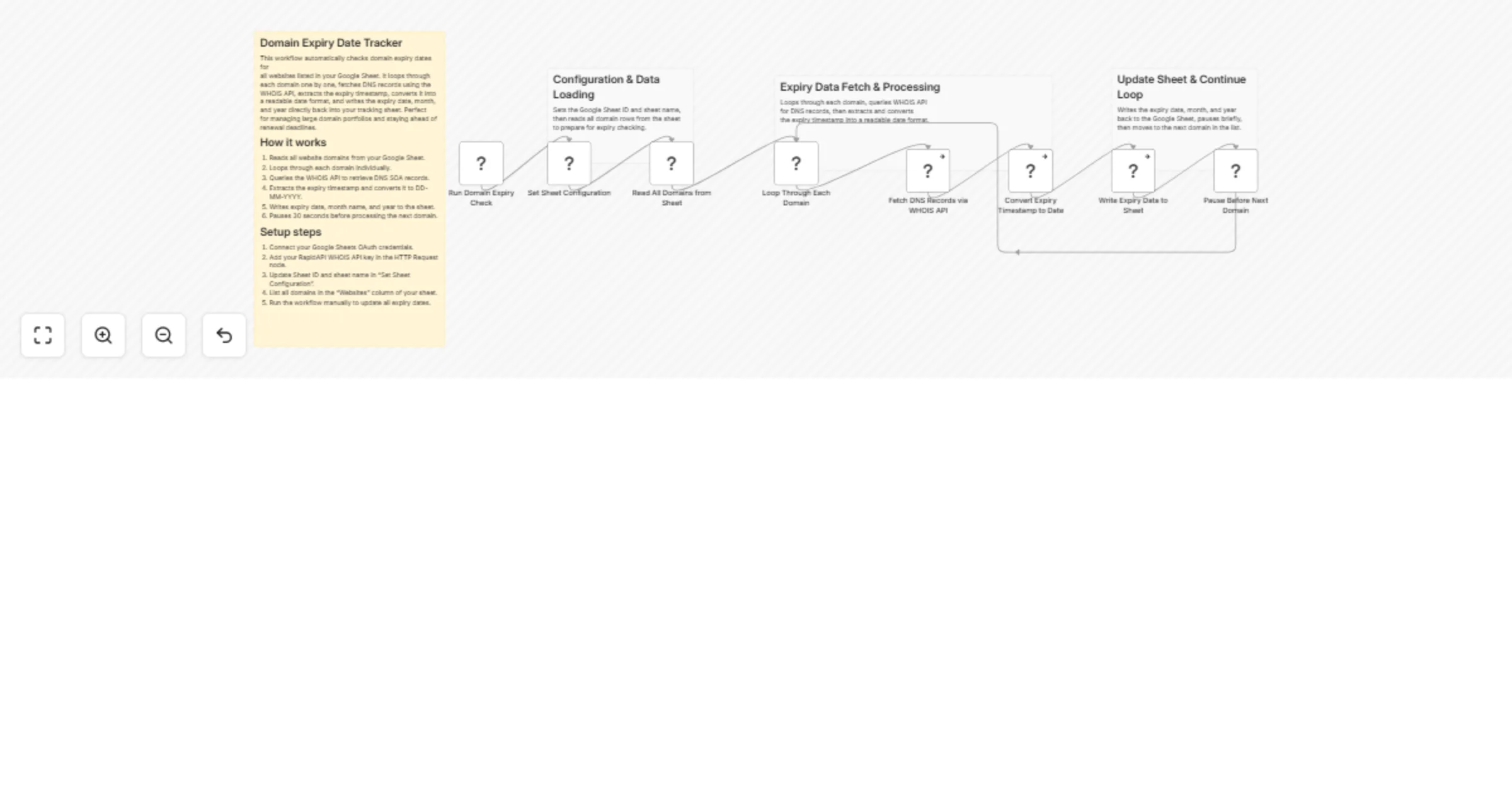
The workflow starts manually and loads configuration values such as Google Sheet ID and sheet name. It reads all domains listed in the Websites column and processes them in a loop.

For each domain, the workflow calls the WHOIS API to fetch DNS SOA records. The expiry timestamp is extracted, converted into a readable date format, and enriched with expiry month and year values.

Once processed, the workflow updates the same Google Sheet row with the new expiry information. A 30-second pause is applied before moving to the next domain to ensure API safety and stability.


Setup requirements

Accounts needed:

  • n8n instance (self-hosted or cloud)
  • Google account with Google Sheets access
  • RapidAPI account with WHOIS API access

Estimated setup time: 10 minutes


Setup steps

1. Import workflow

  • Copy the workflow JSON
  • Open n8n → Workflows → Import from JSON
  • Paste and import
  • Verify all nodes are connected correctly

2. Configure Google Sheets

  • Create a Google Sheet with a Websites column
  • Add Google Sheets OAuth2 credential in n8n
  • Paste your Sheet ID and sheet name inside Set Sheet Configuration node

3. Configure WHOIS API

  • Get your RapidAPI WHOIS API key
  • Add it to the Fetch DNS Records via WHOIS API HTTP Request node
  • Test the API request

4. Verify data mapping

  • Ensure expiry values map correctly to:

  • Domain Expiry

  • Expiry Month

  • Expiry Year

5. Run and monitor

  • Run the workflow manually
  • Check execution logs
  • Verify expiry data updates correctly in Google Sheets

What data gets updated

Domain data:

  • Domain name
  • Expiry date (DD-MM-YYYY)
  • Expiry month (January–December)
  • Expiry year

Sheet updates:

  • Existing rows are matched using the Websites column
  • No duplicate rows are created

Use cases

  • SEO management: Prevent domain expiries that can hurt rankings
  • Agency operations: Track client domains in one central sheet
  • Hosting monitoring: Stay ahead of renewal deadlines
  • Portfolio management: Manage hundreds of domains automatically

Important notes

  • Replace the WHOIS API key before activating
  • Google Sheets column names must match exactly
  • Workflow runs sequentially to avoid rate limits
  • One domain is processed at a time
  • Expiry accuracy depends on DNS SOA availability

Support

Need help or custom development?

📧 Email: [email protected]

🌐 Website: https://isawow.com/


1.2 Logical Blocks

This catalog entry is organized from the workflow JSON. The node-level section below shows the executable blocks available for review before importing the template.

2. Block-by-Block Analysis

Block 1 - Run Domain Expiry Check

Type / Role
n8n-nodes-base.manualTrigger - manualTrigger
Config choices
Version 1

Block 2 - Set Sheet Configuration

Type / Role
n8n-nodes-base.set - set
Config choices
Version 3.4

Block 3 - Read All Domains from Sheet

Type / Role
n8n-nodes-base.googleSheets - googleSheets
Config choices
Version 4.6

Block 4 - Loop Through Each Domain

Type / Role
n8n-nodes-base.splitInBatches - splitInBatches
Config choices
Version 3

Block 5 - Fetch DNS Records via WHOIS API

Type / Role
n8n-nodes-base.httpRequest - httpRequest
Config choices
Version 4.2

Block 6 - Convert Expiry Timestamp to Date

Type / Role
n8n-nodes-base.code - code
Config choices
Version 2

Block 7 - Write Expiry Data to Sheet

Type / Role
n8n-nodes-base.googleSheets - googleSheets
Config choices
Version 4.6

Block 8 - Pause Before Next Domain

Type / Role
n8n-nodes-base.wait - wait
Config choices
Version 1.1

Block 9 - Sticky Note

Type / Role
n8n-nodes-base.stickyNote - stickyNote
Config choices
Version 1

Block 10 - Sticky Note1

Type / Role
n8n-nodes-base.stickyNote - stickyNote
Config choices
Version 1

Block 11 - Sticky Note2

Type / Role
n8n-nodes-base.stickyNote - stickyNote
Config choices
Version 1

Block 12 - Sticky Note3

Type / Role
n8n-nodes-base.stickyNote - stickyNote
Config choices
Version 1

3. Summary Table

Workflow Track domain expiry dates with Google Sheets and WHOIS API
Complexity intermediate
Nodes 12
Categories Document Extraction
Author isaWOW
Published 04 Feb 2026

4. Reproducing the Workflow from Scratch

  1. 1. Download the workflow JSON

    Use the JSON export at /data/workflows/13211/13211.json as the source template for this automation.

  2. 2. Import the template into n8n

    Open n8n, import the downloaded JSON, and review each node before activating the workflow.

  3. 3. Configure credentials and variables

    Replace placeholder credentials, API keys, webhook URLs, account IDs, and environment-specific values with your own settings.

  4. 4. Test with sample data

    Run the workflow manually or in a staging workspace, inspect node output, and confirm downstream systems receive the expected data.

  5. 5. Activate and monitor

    Enable the workflow only after testing, then monitor executions, errors, and rate limits during the first production runs.

5. General Notes & Resources

Review imported nodes carefully before activation. This catalog entry is intended to help you inspect the workflow structure, understand required services, and find related templates faster.

Node names, credentials, schedules, webhook paths, and external service limits may need adjustment for your workspace.

Frequently asked questions

What does Track domain expiry dates with Google Sheets and WHOIS API do?

Automatically track domain expiry dates from Google Sheets, fetch real time DNS expiry data via WHOIS API, and update expiry details back to your sheet with zero manual effort. Automated Domain Exp...

What do I need before importing this workflow?

Review the workflow JSON, configure any required credentials in n8n, and test the automation in a safe workspace before using it in production.

Can I customize this workflow?

Yes. Use the block-by-block analysis and the downloadable JSON to inspect each node, then adjust credentials, prompts, schedules, filters, or destinations for your Document Extraction use case.



