Smart break recommendation system using Google Calendar, weather data, and GPT-4 to Slack
Workflow preview


 Early Deal
DISCOUNT 20%

Important notice
This workflow is provided as-is. Please review and test before using in production.
Overview
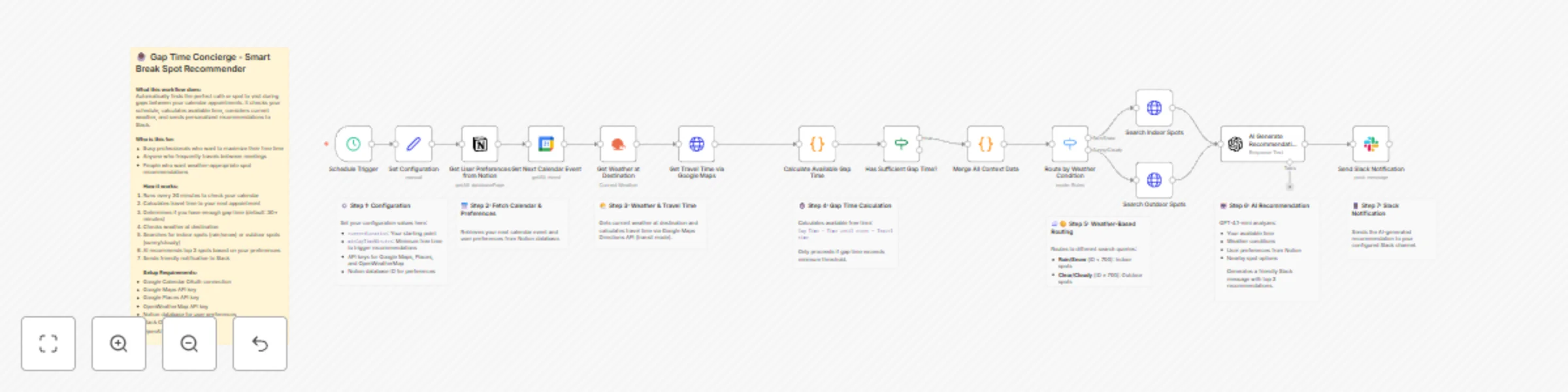
Who is this for This workflow is perfect for busy professionals, consultants, and anyone who frequently travels between meetings. If you want to make the most of your free time between appointments and discover great nearby spots without manual searching, this template is for you. What it does This workflow automatically monitors your Google Calendar and identifies gaps between appointments. When it detects sufficient free time (configurable, default 30+ minutes), it calculates travel time to your next destination, checks the weather, and uses AI to recommend the top 3 spots to visit during your break. Recommendations are weather-aware: indoor spots like cafés in malls or stations for rainy days, and outdoor terraces or open-air venues for nice weather. How it works
Schedule Trigger - Runs every 30 minutes to check your calendar Fetch Data - Gets your next calendar event and user preferences from Notion Calculate Gap Time - Determines available free time by subtracting travel time (via Google Maps) from time until your next appointment Weather Check - Gets current weather at your destination using OpenWeatherMap Smart Routing - Routes to indoor or outdoor spot search based on weather conditions AI Recommendations - GPT-4.1-mini analyzes spots and generates personalized top 3 recommendations Slack Notification - Sends a friendly message with recommendations to your Slack channel
Set up steps
Configure API Keys - Add your Google Maps, Google Places, and OpenWeatherMap API keys in the "Set Configuration" node Connect Google Calendar - Set up OAuth connection and select your calendar Set up Notion - Create a database for user preferences and add the database ID Connect Slack - Set up OAuth and specify your notification channel Connect OpenAI - Add your OpenAI API credentials Customize - Adjust currentLocation and minGapTimeMinutes to your needs
Requirements
Google Cloud account with Maps and Places APIs enabled OpenWeatherMap API key (free tier available) Notion account with a preferences database Slack workspace with bot permissions OpenAI API key
How to customize
Change trigger frequency: Modify the Schedule Trigger interval Adjust minimum gap time: Change minGapTimeMinutes in the configuration node Modify search radius: Edit the radius parameter in the Places API calls (default: 1000m) Customize spot types: Modify the type and keyword parameters in the HTTP Request nodes Change AI model: Switch to a different OpenAI model in the AI node Localize language: Update the AI prompt to generate responses in your preferred language