Review GitHub pull requests with AI and log results to PostgreSQL and Slack
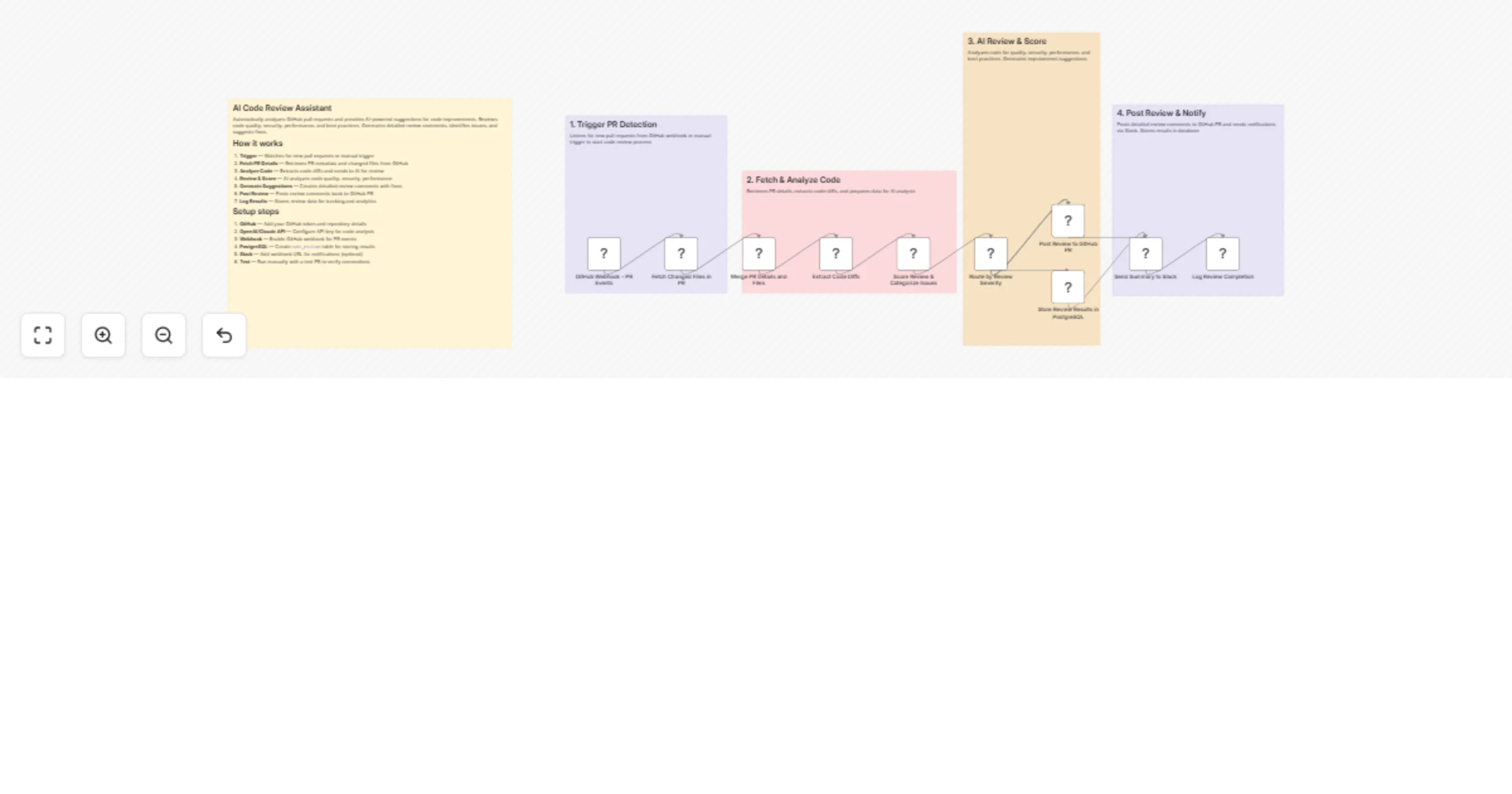
Workflow preview

$20/month : Unlimited workflows
2500 executions/month

THE #1 IN WEB SCRAPING
Scrape any website without limits
HOSTINGER  Early Deal
DISCOUNT 20% Try free
Early DealDISCOUNT 20%
Self-hosted n8n
Unlimited workflows - from $4.99/mo

#1 hub for scraping, AI & automation
6000+ actors - $5 credits/mo
Overview
Automatically detects new GitHub Pull Requests, analyzes changed code with AI, generates detailed review comments (quality, security, performance, best practices), posts suggestions back to the PR, stores results in a database, and sends notifications.
Good to Know
- Triggers automatically on new/updated GitHub Pull Requests via webhook (or manual test)
- Fetches only changed files/diffs — no need to clone full repo
- Uses AI (Grok, OpenAI, Claude, Gemini, etc.) to provide intelligent, context-aware feedback
- Covers multiple dimensions: code quality, bugs, security vulnerabilities, performance issues, maintainability, style/best practices
- Posts formatted review comments directly on the GitHub PR (with severity levels, suggestions, code snippets)
- Stores review history & scores in PostgreSQL (or other DB) for auditing, metrics, team dashboards
- Sends real-time notifications (Slack, Discord, email, etc.) for high-severity findings
- Saves developers hours on initial reviews and catches issues early
How It Works
1. Trigger PR Detection
- GitHub Webhook node — listens for
pull_requestevents (opened, synchronize, reopened, ready_for_review) - Optional: Filter node to ignore drafts, dependabot PRs, or specific branches
- Manual trigger available for testing
2. Fetch & Analyze Code
- GitHub node — retrieves PR details (title, body, number, repo, base/head commits)
- GitHub or HTTP Request — fetches list of changed files + diffs (using GitHub API
/pulls/{number}/filesand diff content) - Merge PR Details & Extract Diffs — combines metadata + code changes into structured format
- Prepares payload: file paths, diff hunks, full file content if needed (truncated for large files)
3. AI Review & Score
- Sends prepared diff data + context (language, repo conventions, custom guidelines) to AI model
- Prompt engineering focuses on:
- Code correctness & bugs
- Security vulnerabilities (OWASP, secrets, injection risks)
- Performance optimizations
- Readability, maintainability, SOLID principles
- Best practices & style (specific to language/framework)
- Refactoring suggestions with examples
- AI returns structured output: severity (low/medium/high/critical), category, comment text, suggested fix (with code block)
- Optional: Score node — assigns overall PR quality score (0–100) based on findings
4. Post Review & Notify
- Route by severity / issue count (e.g. critical → immediate Slack)
- GitHub node — posts detailed review comments on the PR (as bot user)
- Supports threaded replies, line-specific comments (if hunk positions available)
- Adds label e.g.
ai-reviewed,needs-changes - Store Results in PostgreSQL — logs full review (PR link, timestamp, AI output JSON, score, issues list)
- Send Summary to Slack (or Discord/Email/Telegram) — concise message with key findings, link to PR, severity highlights
- Log Completion — records successful execution for monitoring
Data Sources
- GitHub — Pull Requests, diffs, comments, labels (via webhook + API)
- AI Model — Grok (xAI), OpenAI GPT-4o / o1, Anthropic Claude, Google Gemini, or local LLM
- Storage — PostgreSQL (recommended for structured querying), or Supabase, Airtable, Google Sheets
- Notifications — Slack, Discord, Microsoft Teams, Email (SMTP), Telegram
How to Use
- Import the workflow JSON into your n8n instance
- Configure credentials:
- GitHub OAuth / Personal Access Token (with
reposcope) - AI provider API key (Grok/OpenAI/etc.)
- PostgreSQL database connection
- Slack/Discord/Email credentials
- Set up GitHub Webhook:
- In repo Settings → Webhooks → Add webhook
- Payload URL = your n8n webhook URL
- Content type: application/json
- Events: Pull requests
- Customize AI prompt — add repo-specific rules, coding standards, ignored patterns
- Tune filters — minimum severity to post, files to skip (e.g. lock files, generated code)
- Test — create/open a small PR or use Execute Workflow with sample payload
- Activate — turn on the workflow and monitor Executions + Logs
Requirements
- n8n (self-hosted preferred for webhooks)
- GitHub repo with admin access to add webhook & bot token
- AI API access with sufficient token limit (large PRs = large prompts)
- PostgreSQL database (or alternative) for persistent storage
- Notification service account (Slack app, Discord bot, etc.)
Customizing This Workflow
- Add custom best practices — load from Google Sheets/Notion/Airtable and inject into prompt
- Support multi-file analysis — chunk very large PRs or summarize per-file first
- Auto-approve low-risk PRs — add approval action if score > 90 and no critical issues
- Security focus — integrate with tools like Semgrep/Trivy results
- Comment on specific lines — use GitHub API position/hunk data for inline comments
- Team routing — notify language-specific experts via Slack channels
- Metrics dashboard — connect DB to Grafana/Metabase for review trends
- Ignore patterns — skip vendor/, node_modules/, tests/, etc.
- Multiple AI models — fallback or ensemble (e.g. Claude for reasoning + Grok for speed)