Block 1 - Sticky Note
- Type / Role
- n8n-nodes-base.stickyNote - stickyNote
- Config choices
- Version 1
This workflow is provided as-is. Please review and test before using in production.
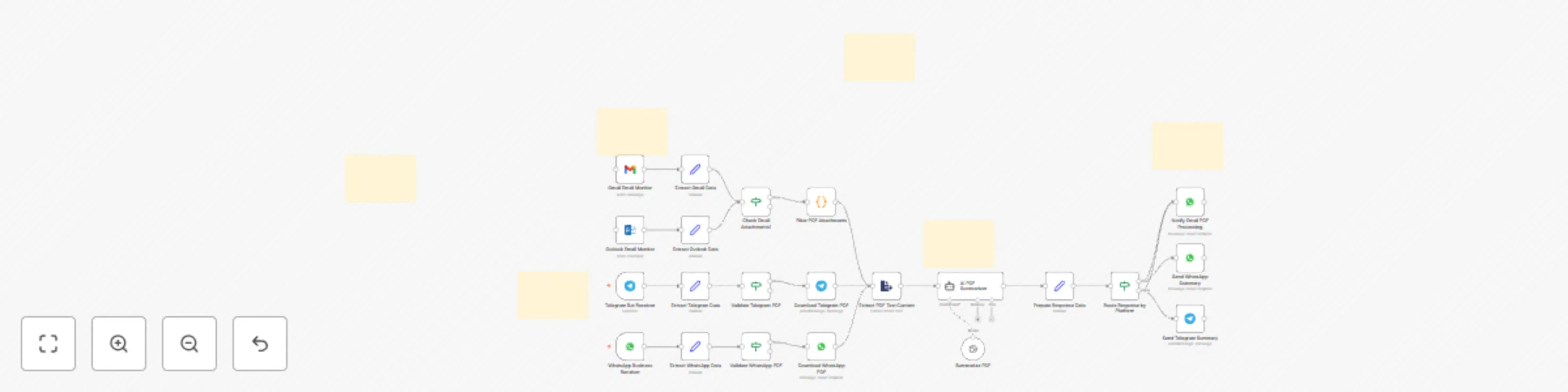
Process PDFs from Gmail, Outlook, Telegram and WhatsApp with OpenAI Transform PDF documents into actionable insights automatically across multiple platforms. This workflow monitors emails and messa...
n8n-nodes-base.stickynote, n8n-nodes-base.gmail, n8n-nodes-base.microsoftoutlook, n8n-nodes-base.telegramtrigger, n8n-nodes-base.whatsapptrigger, n8n-nodes-base.if, n8n-nodes-base.extractfromfile, n8n-nodes-base.set
This workflow is cataloged by N8N Workflows and links back to its original n8n.io source page by papcy.
Original n8n.io sourceTransform PDF documents into actionable insights automatically across multiple platforms. This workflow monitors emails and messaging platforms for PDF attachments, extracts content, and delivers AI-powered summaries.
Business professionals, teams, and organizations needing automated PDF analysis from emails and messaging platforms. Perfect for processing contracts, reports, invoices, and documents requiring quick review.
Monitors Gmail and Outlook for PDF attachments while receiving PDFs via Telegram bot and WhatsApp Business API. Uses OpenAI to extract text and generate structured summaries with executive overviews, key points, important details, insights, and document type identification. Automatically routes summaries back to original senders.
Configure API credentials in respective nodes, update configuration variables for phone numbers and notification settings, then test with sample PDFs.
Modify AI models, customize prompts, adjust response formatting, extend file support, add notification channels, or integrate with external systems.
Perfect for automating document workflows across communication channels.
This catalog entry is organized from the workflow JSON. The node-level section below shows the executable blocks available for review before importing the template.
Showing the first 24 of 28 workflow blocks. Download the JSON for the full node graph.
| Workflow | Process & summarize PDFs from email & messaging apps with OpenAI GPT |
|---|---|
| Complexity | advanced |
| Nodes | 28 |
| Categories | Document Extraction, AI Summarization |
| Author | papcy |
| Published | 02 Jul 2025 |
Use the JSON export at /data/workflows/5592/5592.json as the source template for this automation.
Open n8n, import the downloaded JSON, and review each node before activating the workflow.
Replace placeholder credentials, API keys, webhook URLs, account IDs, and environment-specific values with your own settings.
Run the workflow manually or in a staging workspace, inspect node output, and confirm downstream systems receive the expected data.
Enable the workflow only after testing, then monitor executions, errors, and rate limits during the first production runs.
Review imported nodes carefully before activation. This catalog entry is intended to help you inspect the workflow structure, understand required services, and find related templates faster.
Node names, credentials, schedules, webhook paths, and external service limits may need adjustment for your workspace.
Process PDFs from Gmail, Outlook, Telegram and WhatsApp with OpenAI Transform PDF documents into actionable insights automatically across multiple platforms. This workflow monitors emails and messa...
Review the workflow JSON, configure any required credentials in n8n, and test the automation in a safe workspace before using it in production.
Yes. Use the block-by-block analysis and the downloadable JSON to inspect each node, then adjust credentials, prompts, schedules, filters, or destinations for your Document Extraction, AI Summarization use case.