
Monitor supply chain risks and disruptions with GPT-4o and Slack alerts

Workflow preview
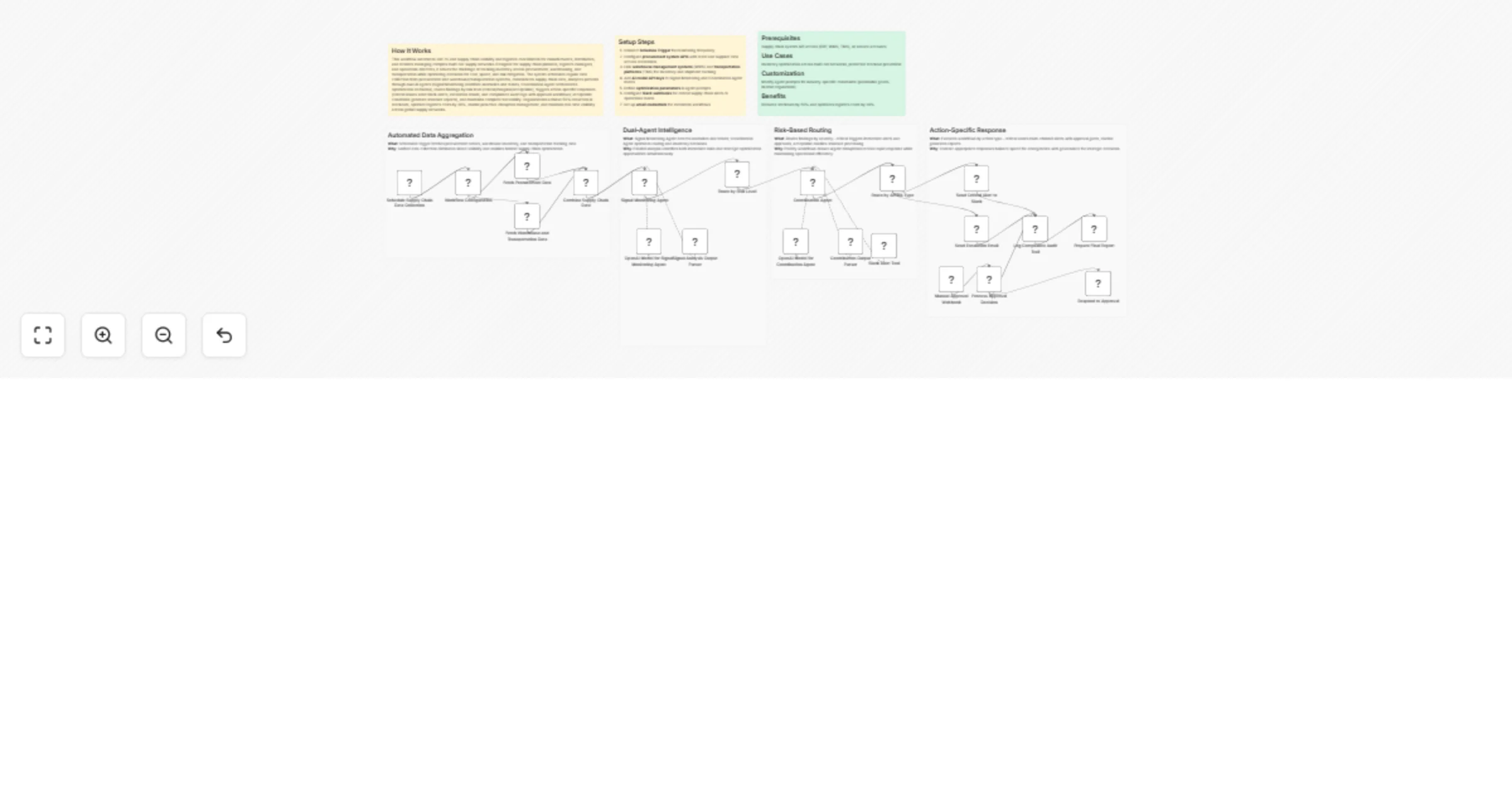
Workflow preview
100%
Monitor supply chain risks and disruptions with GPT-4o and Slack alerts preview
Open on n8n.io

1. Workflow Overview

How It Works This workflow automates end to end supply chain visibility and logistics coordination for manufacturers, distributors, and retailers managing complex multi tier supply networks. Design...

Best for

  • Engineering automation workflows
  • AI Summarization automation workflows
  • advanced n8n builders looking for reusable templates

Tools used

n8n-nodes-base.scheduletrigger, n8n-nodes-base.set, n8n-nodes-base.httprequest, n8n-nodes-base.merge, @n8n/n8n-nodes-langchain.lmchatopenai, @n8n/n8n-nodes-langchain.outputparserstructured, @n8n/n8n-nodes-langchain.agent, n8n-nodes-base.switch

Source and attribution

This workflow is cataloged by N8N Workflows and links back to its original n8n.io source page by Cheng Siong Chin.

Original n8n.io source

1.1 Workflow description

Title
Monitor supply chain risks and disruptions with GPT-4o and Slack alerts
Workflow name
Monitor supply chain risks and disruptions with GPT-4o and Slack alerts

How It Works

This workflow automates end-to-end supply chain visibility and logistics coordination for manufacturers, distributors, and retailers managing complex multi-tier supply networks. Designed for supply chain planners, logistics managers, and operations directors, it solves the challenge of tracking inventory across procurement, warehousing, and transportation while optimizing decisions for cost, speed, and risk mitigation. The system schedules regular data collection from procurement and warehouse/transportation systems, consolidates supply chain data, analyzes patterns through dual AI agents (Signal Monitoring identifies anomalies and trends, Coordination Agent orchestrates optimization decisions), routes findings by risk level (critical/marginal/acceptable), triggers action-specific responses (critical issues send Slack alerts, escalation emails, and compliance audit logs with approval workflows; acceptable conditions generate standard reports), and maintains complete traceability. Organizations achieve 50% reduction in stockouts, optimize logistics costs by 30%, enable proactive disruption management, and maintain real-time visibility across global supply networks.

Setup Steps

  1. Connect Schedule Trigger for monitoring frequency
  2. Configure procurement system APIs with order and supplier data access credentials
  3. Link warehouse management systems (WMS) and transportation platforms (TMS) for inventory and shipment tracking
  4. Add AI model API keys to Signal Monitoring and Coordination Agent nodes
  5. Define optimization parameters in agent prompts
  6. Configure Slack webhooks for critical supply chain alerts to operations teams
  7. Set up email credentials for escalation workflows

Prerequisites

Supply chain system API access (ERP, WMS, TMS), AI service accounts.

Use Cases

Inventory optimization across multi-tier networks, predictive stockout prevention

Customization

Modify agent prompts for industry-specific constraints (perishable goods, hazmat regulations)

Benefits

Reduces stockouts by 50% and optimizes logistics costs by 30%

1.2 Logical Blocks

This catalog entry is organized from the workflow JSON. The node-level section below shows the executable blocks available for review before importing the template.

2. Block-by-Block Analysis

Block 1 - Schedule Supply Chain Data Collection

Type / Role
n8n-nodes-base.scheduleTrigger - scheduleTrigger
Config choices
Version 1.3

Block 2 - Workflow Configuration

Type / Role
n8n-nodes-base.set - set
Config choices
Version 3.4

Block 3 - Fetch Procurement Data

Type / Role
n8n-nodes-base.httpRequest - httpRequest
Config choices
Version 4.3

Block 4 - Fetch Warehouse and Transportation Data

Type / Role
n8n-nodes-base.httpRequest - httpRequest
Config choices
Version 4.3

Block 5 - Combine Supply Chain Data

Type / Role
n8n-nodes-base.merge - merge
Config choices
Version 3.2

Block 6 - OpenAI Model for Signal Monitoring Agent

Type / Role
@n8n/n8n-nodes-langchain.lmChatOpenAi - lmChatOpenAi
Config choices
Version 1.3

Block 7 - Signal Analysis Output Parser

Type / Role
@n8n/n8n-nodes-langchain.outputParserStructured - outputParserStructured
Config choices
Version 1.3

Block 8 - Signal Monitoring Agent

Type / Role
@n8n/n8n-nodes-langchain.agent - agent
Config choices
Version 3.1

Block 9 - Route by Risk Level

Type / Role
n8n-nodes-base.switch - switch
Config choices
Version 3.4

Block 10 - OpenAI Model for Coordination Agent

Type / Role
@n8n/n8n-nodes-langchain.lmChatOpenAi - lmChatOpenAi
Config choices
Version 1.3

Block 11 - Coordination Output Parser

Type / Role
@n8n/n8n-nodes-langchain.outputParserStructured - outputParserStructured
Config choices
Version 1.3

Block 12 - Slack Alert Tool

Type / Role
n8n-nodes-base.slackTool - slackTool
Config choices
Version 2.4

Block 13 - Coordination Agent

Type / Role
@n8n/n8n-nodes-langchain.agent - agent
Config choices
Version 3.1

Block 14 - Route by Action Type

Type / Role
n8n-nodes-base.switch - switch
Config choices
Version 3.4

Block 15 - Manual Approval Webhook

Type / Role
n8n-nodes-base.webhook - webhook
Config choices
Version 2.1

Block 16 - Respond to Approval

Type / Role
n8n-nodes-base.respondToWebhook - respondToWebhook
Config choices
Version 1.5

Block 17 - Process Approval Decision

Type / Role
n8n-nodes-base.code - code
Config choices
Version 2

Block 18 - Send Critical Alert to Slack

Type / Role
n8n-nodes-base.slack - slack
Config choices
Version 2.4

Block 19 - Send Escalation Email

Type / Role
n8n-nodes-base.emailSend - emailSend
Config choices
Version 2.1

Block 20 - Log Compliance Audit Trail

Type / Role
n8n-nodes-base.code - code
Config choices
Version 2

Block 21 - Prepare Final Report

Type / Role
n8n-nodes-base.set - set
Config choices
Version 3.4

Block 22 - Sticky Note

Type / Role
n8n-nodes-base.stickyNote - stickyNote
Config choices
Version 1

Block 23 - Sticky Note1

Type / Role
n8n-nodes-base.stickyNote - stickyNote
Config choices
Version 1

Block 24 - Sticky Note2

Type / Role
n8n-nodes-base.stickyNote - stickyNote
Config choices
Version 1

Showing the first 24 of 28 workflow blocks. Download the JSON for the full node graph.

3. Summary Table

Workflow Monitor supply chain risks and disruptions with GPT-4o and Slack alerts
Complexity advanced
Nodes 28
Categories Engineering, AI Summarization
Author Cheng Siong Chin
Published 12 Feb 2026

4. Reproducing the Workflow from Scratch

  1. 1. Download the workflow JSON

    Use the JSON export at /data/workflows/13337/13337.json as the source template for this automation.

  2. 2. Import the template into n8n

    Open n8n, import the downloaded JSON, and review each node before activating the workflow.

  3. 3. Configure credentials and variables

    Replace placeholder credentials, API keys, webhook URLs, account IDs, and environment-specific values with your own settings.

  4. 4. Test with sample data

    Run the workflow manually or in a staging workspace, inspect node output, and confirm downstream systems receive the expected data.

  5. 5. Activate and monitor

    Enable the workflow only after testing, then monitor executions, errors, and rate limits during the first production runs.

5. General Notes & Resources

Review imported nodes carefully before activation. This catalog entry is intended to help you inspect the workflow structure, understand required services, and find related templates faster.

Node names, credentials, schedules, webhook paths, and external service limits may need adjustment for your workspace.

Frequently asked questions

What does Monitor supply chain risks and disruptions with GPT-4o and Slack alerts do?

How It Works This workflow automates end to end supply chain visibility and logistics coordination for manufacturers, distributors, and retailers managing complex multi tier supply networks. Design...

What do I need before importing this workflow?

Review the workflow JSON, configure any required credentials in n8n, and test the automation in a safe workspace before using it in production.

Can I customize this workflow?

Yes. Use the block-by-block analysis and the downloadable JSON to inspect each node, then adjust credentials, prompts, schedules, filters, or destinations for your Engineering, AI Summarization use case.



