
Monitor employee policy compliance with GPT-4, Slack, and email alerts

Workflow preview
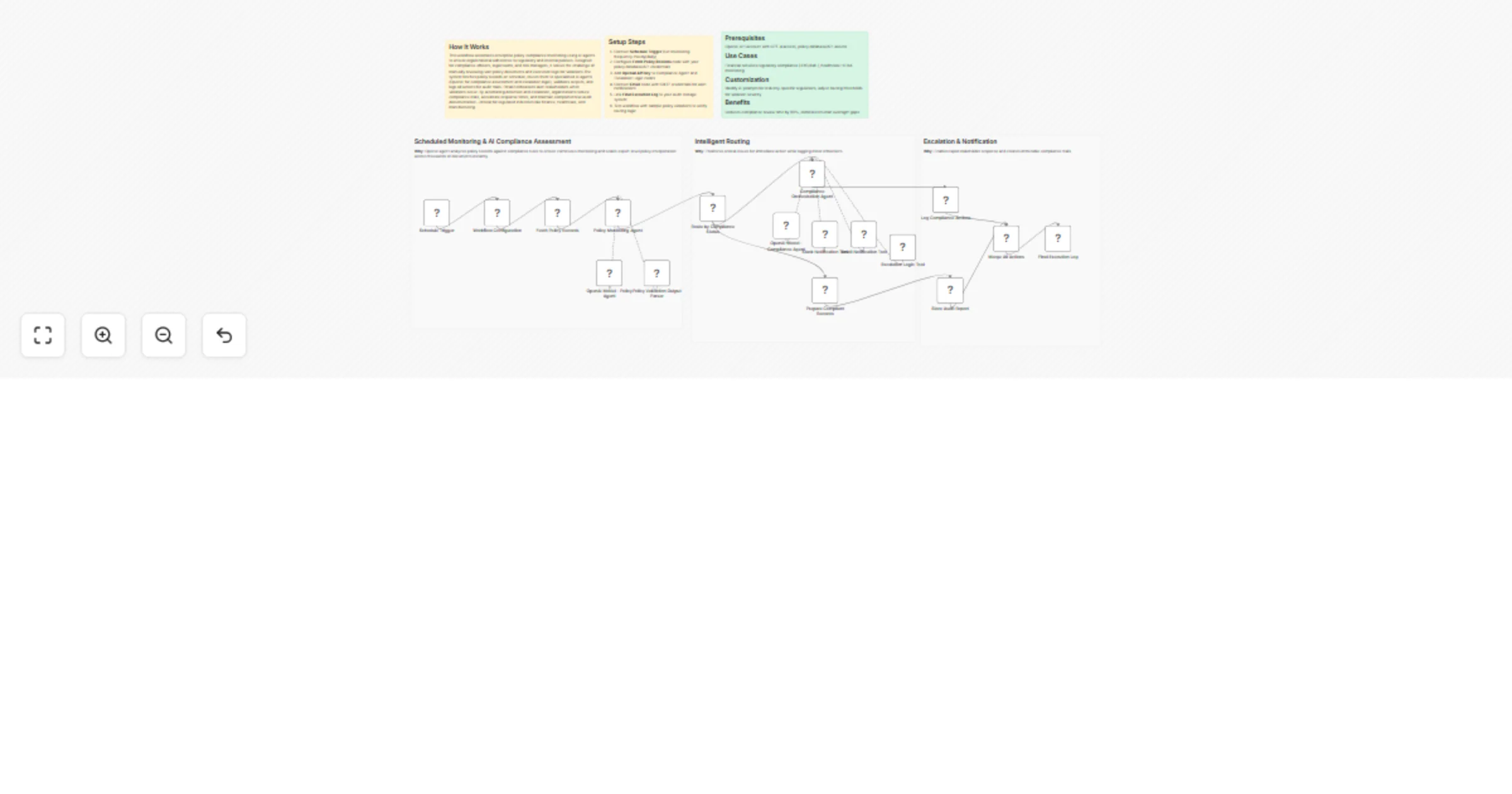
Workflow preview
100%
Monitor employee policy compliance with GPT-4, Slack, and email alerts preview
Open on n8n.io

1. Workflow Overview

How It Works This workflow automates enterprise policy compliance monitoring using AI agents to ensure organizational adherence to regulatory and internal policies. Designed for compliance officers...

Best for

  • Document Extraction automation workflows
  • AI Summarization automation workflows
  • advanced n8n builders looking for reusable templates

Tools used

n8n-nodes-base.scheduletrigger, n8n-nodes-base.set, n8n-nodes-base.datatable, @n8n/n8n-nodes-langchain.agent, @n8n/n8n-nodes-langchain.lmchatopenai, @n8n/n8n-nodes-langchain.outputparserstructured, n8n-nodes-base.switch, n8n-nodes-base.slacktool

Source and attribution

This workflow is cataloged by N8N Workflows and links back to its original n8n.io source page by Cheng Siong Chin.

Original n8n.io source

1.1 Workflow description

Title
Monitor employee policy compliance with GPT-4, Slack, and email alerts
Workflow name
Monitor employee policy compliance with GPT-4, Slack, and email alerts

How It Works

This workflow automates enterprise policy compliance monitoring using AI agents to ensure organizational adherence to regulatory and internal policies. Designed for compliance officers, legal teams, and risk managers, it solves the challenge of manually reviewing vast policy documents and execution logs for violations.The system fetches policy records on schedule, routes them to specialized AI agents (OpenAI for compliance assessment and escalation logic), validates outputs, and logs all actions for audit trails. Email notifications alert stakeholders when violations occur. By automating detection and escalation, organizations reduce compliance risks, accelerate response times, and maintain comprehensive audit documentation—critical for regulated industries like finance, healthcare, and manufacturing.

Setup Steps

  1. Connect Schedule Trigger (set monitoring frequency: hourly/daily)
  2. Configure Fetch Policy Records node with your policy database/API credentials
  3. Add OpenAI API key to Compliance Agent and Escalation Logic nodes
  4. Connect Email node with SMTP credentials for alert notifications
  5. Link Final Execution Log to your audit storage system
  6. Test workflow with sample policy violations to verify routing logic

Prerequisites

OpenAI API account with GPT-4 access, policy database/API access

Use Cases

Financial services regulatory compliance (KYC/AML), healthcare HIPAA monitoring

Customization

Modify AI prompts for industry-specific regulations, adjust routing thresholds for violation severity

Benefits

Reduces compliance review time by 90%, eliminates human oversight gaps

1.2 Logical Blocks

This catalog entry is organized from the workflow JSON. The node-level section below shows the executable blocks available for review before importing the template.

2. Block-by-Block Analysis

Block 1 - Schedule Trigger

Type / Role
n8n-nodes-base.scheduleTrigger - scheduleTrigger
Config choices
Version 1.3

Block 2 - Workflow Configuration

Type / Role
n8n-nodes-base.set - set
Config choices
Version 3.4

Block 3 - Fetch Policy Records

Type / Role
n8n-nodes-base.dataTable - dataTable
Config choices
Version 1.1

Block 4 - Policy Monitoring Agent

Type / Role
@n8n/n8n-nodes-langchain.agent - agent
Config choices
Version 3.1

Block 5 - OpenAI Model - Policy Agent

Type / Role
@n8n/n8n-nodes-langchain.lmChatOpenAi - lmChatOpenAi
Config choices
Version 1.3

Block 6 - Policy Validation Output Parser

Type / Role
@n8n/n8n-nodes-langchain.outputParserStructured - outputParserStructured
Config choices
Version 1.3

Block 7 - Route by Compliance Status

Type / Role
n8n-nodes-base.switch - switch
Config choices
Version 3.4

Block 8 - Compliance Orchestration Agent

Type / Role
@n8n/n8n-nodes-langchain.agent - agent
Config choices
Version 3.1

Block 9 - OpenAI Model - Compliance Agent

Type / Role
@n8n/n8n-nodes-langchain.lmChatOpenAi - lmChatOpenAi
Config choices
Version 1.3

Block 10 - Slack Notification Tool

Type / Role
n8n-nodes-base.slackTool - slackTool
Config choices
Version 2.4

Block 11 - Email Notification Tool

Type / Role
n8n-nodes-base.emailSendTool - emailSendTool
Config choices
Version 2.1

Block 12 - Escalation Logic Tool

Type / Role
@n8n/n8n-nodes-langchain.toolCode - toolCode
Config choices
Version 1.3

Block 13 - Log Compliance Actions

Type / Role
n8n-nodes-base.dataTable - dataTable
Config choices
Version 1.1

Block 14 - Prepare Compliant Records

Type / Role
n8n-nodes-base.set - set
Config choices
Version 3.4

Block 15 - Store Audit Report

Type / Role
n8n-nodes-base.dataTable - dataTable
Config choices
Version 1.1

Block 16 - Merge All Actions

Type / Role
n8n-nodes-base.merge - merge
Config choices
Version 3.2

Block 17 - Final Execution Log

Type / Role
n8n-nodes-base.dataTable - dataTable
Config choices
Version 1.1

Block 18 - Sticky Note

Type / Role
n8n-nodes-base.stickyNote - stickyNote
Config choices
Version 1

Block 19 - Sticky Note1

Type / Role
n8n-nodes-base.stickyNote - stickyNote
Config choices
Version 1

Block 20 - Sticky Note2

Type / Role
n8n-nodes-base.stickyNote - stickyNote
Config choices
Version 1

Block 21 - Sticky Note3

Type / Role
n8n-nodes-base.stickyNote - stickyNote
Config choices
Version 1

Block 22 - Sticky Note4

Type / Role
n8n-nodes-base.stickyNote - stickyNote
Config choices
Version 1

Block 23 - Sticky Note5

Type / Role
n8n-nodes-base.stickyNote - stickyNote
Config choices
Version 1

3. Summary Table

Workflow Monitor employee policy compliance with GPT-4, Slack, and email alerts
Complexity advanced
Nodes 23
Categories Document Extraction, AI Summarization
Author Cheng Siong Chin
Published 12 Feb 2026

4. Reproducing the Workflow from Scratch

  1. 1. Download the workflow JSON

    Use the JSON export at /data/workflows/13318/13318.json as the source template for this automation.

  2. 2. Import the template into n8n

    Open n8n, import the downloaded JSON, and review each node before activating the workflow.

  3. 3. Configure credentials and variables

    Replace placeholder credentials, API keys, webhook URLs, account IDs, and environment-specific values with your own settings.

  4. 4. Test with sample data

    Run the workflow manually or in a staging workspace, inspect node output, and confirm downstream systems receive the expected data.

  5. 5. Activate and monitor

    Enable the workflow only after testing, then monitor executions, errors, and rate limits during the first production runs.

5. General Notes & Resources

Review imported nodes carefully before activation. This catalog entry is intended to help you inspect the workflow structure, understand required services, and find related templates faster.

Node names, credentials, schedules, webhook paths, and external service limits may need adjustment for your workspace.

Frequently asked questions

What does Monitor employee policy compliance with GPT-4, Slack, and email alerts do?

How It Works This workflow automates enterprise policy compliance monitoring using AI agents to ensure organizational adherence to regulatory and internal policies. Designed for compliance officers...

What do I need before importing this workflow?

Review the workflow JSON, configure any required credentials in n8n, and test the automation in a safe workspace before using it in production.

Can I customize this workflow?

Yes. Use the block-by-block analysis and the downloadable JSON to inspect each node, then adjust credentials, prompts, schedules, filters, or destinations for your Document Extraction, AI Summarization use case.



