Block 1 - When clicking ‘Execute workflow’
- Type / Role
- n8n-nodes-base.manualTrigger - manualTrigger
- Config choices
- Version 1
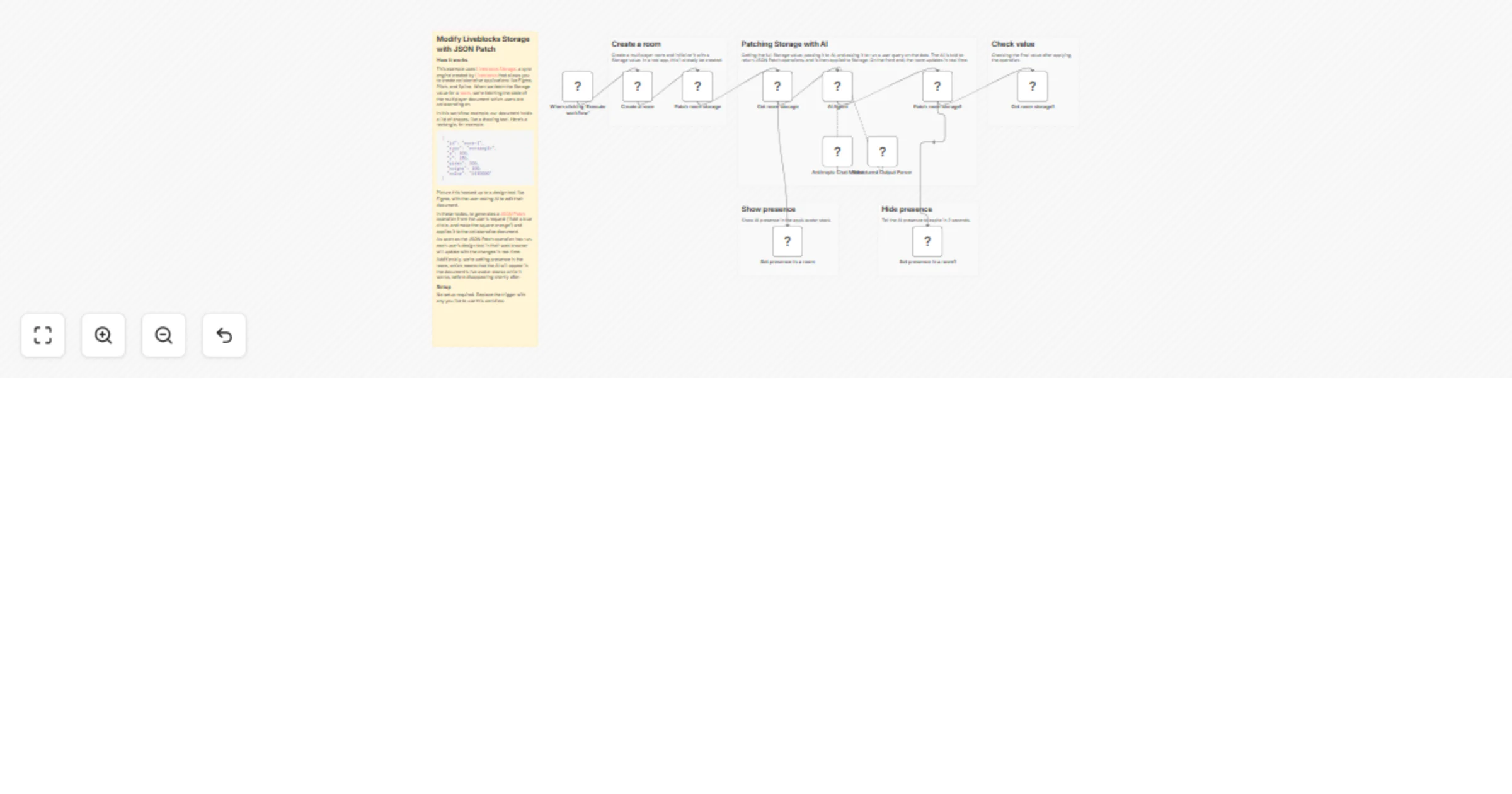
Modify Liveblocks Storage with JSON Patch This example uses Liveblocks Storage, a sync engine created by...
n8n-nodes-base.manualtrigger, custom.liveblocks, @n8n/n8n-nodes-langchain.agent, @n8n/n8n-nodes-langchain.lmchatanthropic, @n8n/n8n-nodes-langchain.outputparserstructured, n8n-nodes-base.stickynote
This workflow is cataloged by N8N Workflows and links back to its original n8n.io source page by Liveblocks.
Original n8n.io sourceThis example uses Liveblocks Storage, a sync engine created by Liveblocks that allows you to create collaborative applications like Figma, Pitch, and Spline. When we fetch the Storage value for a room, we're fetching the state of the multiplayer document which users are collaborating on.
In this workflow example, our document holds a list of shapes, like a drawing tool. Here's a rectangle, for example:
{
"id": "rect-1",
"type": "rectangle",
"x": 100,
"y": 150,
"width": 200,
"height": 100,
"color": "#ff0000"
}
Picture this hooked up to a design tool like Figma, with the user asking AI to edit their document.
In these nodes, to generates a JSON Patch operation from the user's request ("Add a blue circle, and make the square orange") and applies it to the collaborative document.
As soon as the JSON Patch operation has run, each user's design tool in their web browser will update with the changes in real time.
Additionally, we're setting presence in the room, which means that the AI will appear in the document's live avatar stacks while it works, before disappearing shortly after.
This catalog entry is organized from the workflow JSON. The node-level section below shows the executable blocks available for review before importing the template.
| Workflow | Modify Liveblocks storage with JSON Patch and Anthropic Claude |
|---|---|
| Complexity | advanced |
| Nodes | 17 |
| Categories | Engineering, AI RAG |
| Author | Liveblocks |
| Published | 24 Mar 2026 |
Use the JSON export at /data/workflows/14301/14301.json as the source template for this automation.
Open n8n, import the downloaded JSON, and review each node before activating the workflow.
Replace placeholder credentials, API keys, webhook URLs, account IDs, and environment-specific values with your own settings.
Run the workflow manually or in a staging workspace, inspect node output, and confirm downstream systems receive the expected data.
Enable the workflow only after testing, then monitor executions, errors, and rate limits during the first production runs.
Review imported nodes carefully before activation. This catalog entry is intended to help you inspect the workflow structure, understand required services, and find related templates faster.
Node names, credentials, schedules, webhook paths, and external service limits may need adjustment for your workspace.
Modify Liveblocks Storage with JSON Patch This example uses Liveblocks Storage, a sync engine created by...
Review the workflow JSON, configure any required credentials in n8n, and test the automation in a safe workspace before using it in production.
Yes. Use the block-by-block analysis and the downloadable JSON to inspect each node, then adjust credentials, prompts, schedules, filters, or destinations for your Engineering, AI RAG use case.