
Meal planner: cost tracking, leftover recipes & nutrition diary in Google Sheets

Workflow preview
Workflow preview
100%
Meal planner: cost tracking, leftover recipes & nutrition diary in Google Sheets preview
Open on n8n.io

Important notice

This workflow is provided as-is. Please review and test before using in production.

1. Workflow Overview

Who's it for This template is for home cooks, small restaurant owners, or anyone who wants to streamline their meal planning, ingredient cost tracking, leftover management, nutritional analysis, an...

Best for

  • Personal Productivity automation workflows
  • Multimodal AI automation workflows
  • advanced n8n builders looking for reusable templates

Tools used

@n8n/n8n-nodes-langchain.lmchatopenrouter, @n8n/n8n-nodes-langchain.outputparserstructured, n8n-nodes-base.googlesheets, n8n-nodes-base.webhook, n8n-nodes-base.twitter, @n8n/n8n-nodes-langchain.agent, n8n-nodes-base.stickynote

Source and attribution

This workflow is cataloged by N8N Workflows and links back to its original n8n.io source page by takuma.

Original n8n.io source

1.1 Workflow description

Title
Meal planner: cost tracking, leftover recipes & nutrition diary in Google Sheets
Workflow name
Meal planner: cost tracking, leftover recipes & nutrition diary in Google Sheets

Who's it for

This template is for home cooks, small restaurant owners, or anyone who wants to streamline their meal planning, ingredient cost tracking, leftover management, nutritional analysis, and social media promotion. It's ideal for those looking to optimize their kitchen operations, reduce food waste, maintain a healthy diet, and efficiently share their culinary creations.

How it works / What it does

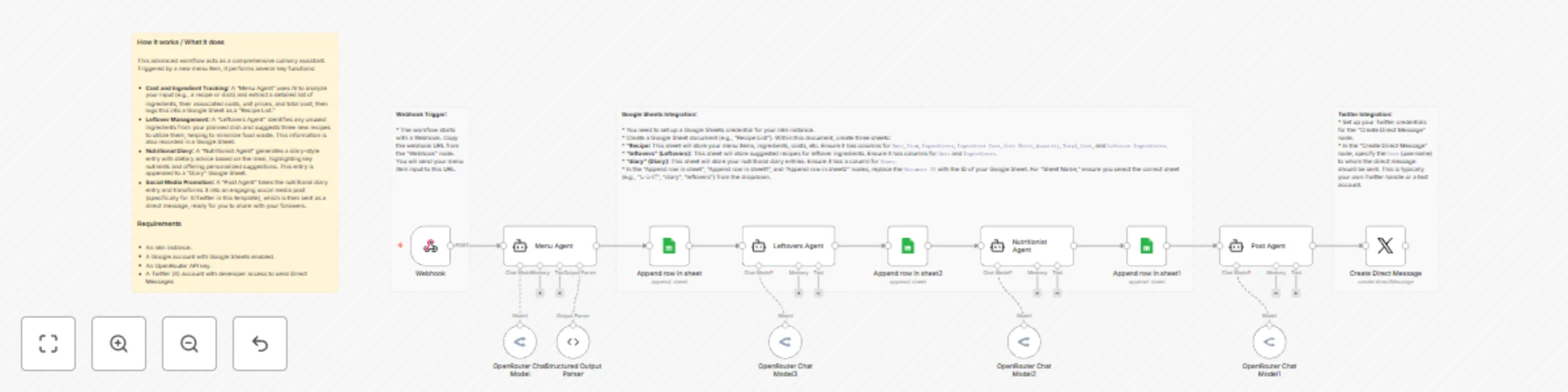
This advanced workflow acts as a comprehensive culinary assistant. Triggered by a new menu item, it performs several key functions:

  • Cost and Ingredient Tracking: A "Menu Agent" uses AI to analyze your input (e.g., a recipe or dish) and extract a detailed list of ingredients, their associated costs, unit prices, and total cost, then logs this into a Google Sheet as a "Recipe List."
  • Leftover Management: A "Leftovers Agent" identifies any unused ingredients from your planned dish and suggests three new recipes to utilize them, helping to minimize food waste. This information is also recorded in a Google Sheet.
  • Nutritional Diary: A "Nutritionist Agent" generates a diary-style entry with dietary advice based on the meal, highlighting key nutrients and offering personalized suggestions. This entry is appended to a "Diary" Google Sheet.
  • Social Media Promotion: A "Post Agent" takes the nutritional diary entry and transforms it into an engaging social media post (specifically for X/Twitter in this template), which is then sent as a direct message, ready for you to share with your followers.

How to set up

  1. Webhook Trigger:
    • The workflow starts with a Webhook. Copy the webhook URL from the "Webhook" node. You will send your menu item input to this URL.
  2. Google Sheets Integration:
    • You need to set up a Google Sheets credential for your n8n instance.
    • Create a Google Sheet document (e.g., "Recipe List"). Within this document, create three sheets:
      • "Recipe: This sheet will store your menu items, ingredients, costs, etc. Ensure it has columns for Date, Item, Ingredients, Ingredient Cost, Unit Price, Quantity, Total, Cost, and Leftover Ingredients.
      • "leftovers" (Leftovers): This sheet will store suggested recipes for leftover ingredients. Ensure it has columns for Date and Ingredients.
      • "diary" (Diary): This sheet will store your nutritional diary entries. Ensure it has a column for Diary.
    • In the "Append row in sheet", "Append row in sheet1", and "Append row in sheet2" nodes, replace the Document ID with the ID of your Google Sheet. For "Sheet Name," ensure you select the correct sheet (e.g., "レシピ", "diary", "leftovers") from the dropdown.
  3. OpenRouter Chat Model:
    • Set up your OpenRouter credentials in the "OpenRouter Chat Model" nodes. You will need your OpenRouter API key.
  4. Twitter Integration:
    • Set up your Twitter credentials for the "Create Direct Message" node.
    • In the "Create Direct Message" node, specify the User (username) to whom the direct message should be sent. This is typically your own Twitter handle or a test account.

Requirements

  • An n8n instance.
  • A Google account with Google Sheets enabled.
  • An OpenRouter API key.
  • A Twitter (X) account with developer access to send Direct Messages.

How to customize the workflow

  • Input Data: The initial input to the "Webhook" node is expected to be the name of a dish or recipe. You can modify the "Menu Agent" to accept more detailed inputs if needed.
  • Google Sheets Structure: Adjust the column mappings in the Google Sheets nodes if your spreadsheet column headers differ.
  • AI Agent Prompts: Customize the System Message in each AI Agent node (Menu Agent, Leftovers Agent, Nutritionist Agent, Post Agent) to refine their behavior and the kind of output they generate. For example, you could ask the Nutritionist Agent to focus on specific dietary needs.
  • Social Media Platform: The "Create Direct Message" node is configured for Twitter. You can swap this with another social media node (e.g., Mastodon, Discord) if you prefer to post elsewhere, remembering to adjust the "Post Agent" system message accordingly.
  • Output Parser: The "Structured Output Parser" is configured for a specific JSON structure. If you change the "Menu Agent" to output a different structure, you'll need to update this parser.

1.2 Logical Blocks

This catalog entry is organized from the workflow JSON. The node-level section below shows the executable blocks available for review before importing the template.

2. Block-by-Block Analysis

Block 1 - OpenRouter Chat Model

Type / Role
@n8n/n8n-nodes-langchain.lmChatOpenRouter - lmChatOpenRouter
Config choices
Version 1

Block 2 - Structured Output Parser

Type / Role
@n8n/n8n-nodes-langchain.outputParserStructured - outputParserStructured
Config choices
Version 1.3

Block 3 - Append row in sheet

Type / Role
n8n-nodes-base.googleSheets - googleSheets
Config choices
Version 4.7

Block 4 - Append row in sheet1

Type / Role
n8n-nodes-base.googleSheets - googleSheets
Config choices
Version 4.7

Block 5 - Webhook

Type / Role
n8n-nodes-base.webhook - webhook
Config choices
Version 2.1

Block 6 - OpenRouter Chat Model1

Type / Role
@n8n/n8n-nodes-langchain.lmChatOpenRouter - lmChatOpenRouter
Config choices
Version 1

Block 7 - OpenRouter Chat Model2

Type / Role
@n8n/n8n-nodes-langchain.lmChatOpenRouter - lmChatOpenRouter
Config choices
Version 1

Block 8 - OpenRouter Chat Model3

Type / Role
@n8n/n8n-nodes-langchain.lmChatOpenRouter - lmChatOpenRouter
Config choices
Version 1

Block 9 - Append row in sheet2

Type / Role
n8n-nodes-base.googleSheets - googleSheets
Config choices
Version 4.7

Block 10 - Create Direct Message

Type / Role
n8n-nodes-base.twitter - twitter
Config choices
Version 2

Block 11 - Menu Agent

Type / Role
@n8n/n8n-nodes-langchain.agent - agent
Config choices
Version 3

Block 12 - Leftovers Agent

Type / Role
@n8n/n8n-nodes-langchain.agent - agent
Config choices
Version 3

Block 13 - Nutritionist Agent

Type / Role
@n8n/n8n-nodes-langchain.agent - agent
Config choices
Version 3

Block 14 - Post Agent

Type / Role
@n8n/n8n-nodes-langchain.agent - agent
Config choices
Version 3

Block 15 - Sticky Note

Type / Role
n8n-nodes-base.stickyNote - stickyNote
Config choices
Version 1

Block 16 - Sticky Note1

Type / Role
n8n-nodes-base.stickyNote - stickyNote
Config choices
Version 1

Block 17 - Sticky Note2

Type / Role
n8n-nodes-base.stickyNote - stickyNote
Config choices
Version 1

Block 18 - Sticky Note4

Type / Role
n8n-nodes-base.stickyNote - stickyNote
Config choices
Version 1

3. Summary Table

Workflow Meal planner: cost tracking, leftover recipes & nutrition diary in Google Sheets
Complexity advanced
Nodes 18
Categories Personal Productivity, Multimodal AI
Author takuma
Published 18 Nov 2025

4. Reproducing the Workflow from Scratch

  1. 1. Download the workflow JSON

    Use the JSON export at /data/workflows/10967/10967.json as the source template for this automation.

  2. 2. Import the template into n8n

    Open n8n, import the downloaded JSON, and review each node before activating the workflow.

  3. 3. Configure credentials and variables

    Replace placeholder credentials, API keys, webhook URLs, account IDs, and environment-specific values with your own settings.

  4. 4. Test with sample data

    Run the workflow manually or in a staging workspace, inspect node output, and confirm downstream systems receive the expected data.

  5. 5. Activate and monitor

    Enable the workflow only after testing, then monitor executions, errors, and rate limits during the first production runs.

5. General Notes & Resources

Review imported nodes carefully before activation. This catalog entry is intended to help you inspect the workflow structure, understand required services, and find related templates faster.

Node names, credentials, schedules, webhook paths, and external service limits may need adjustment for your workspace.

Frequently asked questions

What does Meal planner: cost tracking, leftover recipes & nutrition diary in Google Sheets do?

Who's it for This template is for home cooks, small restaurant owners, or anyone who wants to streamline their meal planning, ingredient cost tracking, leftover management, nutritional analysis, an...

What do I need before importing this workflow?

Review the workflow JSON, configure any required credentials in n8n, and test the automation in a safe workspace before using it in production.

Can I customize this workflow?

Yes. Use the block-by-block analysis and the downloadable JSON to inspect each node, then adjust credentials, prompts, schedules, filters, or destinations for your Personal Productivity, Multimodal AI use case.



