
Manage engineering change requests via webhooks and Slack approvals

Workflow preview
Workflow preview
100%
Manage engineering change requests via webhooks and Slack approvals preview
Open on n8n.io

1. Workflow Overview

️ Manage Engineering Change Requests (ECR) via Slack Overview Streamline your engineering change management process by integrating generic webhooks with Slack interactive approvals. This workfl...

Best for

  • Engineering automation workflows
  • advanced n8n builders looking for reusable templates

Tools used

n8n-nodes-base.webhook, n8n-nodes-base.if, n8n-nodes-base.switch, n8n-nodes-base.set, n8n-nodes-base.slack, n8n-nodes-base.wait, n8n-nodes-base.respondtowebhook, n8n-nodes-base.stickynote

Source and attribution

This workflow is cataloged by N8N Workflows and links back to its original n8n.io source page by TAKUTO ISHIKAWA.

Original n8n.io source

1.1 Workflow description

Title
Manage engineering change requests via webhooks and Slack approvals
Workflow name
Manage engineering change requests via webhooks and Slack approvals

⚙️ Manage Engineering Change Requests (ECR) via Slack

📋 Overview

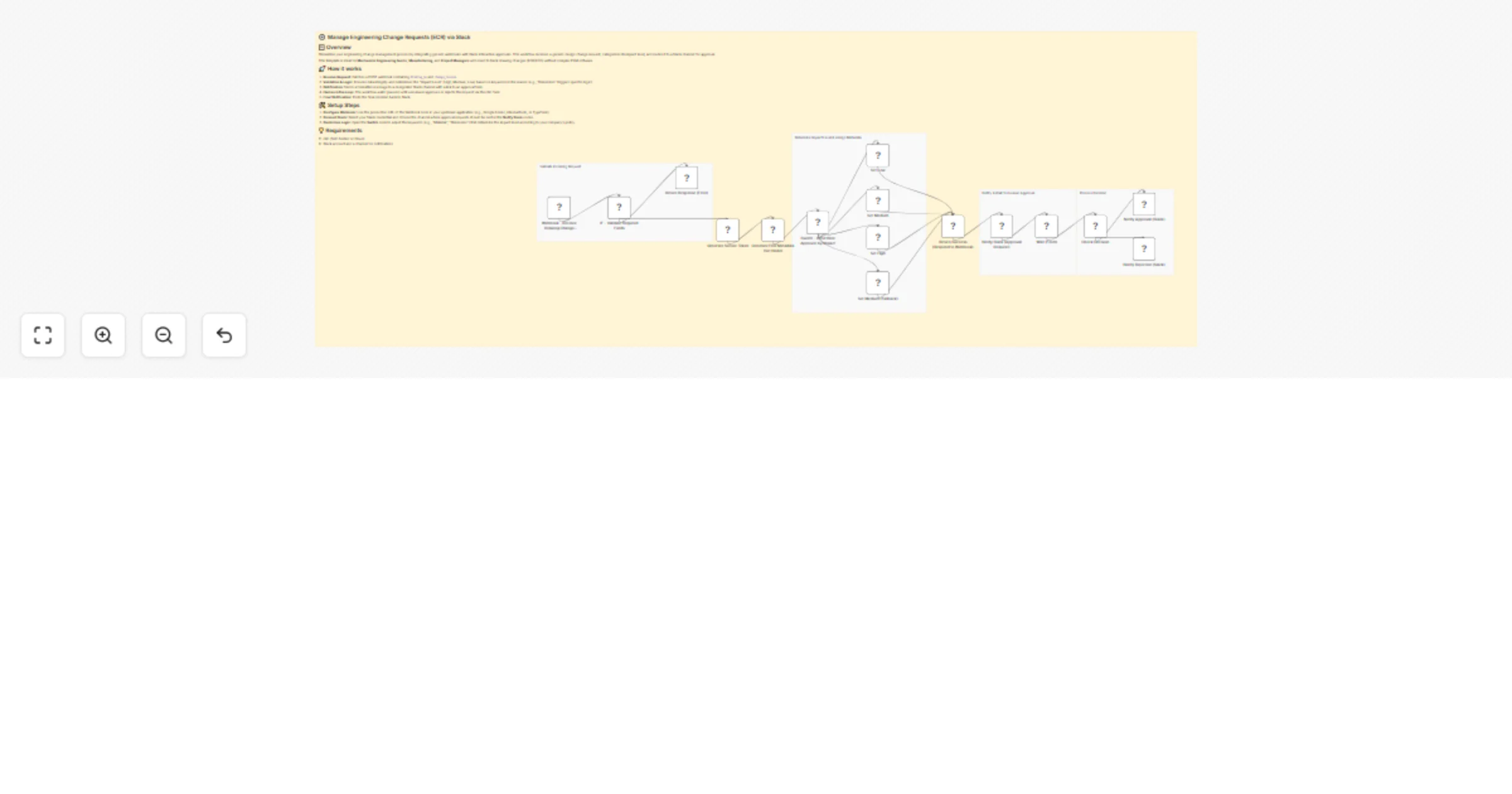
Streamline your engineering change management process by integrating generic webhooks with Slack interactive approvals. This workflow receives a generic design change request, categorizes its impact level, and routes it to a Slack channel for approval.

This template is ideal for Mechanical Engineering teams, Manufacturing, and Project Managers who need to track drawing changes (ECR/ECO) without complex PLM software.

🚀 How it works

  1. Receive Request: Catches a POST webhook containing drawing_no and change_reason.
  2. Validation & Logic: Ensures data integrity and determines the "Impact Level" (High, Medium, Low) based on keywords in the reason (e.g., "Dimension" triggers specific logic).
  3. Notification: Sends a formatted message to a designated Slack channel with a link to an approval form.
  4. Human in the Loop: The workflow waits (pauses) until a reviewer approves or rejects the request via the n8n form.
  5. Final Notification: Posts the final decision back to Slack.

🛠️ Setup Steps

  1. Configure Webhook: Use the production URL of the Webhook node in your upstream application (e.g., Google Forms, internal tools, or Typeform).
  2. Connect Slack: Select your Slack credential and choose the channel where approval requests should be sent in the Notify Slack nodes.
  3. Customize Logic: Open the Switch node to adjust the keywords (e.g., "Material", "Dimension") that determine the impact level according to your company's policy.

💡 Requirements

  • n8n (Self-hosted or Cloud)
  • Slack account and a channel for notifications

1.2 Logical Blocks

This catalog entry is organized from the workflow JSON. The node-level section below shows the executable blocks available for review before importing the template.

2. Block-by-Block Analysis

Block 1 - Webhook - Receive Drawing Change Request

Type / Role
n8n-nodes-base.webhook - webhook
Config choices
Version 2.1

Block 2 - IF - Validate Required Fields

Type / Role
n8n-nodes-base.if - if
Config choices
Version 2.3

Block 3 - Switch - Determine Approver by Impact

Type / Role
n8n-nodes-base.switch - switch
Config choices
Version 3.4

Block 4 - Set Low

Type / Role
n8n-nodes-base.set - set
Config choices
Version 3.4

Block 5 - Set High

Type / Role
n8n-nodes-base.set - set
Config choices
Version 3.4

Block 6 - Set Medium

Type / Role
n8n-nodes-base.set - set
Config choices
Version 3.4

Block 7 - Set Medium (Fallback)

Type / Role
n8n-nodes-base.set - set
Config choices
Version 3.4

Block 8 - Notify Slack (Approval Request)

Type / Role
n8n-nodes-base.slack - slack
Config choices
Version 2.4

Block 9 - Wait (Form)

Type / Role
n8n-nodes-base.wait - wait
Config choices
Version 1.1

Block 10 - Notify Approval (Slack)

Type / Role
n8n-nodes-base.slack - slack
Config choices
Version 2.4

Block 11 - Notify Rejection (Slack)

Type / Role
n8n-nodes-base.slack - slack
Config choices
Version 2.4

Block 12 - Return Response (Error)

Type / Role
n8n-nodes-base.respondToWebhook - respondToWebhook
Config choices
Version 1.5

Block 13 - Generate ECR Metadata (Set Node)

Type / Role
n8n-nodes-base.set - set
Config choices
Version 3.4

Block 14 - Return Success (Respond to Webhook)

Type / Role
n8n-nodes-base.respondToWebhook - respondToWebhook
Config choices
Version 1.5

Block 15 - Sticky Note

Type / Role
n8n-nodes-base.stickyNote - stickyNote
Config choices
Version 1

Block 16 - Sticky Note1

Type / Role
n8n-nodes-base.stickyNote - stickyNote
Config choices
Version 1

Block 17 - Sticky Note2

Type / Role
n8n-nodes-base.stickyNote - stickyNote
Config choices
Version 1

Block 18 - Sticky Note3

Type / Role
n8n-nodes-base.stickyNote - stickyNote
Config choices
Version 1

Block 19 - Sticky Note4

Type / Role
n8n-nodes-base.stickyNote - stickyNote
Config choices
Version 1

Block 20 - Check Decision

Type / Role
n8n-nodes-base.switch - switch
Config choices
Version 3.4

Block 21 - Generate Secure Token

Type / Role
n8n-nodes-base.crypto - crypto
Config choices
Version 1

3. Summary Table

Workflow Manage engineering change requests via webhooks and Slack approvals
Complexity advanced
Nodes 21
Categories Engineering
Author TAKUTO ISHIKAWA
Published 07 Mar 2026

4. Reproducing the Workflow from Scratch

  1. 1. Download the workflow JSON

    Use the JSON export at /data/workflows/13932/13932.json as the source template for this automation.

  2. 2. Import the template into n8n

    Open n8n, import the downloaded JSON, and review each node before activating the workflow.

  3. 3. Configure credentials and variables

    Replace placeholder credentials, API keys, webhook URLs, account IDs, and environment-specific values with your own settings.

  4. 4. Test with sample data

    Run the workflow manually or in a staging workspace, inspect node output, and confirm downstream systems receive the expected data.

  5. 5. Activate and monitor

    Enable the workflow only after testing, then monitor executions, errors, and rate limits during the first production runs.

5. General Notes & Resources

Review imported nodes carefully before activation. This catalog entry is intended to help you inspect the workflow structure, understand required services, and find related templates faster.

Node names, credentials, schedules, webhook paths, and external service limits may need adjustment for your workspace.

Frequently asked questions

What does Manage engineering change requests via webhooks and Slack approvals do?

️ Manage Engineering Change Requests (ECR) via Slack Overview Streamline your engineering change management process by integrating generic webhooks with Slack interactive approvals. This workfl...

What do I need before importing this workflow?

Review the workflow JSON, configure any required credentials in n8n, and test the automation in a safe workspace before using it in production.

Can I customize this workflow?

Yes. Use the block-by-block analysis and the downloadable JSON to inspect each node, then adjust credentials, prompts, schedules, filters, or destinations for your Engineering use case.



