Legal Case Research Extractor, Data Miner with Bright Data MCP & Google Gemini
Workflow preview


 Early Deal
DISCOUNT 20%

Important notice
This workflow is provided as-is. Please review and test before using in production.
Overview
Notice
Community nodes can only be installed on self-hosted instances of n8n.
Who this is for
The Legal Case Research Extractor is a powerful automated workflow designed for legal tech teams, researchers, law firms, and data scientists focused on transforming unstructured legal case data into actionable, structured insights.
This workflow is tailored for:
Legal Researchers automating case law data mining
Litigation Support Teams handling large volumes of case records
LawTech Startups building AI-powered legal research assistants
Compliance Analysts extracting case-specific insights
AI Developers working on legal NLP, summarization, and search engines
What problem is this workflow solving?
Legal case data is often locked in semi-structured or raw HTML formats, scattered across jurisdiction-specific websites. Manually extracting and processing this data is tedious and inefficient.
This workflow automates:
Extraction of legal case data via Bright Data's powerful MCP infrastructure
Parsing of HTML into clean, readable text using Google Gemini LLM
Structuring and delivering the output through webhook and file storage
What this workflow does
Input
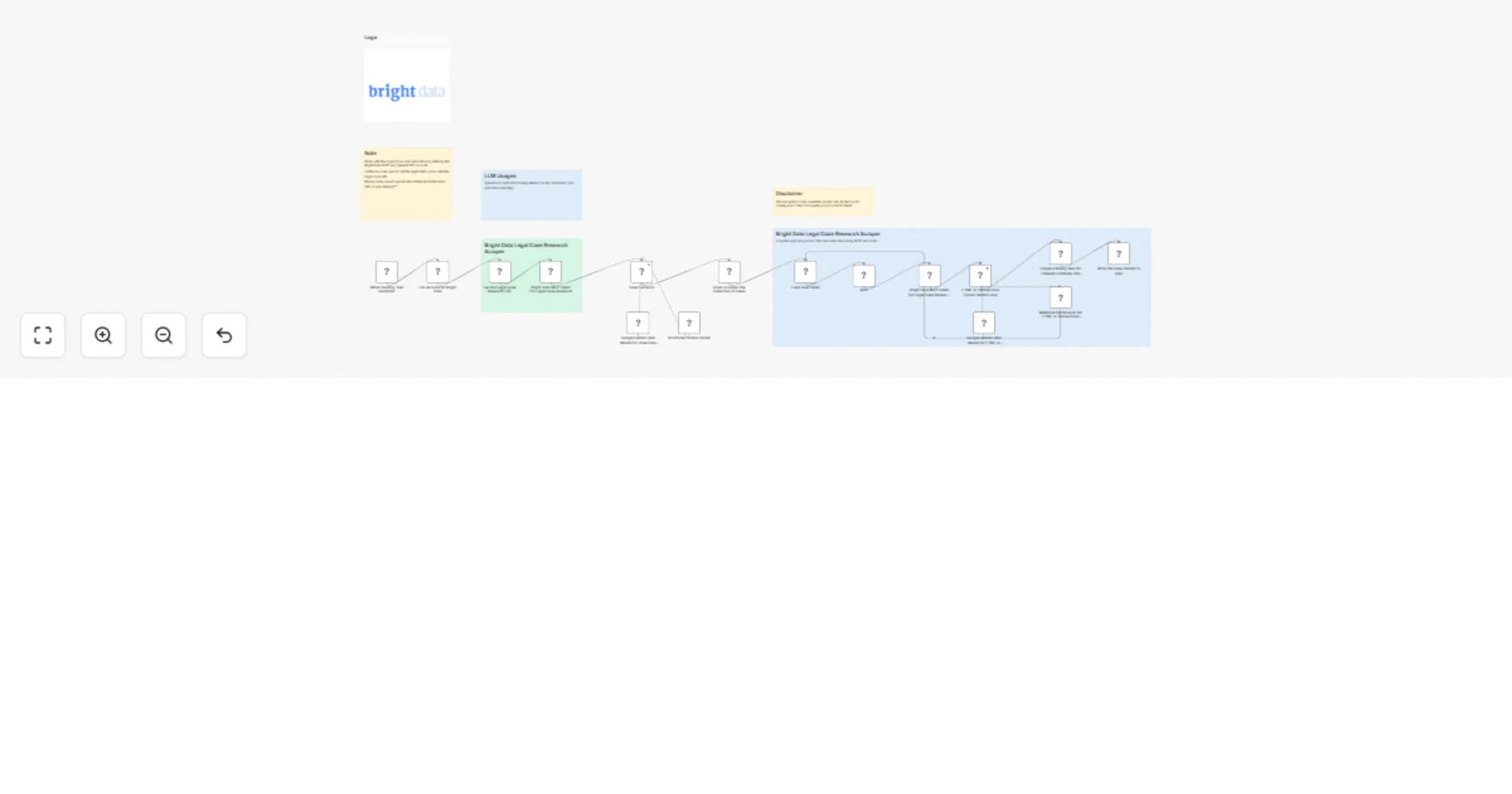
- Set the Legal Case Research URL node is responsible for setting the legal case URL for the data extraction.
Bright Data MCP Data Extractor
- Bright Data MCP Client For Legal Case Research node is responsible for the legal case extraction via the Bright Data MCP tool - scrape_as_html
Case Extractor
- Google Gemini based Case Extractor is responsible for producing a paginated list of cases
Loop through Legal Case URLs
Receives a collection of legal case links to process
Each URL represents a different case from a target legal website
Bright Data MCP Scraping
Utilizes Bright Data’s scrape_as_html MCP mode
Retrieves raw HTML content of each legal case
Google Gemini LLM Extraction
Transforms raw HTML into clean, structured text
Performs additional information extraction if required (e.g., case summary, court, jurisdiction etc.)
Webhook Notification
Sends extracted legal case content to a configurable webhook URL
Enables downstream processing or storage in legal databases
Binary Conversion & File Persistence
Converts the structured text to binary format
Saves the final response to disk for archival or further processing
Pre-conditions
- Knowledge of Model Context Protocol (MCP) is highly essential. Please read this blog post - model-context-protocol
- You need to have the Bright Data account and do the necessary setup as mentioned in the Setup section below.
- You need to have the Google Gemini API Key. Visit Google AI Studio
- You need to install the Bright Data MCP Server @brightdata/mcp
- You need to install the n8n-nodes-mcp
Setup
- Please make sure to setup n8n locally with MCP Servers by navigating to n8n-nodes-mcp
- Please make sure to install the Bright Data MCP Server @brightdata/mcp on your local machine.
- Sign up at Bright Data.
- Create a Web Unlocker proxy zone called mcp_unlocker on Bright Data control panel.
- Navigate to Proxies & Scraping and create a new Web Unlocker zone by selecting Web Unlocker API under Scraping Solutions.
- In n8n, configure the Google Gemini(PaLM) Api account with the Google Gemini API key (or access through Vertex AI or proxy).
- In n8n, configure the credentials to connect with MCP Client (STDIO) account with the Bright Data MCP Server as shown below.
Make sure to copy the Bright Data API_TOKEN within the Environments textbox above as API_TOKEN=<your-token>
How to customize this workflow to your needs
Target New Legal Portals
- Modify the legal case input URLs to scrape from different state or federal case databases
Customize LLM Extraction
Modify the prompt to extract specific fields: case number, plaintiff, case summary, outcome, legal precedents etc.
Add a summarization step if needed
Enhance Loop Handling
Integrate with a Google Sheet or API to dynamically fetch case URLs
Add error handling logic to skip failed cases and log them
Improve Security & Compliance
Redact sensitive information before sending via webhook
Store processed case data in encrypted cloud storage
Output Formats
Save as PDF, JSON, or Markdown
Enable output to cloud storage (S3, Google Drive) or legal document management systems